Decline of carbon-dioxide-gobbling plankton coincided with ancient global cooling
January 8th, 2009 By Hugh Powell Decline of carbon-dioxide-gobbling plankton coincided with ancient global cooling

Enlarge

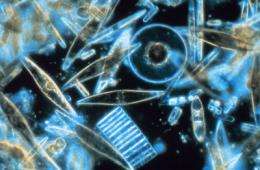
Diatoms are abundant oceanic plankton that remove billions of tons of carbon dioxide from the air each year. Their evolutionary history needs to be rewritten, according to a new Cornell study. Image: NOAA/Gordon Taylor

(PhysOrg.com) -- The evolutionary history of diatoms -- abundant oceanic plankton that remove billions of tons of carbon dioxide from the air each year -- needs to be rewritten, according to a new Cornell study. The findings suggest that after a sudden rise in species numbers, diatoms abruptly declined about 33 million years ago -- trends that coincided with severe global cooling.

The study is published in the Jan. 8 issue of the journal Nature.

The research casts doubt on the long-held theory that diatoms' success was tied to an influx of nutrients into the oceans from the rise of grasslands about 18 million years ago. New evidence from a study led by graduate student Dan Rabosky of the Department of Ecology and Evolutionary Biology takes into account a widespread problem in paleontology: that younger fossils are easier to find than older ones.

"We just tried to address the simple fact that the number of available fossils is colossally greater from recent time periods than from earlier time periods," Rabosky said. "It's a pretty standard correction in some fields, but it hasn't been applied to planktonic paleontology up till now."

More than 90 percent of known diatom fossils are younger than 18 million years. So an unadjusted survey of diatom fossils suggests that more diatom species were alive in the recent past than 18 million years ago.

The dearth of early fossils is understandable. Sampling for diatom fossils requires immense drill ships to bore into seafloor sediment. To find an ancient fossil, scientists first have to find ancient sediment -- and that's no easy task because plate tectonics constantly shift the ocean floor, fossils and all. Much of the seafloor is simply too young to sample.

So Rabosky and co-author Ulf Sorhannus of Edinboro University of Pennsylvania controlled for how many samples had been taken from each million-year period of the Earth's history, going back 40 million years. After reanalysis, the long-accepted boom in diatoms over the last 18 million years disappeared. In its place was a slow recent rise, with a much more dramatic increase and decline at the end of the Eocene epoch, about 33 million years ago.

With the new timeline, diatoms achieved their peak diversity at least 10 million years before grasslands became commonplace.

"If there was a truly significant change in diatom diversity at all, it happened 30 million years ago," Rabosky said. "The shallow, gradual increase we see is totally different from the kind of exponential increase you would expect if grasslands were the cause."

As an example of that kind of increase, Rabosky turned to another fossil record: horse teeth. Before grasslands, horses had small teeth suited for chewing soft leaves. But as grasslands appeared, much hardier teeth appeared adapted to a lifetime of chewing tough, silica-studded grass leaves. Diatoms ought to show a similar evolutionary response to the sudden availability of silica, Rabosky said, but they don't.

Although the new results don't explain the current prevalence of diatoms in the ocean, Rabosky said that whatever led to diatoms' rise at the end of the Eocene, the tiny organisms may have contributed to the global cooling that followed.

"Why diatom diversity peaked for 4 to 5 million years and then dropped is a big mystery," Rabosky said. "But it corresponds with a period when the global climate swung from hothouse to icehouse. It's tempting to speculate that these tiny plankton, by taking carbon dioxide out of the air, might have helped trigger the most severe global cooling event in the past 100 million years."

Provided by Cornell University


print this article email this article download pdf blog this article bookmark this article     Digg this Stumble it share on Facebook share on Reddit add to delicious save to Yahoo! bookmarks
4.6/5 after 12 votes

Rank Filter

Move the slider to adjust rank threshold, so that you can hide some of the comments.


Display comments: newest first

  • GrayMouser - Jan 08, 2009
    • Rank: 1 / 5 (1)
    Which is the horse and which is the cart?

January 8th, 2009 all stories
Biology /

Comments: 1
Rank: 4.6/5 after 12 votes

  • Stumble this up

  • Digg this

  • Share it:
  • share on Facebook
  • share on MySpace
  • share on Slashdot
  • rss-newsfeed
  • share on Google
  • share on Reddit
  • add to delicious
  • save to Yahoo! bookmarks
  • share on Windows Live
  • Add to Mixx!
Rating: 4.6/5 after 12 votes


  • Physicists Demonstrate Quantum Memory with Matter Qubits
    Physicists Demonstrate Quantum Memory with Matter Qubits
    Physics / General Physics
    created Jul 03, 2009 | popularity 4.4 / 5 (17) | comments 1
  • 'Holey' Nanosheets for Wastewater Dye Removal
    Nanotechnology / Nanomaterials
    created Jul 01, 2009 | popularity 5 / 5 (5) | comments 1
  • Jellyfish Robot Swims Like its Biological Counterpart
    Jellyfish Robot Swims Like its Biological Counterpart
    Electronics / Robotics
    created Jun 26, 2009 | popularity 4.4 / 5 (8) | comments 1
  • Could Maxwell's Demon Exist in Nanoscale Systems?
    Could Maxwell's Demon Exist in Nanoscale Systems?
    Physics / General Physics
    created Jun 24, 2009 | popularity 4.4 / 5 (18) | comments 29
  • Living Safely with Robots, Beyond Asimov's Laws
    Living Safely with Robots, Beyond Asimov's Laws
    Electronics / Robotics
    created Jun 22, 2009 | popularity 4.6 / 5 (54) | comments 40
  • Other News

    New research shows key player in mitosis not required for chromosome alignment

    New research shows key player in mitosis not required for chromosome alignment

    Biology / Microbiology

    created 8 minutes ago | popularity not rated yet | comments 0

    (PhysOrg.com) -- K-fibers, structures long thought to play a key role in the alignment of chromosomes prior to cell division, are not required after all, say Indiana University and New York State Department ...


    Scientists are learning more about big birds from feathers

    Scientists are learning more about big birds from feathers

    Biology / Plants & Animals

    created 26 minutes ago | popularity not rated yet | comments 0

    (PhysOrg.com) -- Catching adult eagles for research purposes is no easy task, but a Purdue University researcher has found a way around the problem, and, in the process, gathered even more information about ...


    Battle of the sexes benefits offspring, says research

    Battle of the sexes benefits offspring, says research

    Biology / Plants & Animals

    created 6 hours ago | popularity 5 / 5 (1) | comments 0

    Parents compensate for a lazy partner by working harder to bring up their offspring, but not enough to completely make up for the lack of parenting, says research by bird biologists at the University of Bath.


    Hormone clue to root growth

    Biology / Plants & Animals

    created 2 hours ago | popularity not rated yet | comments 0

    (PhysOrg.com) -- Plant roots provide the crops we eat with water, nutrients and anchorage. Understanding how roots grow and how hormones control that growth is crucial to improving crop yields, which will be necessary to ...


    Final rules out for government stem cell research

    Biology / Other

    created 2 hours ago | popularity not rated yet | comments 0

    (AP) -- The government is creating a master list of which embryonic stem cells qualify for taxpayer-funded research, now that President Barack Obama has lifted restrictions on the field.