How Martian winds make rocks walk
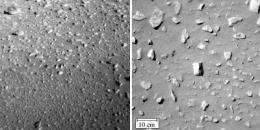
January 8th, 2009 Spirit Rover Images of Martian Rocks

Enlarge

These Spirit Rover camera images of the intercrater plain between Mars' Lahontan Crater show uniformly-spaced small rocks, known as clasts. The image on the left is a portion of NAVCAM image ID 2 N 137561115 EFF 47 00 P1827 L0 M1. The image on the right is a portion of Pancam image 2 P 137636467 EFF 47 DQ P2514 R1 C1. Credit: Geological Society of America.

Rocks on Mars are on the move, rolling into the wind and forming organized patterns, according to new research.

The new finding counters the previous explanation of the evenly spaced arrangement of small rocks on Mars. That explanation suggested the rocks were picked up and carried downwind by extreme high-speed winds thought to occur on Mars in the past.

Images taken by the Mars Exploration Rover Spirit show small rocks regularly spaced about 5 to 7 centimeters apart on the intercrater plains between Lahontan Crater and the Columbia Hills.

Although Mars is a windy planet, it would be difficult for the wind to carry the small rocks, which range in size from a quarter to a softball, said Jon D. Pelletier, associate professor of geosciences at The University of Arizona in Tucson.

Pelletier and his colleagues suggest that wind blows sand away from the front of the rock, creating a pit, and then deposits that sand behind the rock, creating a hill.

The rock then rolls forward into the pit, moving into the wind, he said.

As long as the wind continues to blow, the process is repeated and the rocks move forward.

This explanation does not require extreme winds, Pelletier said.

"You get this happening five, 10, 20 times then you start to really move these things around," he said. "They can move many times their diameter."

Image of Pelletier Computer Simulations
Enlarge

These images show how the simulated rocks ended up being spaced by the computer simulations. The image on the left is the starting position. The image on the right shows the final spacing of the rocks. The yellow streaks behind the rocks represents the sand piled up behind the rocks by the wind. Credit: Jon D. Pelletier, The University of Arizona


The process is nearly the same with a cluster of rocks.

However, with a cluster of rocks, those in the front of the group shield those in the middle or on the edges from the wind, Pelletier said.

Because the middle and outer rocks are not directly hit by the wind, the wind creates pits to the sides of those rocks. Therefore, they roll to the side, not directly into the wind, and the cluster begins to spread out.

Pelletier, Andrew L. Leier of the University of Calgary in Alberta, Canada, and James R. Steidtmann of the University of Wyoming in Laramie report their findings in the paper, "Wind-Driven Reorganization of Coarse Clasts on the Surface of Mars." The paper is in the January issue of the journal Geology.

When Leier was a graduate student at the UA, he told Pelletier about an experiment on the upwind migration of rocks that Steidtmann, Leier's thesis advisor, had conducted.

Steidtmann had studied upwind migration about 30 years ago. He used a wind tunnel to see how pebbles on sand moved in the wind. Steidtmann's research showed that the rocks moved upwind and that over time, a regular pattern emerged.

Pelletier wasn't sure how he could use the idea.

Some time later, while attending a lecture that showed pictures of uniformly organized rocks on Mars, Pelletier recalled his conversations with Leier about Steidtmann's experiments -- and it all came together.

To investigate the regular patterns of the rocks on Mars, Pelletier combined three standard numerical computer models. The first modeled air flow, the second modeled erosion and deposition of sand and the third modeled the rocks' movement, he said.

"We can model it on the computer to try to get a better sense of what's actually happening and to provide another sort of documentation or justification for the idea," he said.

Pelletier was the first to combine the three standard models and apply them to this new problem.

He also conducted what is known as a Monte Carlo simulation, which applied his combination numerical model over and over to a random pattern of rocks to see how the rocks ultimately end up.

Pelletier ran the simulation 1,000 times. The rocks ended up into a regular pattern 90 percent of the time, he said.

As an independent verification, he also compared the pattern predicted by the numerical model to the distances between each rock and its nearest neighbor in the Mars images. The patterns of the Martian rocks matched what the model predicted.

Pelletier said upwind migration of rocks also occurs on Earth.

Co-author Leier wrote in an e-mail, "Something as seemingly mundane as the distribution of rocks on a sandy, wind-blown surface can actually be used to tell us a lot about how wind-related processes operate on a place as familiar as the Earth and as alien as Mars."

However, because plants and animals can alter wind patterns and rearrange rocks, it is much more difficult to study this process on Earth, Pelletier said.

Of Mars' mysterious walking rocks, he said, "This is a neat problem, but there are bigger fish to fry."

Pelletier plans to apply the same numerical models to larger features on Mars such as sand dunes and wind-sculpted valleys and ridges called "yardangs."

He said understanding the climate history of other planets and where those climates went awry can help in understanding our own climate system.

Source: University of Arizona


print this article email this article download pdf blog this article bookmark this article     Digg this Stumble it share on Facebook share on Reddit add to delicious save to Yahoo! bookmarks
4.8/5 after 5 votes

Rank Filter

Move the slider to adjust rank threshold, so that you can hide some of the comments.


Display comments: newest first

  • gmurphy - Jan 08, 2009
    • Rank: 5 / 5 (1)
    surely this would have to happen on a hill?, if the pebbles are being continuously undercut by the wind aren't they going to end up just stuck in a hole?, obviously this doesn't happen because the researcher actually did wind tunnel testing
  • brant - Jan 08, 2009
    • Rank: 1 / 5 (1)
    No, you dont need to actually do anything. You just have to write some equations and run them on a computer.
    I keep expecting God to show up in a simulation next.
  • Arikin - Jan 08, 2009
    • Rank: not rated yet
    The hole the rocks rolls into fills up and the process happens over again. The wind is strong enough for small dirt/sand particles but not the bigger rocks. Seeing this yourself helps, so try the simple experiment.

    Of course an incline would help but not always available. This is talking about generally flat surfaces.

    The problem with the previous NASA theory was the lack of sufficient atmosphere to produce the required winds forces needed to push the rocks along with the wind.
  • Ashibayai - Jan 09, 2009
    • Rank: not rated yet
    I wonder if analysis of the moving rocks would help gather data on recent wind directions. Assuming the wind direction is pretty consistent, which it should be for this to be happening, it should be help extract some data on wind conditions using camera's alone.
  • smiffy - Jan 09, 2009
    • Rank: not rated yet
    gmurphy is right. If a rock advances by falling down the wind-made slope then it has lost height. It can only continue to move if one of two conditions holds -
    1) It somehow manages to regain that lost height by climbing against gravity.
    2) It continues to lose height.

    No mechanism for option 1 is offered by the researchers. I can't think of one. I rather suspect there isn't one.
    Therefore option 2, which itself has two possible options.
    a. The rocks are on an incline, as gmurphy suggests.
    b. The rock continues to lose height, thereby burying itself deeper in the sand.

    Obviously option a is not very interesting - rocks moving downhill over time is hardly novel!
    So option b. The rock will continue to move into the patterns both the wind tunnel experiments and the computer simulations demonstrate - as long as the depth of sand permits.

    If the sand is deep enough they will eventually be buried upto the depth of the leading edge of the rock.

    Whether this results in the even spacing will depend on the depth of sand and the height of the rocks.
  • deatopmg - Jan 09, 2009
    • Rank: not rated yet
    As I said in a previous post on another physorg review of the same paper; This is a very nice piece of work by Leier et al in spite of the fact that higher levels of NASA routinely feed us with obfuscations and crap.
  • smiffy - Jan 11, 2009
    • Rank: not rated yet
    I can't agree. It seems to me that the simple piece of reasoning that gmurphy applied invalidates this study. I would guess that there is only enough Potential Energy in the rocks to advance them at most one diameter - not the many diameters the researchers claim. Certainly nothing like the computer simulation illustration with PacMan-like trails.

    If you look at the illustration you see on the bottom a neat line of rocks. If this were to actually occur in Nature it would have already caused much interest. I suspect that the simulations are flawed, greatly exaggerating the rocks' movement. For practical reasons the wind tunnel analogues might have been limited in scope.

    (However it occurs to me that this spacing pattern could possibly be effected by the motion of water under the rocks. The water might have enough force to lift the rocks sufficiently for them to advance progressively. Maybe they should be thinking ancient river beds and flood plains, not windswept deserts.)

  • theophys - Jan 13, 2009
    • Rank: not rated yet
    If a rock advances by falling down the wind-made slope then it has lost height. It can only continue to move if one of two conditions holds -
    1) It somehow manages to regain that lost height by climbing against gravity.
    2) It continues to lose height.

    No mechanism for option 1 is offered by the researchers. I can't think of one. I rather suspect there isn't one.
    Therefore option 2, which itself has two possible options.
    a. The rocks are on an incline, as gmurphy suggests.
    b. The rock continues to lose height, thereby burying itself deeper in the sand.

    You forget the curvature of the planet itself. For a rock in the flatlands, pretty much any direction (obviously disregarding up towards, the scarse atmosphere) could be considered downhill. Thus, the rock falls into the wind-formed ditch and can repeat the motion over and over.
    Arkin is right, you can actually preform the simple expiriment at home. Get a few deceent sized pebbles and put them on a flat surface covered with sand or dirt. Get a fan going ( the stronger it is, the faster you will get results) and wait. Keep waiting. Keep waiting. It's going to take awhile, so it's ok to go do something else like make a snack or fly around the world.

January 8th, 2009 all stories
Space & Earth / Space Exploration

Comments: 8
Rank: 4.8/5 after 5 votes

  • Stumble this up

  • Digg this

  • Share it:
  • share on Facebook
  • share on MySpace
  • share on Slashdot
  • rss-newsfeed
  • share on Google
  • share on Reddit
  • add to delicious
  • save to Yahoo! bookmarks
  • share on Windows Live
  • Add to Mixx!
Rating: 4.8/5 after 5 votes

  • Related Stories

  • Meteorite bombardment may have made Earth more habitable
    created Jun 01, 2009 | popularity not rated yet | comments 0
  • Opportunity Rover Sees Variable Environmental History at Martian Victoria Crater
    created May 21, 2009 | popularity not rated yet | comments 0
  • Spirit rover's wheels stuck in soft Martian dirt
    created May 12, 2009 | popularity not rated yet | comments 0
  • Mars Rover Update
    created Mar 26, 2009 | popularity not rated yet | comments 0
  • Mars Express zeroes in on erosion features
    created Mar 19, 2009 | popularity not rated yet | comments 0


  • Physicists Demonstrate Quantum Memory with Matter Qubits
    Physicists Demonstrate Quantum Memory with Matter Qubits
    Physics / General Physics
    created Jul 03, 2009 | popularity 4.4 / 5 (17) | comments 1
  • 'Holey' Nanosheets for Wastewater Dye Removal
    Nanotechnology / Nanomaterials
    created Jul 01, 2009 | popularity 5 / 5 (5) | comments 1
  • Jellyfish Robot Swims Like its Biological Counterpart
    Jellyfish Robot Swims Like its Biological Counterpart
    Electronics / Robotics
    created Jun 26, 2009 | popularity 4.4 / 5 (8) | comments 1
  • Could Maxwell's Demon Exist in Nanoscale Systems?
    Could Maxwell's Demon Exist in Nanoscale Systems?
    Physics / General Physics
    created Jun 24, 2009 | popularity 4.4 / 5 (18) | comments 29
  • Living Safely with Robots, Beyond Asimov's Laws
    Living Safely with Robots, Beyond Asimov's Laws
    Electronics / Robotics
    created Jun 22, 2009 | popularity 4.6 / 5 (53) | comments 40
  • Other News

    China environmental phenomena monitored from space

    Space & Earth / Earth Sciences

    created 1minute ago | popularity not rated yet | comments 0

    China is in a very seismically active area and has had many catastrophic earthquakes during its history. A joint European-Chinese team is using satellite radar data to monitor ground deformation across major continental faults ...


    California to require sun-blocking car windows

    Space & Earth / Environment

    created 1hour ago | popularity 3 / 5 (2) | comments 4

    New cars sold in California must include windshields that block or absorb the sun's rays beginning in 2012, the state's Air Resources Board recently ruled.


    Scientists: Silent tremors may foretell next Big One

    Space & Earth / Earth Sciences

    created 1hour ago | popularity not rated yet | comments 0

    The seismometer is snugged in its hole and tamped over with dirt. Now it's time for the stomp test.


    Steam billows from the cooling towers at a nuclear power generating station in Byron

    Tropical zone expanding due to climate change: study

    Space & Earth / Earth Sciences

    created 4 hours ago | popularity 3.7 / 5 (3) | comments 0

    Climate change is rapidly expanding the size of the world's tropical zone, threatening to bring disease and drought to heavily populated areas, an Australian study has found.


    The least sea ice in 800 years

    The least sea ice in 800 years

    Space & Earth / Earth Sciences

    created Jul 01, 2009 | popularity 4.1 / 5 (65) | comments 60

    New research, which reconstructs the extent of ice in the sea between Greenland and Svalbard from the 13th century to the present indicates that there has never been so little sea ice as there is now. The ...