Sea level rise of 1 meter within 100 years
January 8, 2009
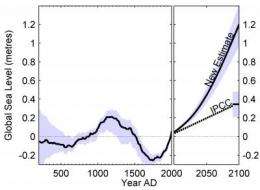
The curve shows the sea level from the year 200 to the year 2100. The future rise in sea level of 1 m is calculated from global warming of 3 degrees in this century. The dotted line indicates the UN Intergovernmental Panel on Climate Change's prediction. The blue shade indicates the calculations' degree of uncertainty. Credit: Aslak Grinsted, Niels Bohr Institutet
New research indicates that the ocean could rise in the next 100 years to a meter higher than the current sea level - which is three times higher than predictions from the UN's Intergovernmental Panel on Climate Change, IPCC. The groundbreaking new results from an international collaboration between researchers from the Niels Bohr Institute at the University of Copenhagen, England and Finland are published in the scientific journal Climate Dynamics.
According to the UN's Intergovernmental Panel on Climate Change the global climate in the coming century will be 2-4 degrees warmer than today, but the ocean is much slower to warm up than the air and the large ice sheets on Greenland and Antarctica are also slower to melt. The great uncertainty in the calculation of the future rise in the sea level lies in the uncertainty over how quickly the ice sheets on land will melt and flow out to sea. The model predictions of the melting of the ice sheets are the basis for the Intergovernmental Panel on Climate Change's predictions for the rise in sea level are not capable of showing the rapid changes observed in recent years. The new research has therefore taken a different approach.
Looking at the direct correlation
"Instead of making calculations based on what one believes will happen with the melting of the ice sheets we have made calculations based on what has actually happened in the past. We have looked at the direct relationship between the global temperature and the sea level 2000 years into the past", explains Aslak Grinsted, who is a geophysicist at the Centre for Ice and Climate at the Niels Bohr Institute at the University of Copenhagen.
With the help of annual growth rings of trees and analysis from ice core borings researchers have been able to calculate the temperature for the global climate 2000 years back in time. For around 300 years the sea level has been closely observed in several places around the world and in addition to that there is historical knowledge of the sea level of the past in different places in the world.
By linking the two sets of information together Aslak Grinsted could see the relationship between temperature and sea level. For example, in the Middle Ages around 12th century there was a warm period where the sea level was approximately 20 cm higher than today and in the 18th century there was the 'little ice age', where the sea level was approximately 25 cm lower than it is today.
A rise in sea level in the future as in the past
Assuming that the climate in the coming century will be three degrees warmer, the new model predictions indicate that the ocean will rise between 0,9 and 1,3 meters. To rise so much so quickly means that the ice sheets will melt much faster than previously believed. But it has already been observed that the ice sheets react quicker to increases in temperature than experts thought just a few years ago. And studies from the ice age show that ice sheets can melt quickly. When the ice age ended 11.700 years ago, the ice sheets melted so quickly that sea level rose 11 millimeters per year - equivalent to a meter in 100 years. In the current situation with global warming, Aslak Grinsted believes, that the sea level will rise with the same speed - that is to say a meter in the span of the next 100 years.
Source: University of Copenhagen
-
Engineers build first sub-10-nm carbon nanotube transistor
Feb 01, 2012 |
4.9 / 5 (31) |
30
-
Something old, something new: Evolution and the structural divergence of duplicate genes
Jan 31, 2012 |
4.6 / 5 (7) |
1
-
The hidden nanoworld of ice crystals: Revealing the dynamic behavior of quasi-liquid layers
Jan 30, 2012 |
5 / 5 (3) |
1
-
Stock market network reveals investor clustering
Jan 27, 2012 |
3.9 / 5 (23) |
8
-
Of microchemistry and molecules: Electronic microfluidic device synthesizes biocompatible probes
Jan 26, 2012 |
5 / 5 (1) |
0
-
Discrepancy between oxygen and carbon-dioxide levels
18 hours ago
-
where gems are found in the world
21 hours ago
-
Wind Waves in Reservoir ~ Wind run-up and Wind set-up
Feb 08, 2012
-
Balance of oxygen in the atmosphere
Feb 01, 2012
-
The case for a methanol-based economy
Jan 30, 2012
-
Weather in a rotating cylinder
Jan 25, 2012
- More from Physics Forums - Earth
More news stories
Humans may have helped the decline of African rainforests 3000 years ago
(PhysOrg.com) -- Large areas of rainforests in Central Africa mysteriously disappeared over three thousand years ago, to be replaced by savannas. The prevailing theory has been that the cause was a change ...
Could Venus be shifting gear?
(PhysOrg.com) -- ESAs Venus Express spacecraft has discovered that our cloud-covered neighbour spins a little slower than previously measured. Peering through the dense atmosphere in the infrared, the ...
Space & Earth / Space Exploration
7 hours ago |
5 / 5 (5) |
7
|
Mars Science Laboratory computer issue resolved
(PhysOrg.com) -- Engineers have found the root cause of a computer reset that occurred two months ago on NASA's Mars Science Laboratory and have determined how to correct it.
Space & Earth / Space Exploration
8 hours ago |
5 / 5 (5) |
3
|
Clam fields found at deep, low-temperature Mariana vents
(PhysOrg.com) -- Scientists have marveled at the unusual life forms thriving at high temperature hydrothermal vents of the deep ocean.
Space & Earth / Earth Sciences
7 hours ago |
not rated yet |
0
|
Two new moons for Jupiter
Advances in technology have lead to the discovery of new planets outside of our Solar System, and now even new moons in our own backyard.
Space & Earth / Space Exploration
7 hours ago |
not rated yet |
5
Complex wiring of the nervous system may rely on a just a handful of genes and proteins
Researchers at the Salk Institute have discovered a startling feature of early brain development that helps to explain how complex neuron wiring patterns are programmed using just a handful of critical genes. ...
CIA website offline, Anonymous takes credit
The website of the Central Intelligence Agency was unresponsive on Friday after the hacker group Anonymous claimed to have knocked it offline.
Q&A: Obama and the birth control controversy
(AP) -- What birth control debate? A half-century after the introduction of the pill, acceptance of birth control by American women is virtually universal.
The power of estrogen -- male snakes attract other males
A new study has shown that boosting the estrogen levels of male garter snakes causes them to secrete the same pheromones that females use to attract suitors, and turned the males into just about the sexiest ...
New error-correcting codes guarantee the fastest possible rate of data transmission
Error-correcting codes are one of the triumphs of the digital age. Theyre a way of encoding information so that it can be transmitted across a communication channel such as an optical fiber o ...
Both maternal and paternal age linked to autism
Older maternal and paternal age are jointly associated with having a child with autism, according to a recently published study led by researchers at The University of Texas Health Science Center at Houston (UTHealth).
Jan 08, 2009
Rank: 2.5 / 5 (15)
Thanking you in advance for calling Al Gore first,
Mike
Jan 08, 2009
Rank: 3 / 5 (10)
Jan 08, 2009
Rank: 3.3 / 5 (7)
Jan 08, 2009
Rank: 2.3 / 5 (10)
On the other hand, if you accept historical events for this, why not accept historical reading of CO2 levels many times higher than now with out runaway warming?
Jan 08, 2009
Rank: 2.4 / 5 (11)
For the love of all that you hold admirable, please do not try to make sense out of any study you read on physorg. Don't you realize that the only thing that matters is that we must follow Dr. Gore. We must believe with our hearts, NOT our minds. You are NOT a scientist. They are saying one meter, ONE METER of sea level rise! That's about three feet. When Dr. Gore finds out about this, this... ridiculous claim he will set these physorg people straight! If... IF they change their ways and begin to publish the truth IMMEDIATELY, Dr. Gore might be able to find a small place for them in the new world order of peace, habitability and oneness with nature that all right-thinking people strive for, and hold deeply in their hearts.
Hug a tree today!
Mike :)
Jan 09, 2009
Rank: 2.8 / 5 (11)
Jan 09, 2009
Rank: 3.3 / 5 (4)
Correlation does not imply causation. Without knowing the mechanism they cannot make reliable predictions.
Models can be used to test possible mechanisms and past data used to test the models. This appears to be the method used by the IPCC.
I know I'm opening myself up to a world of abuse by appearing to praise models or anything originating from the IPCC, but this is the way science works. Observe, theorise, test, and refine.
Jan 09, 2009
Rank: 2.5 / 5 (10)
Jan 09, 2009
Rank: 3.1 / 5 (11)
Now, the problems: It is not a reasonable result. You are saying that sea level will rise at the same rate as at the end of an ice age. That violates common sense, so that will require a lot of corroberating evidence. Then, they will have to show that the correlation between temp and sea level is linear and not Arrhenius shaped (my gut tells me that it should be the latter). This goes to show that extrapolation is almost always a bad idea that gives unsupportable results.
Furthermore, they explain that this is based on a 3 degrees (C?) rise in temperatures. This temperature rise is utterly unsubstantiated in facts. There is no evidence for it (climate models, which are extrapolations themselves, cannot be evidence. Their results are interesting, but provide possibilities only.)
Alright, maybe it is that bad an article.
Jan 09, 2009
Rank: 3 / 5 (10)
It's almost as though this research assumed x amount of ice means x amount of sea level rise, and ignored all other factors that are potentially at play.
It's simply a poor model.
Jan 09, 2009
Rank: 1 / 5 (2)
Jan 09, 2009
Rank: 2 / 5 (4)
Are you in, genius?
Are you in, competent?
Are you in, sufferable?
[from the classic Bugs Bunny / Roadrunner cartoons ;
Jan 09, 2009
Rank: 1 / 5 (3)
Jan 10, 2009
Rank: 3 / 5 (2)
Jan 12, 2009
Rank: not rated yet
Realistically you wouldn't though. If there was a permanent and constant 3 degree rise 1 meter is reasonable.
I don't see a 3 degree rise by 2100 happening, neither do even the most bold of agw predictions. I think the average noted rise now a days is 0.5 degrees C with the bigger ones being around 1 full degree C.