Biggest Full Moon of the Year: Take 2
January 8, 2009
Biggest Full Moon of the Year: Take 2

Enlarge

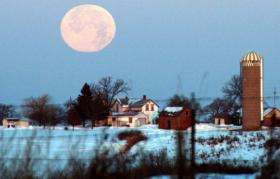
The perigee full of Dec. 2008. "A cold wind was blowing as the Moon set over a neighbor's farm," says photographer Eric Ingmundson of Sparta, Wisconsin. "Next time (Jan. 10th) I plan to use a tripod."

When last month's full Moon rose over Florida, onlooker Raquel Stanton of Cocoa Beach realized that something was up.

"The Moon was stunningly gorgeous--and it looked bigger than usual!" she says. "My whole family noticed and watched in awe."

Like millions of others around the world, she had witnessed the biggest full Moon of 2008--a "perigee Moon," 14% wider and 30% brighter than lesser Moons she had seen before. "I'll never forget it."

Alert: It's about to happen again.

This Saturday night, Jan. 10th, another perigee Moon is coming. It's the biggest full Moon of 2009, almost identical to the one that impressed onlookers in Dec. 2008.

Johannes Kepler explained the phenomenon 400 years ago. The Moon's orbit around Earth is not a circle; it is an ellipse, with one side 50,000 km closer to Earth than the other. Astronomers call the point of closest approach "perigee," and that is where the Moon will be this weekend.

Perigee full Moons come along once or twice a year. 2008 ended with one and now 2009 is beginning with another. It's the best kind of déją vu for people who love the magic of a moonlit landscape.

January is a snowy month in the northern hemisphere, and the combination of snow + perigee moonlight is simply amazing. When the Moon soars overhead at midnight, the white terrain springs to life with a reflected glow that banishes night, yet is not the same as day. You can read a newspaper, ride a bike, write a letter, and at the same time count the stars overhead. It is an otherworldly experience that really must be sampled first hand.

Another magic moment happens when the perigee Moon is near the horizon. That is when illusion mixes with reality to produce a truly stunning view. For reasons not fully understood by astronomers or psychologists, low-hanging Moons look unnaturally large when they beam through trees, buildings and other foreground objects. This weekend, why not let the "Moon illusion" amplify a full Moon that's extra-big to begin with? The swollen orb rising in the east at sunset may seem so nearby, you catch yourself reaching out to touch it.

You won't be the only one. Even at perigee, the Moon is 360,000 km away, yet the distant beauty beckons to poets, stargazers and NASA with equal force: "Come back," it seems to say, "I'm really not so far away."

Source: by Dr. Tony Phillips, Science@NASA


Rank 5 /5 (3 votes)
Relevant PhysicsForums posts
  • Titan's lack of impact craters
    created12 hours ago
  • Real pictures of black hole eating a star?
    createdFeb 08, 2012
  • Hypothetical way to travel faster than light, but not technically exceed lightspeed
    createdFeb 06, 2012
  • How do scientists monitor the Sun's activity?
    createdFeb 05, 2012
  • Search patterns in observational studies
    createdFeb 05, 2012
  • Derivation of Pogson's law
    createdFeb 03, 2012
  • More from Physics Forums - General Astronomy

More news stories

Deconstructing a mystery: What caused Snowmaggedon?

In the quiet after the storms, streets and cars had all but disappeared under piles of snow. The U.S. Postal Service suspended service for the first time in 30 years. Snow plows struggled to push the evidence ...

Space & Earth / Earth Sciences

created 7 hours ago | popularity 4.7 / 5 (3) | comments 1 | with audio podcast

Ocean microbe communities changing, but long-term environmental impact is unclear

As oceans warm due to climate change, water layers will mix less and affect the microbes and plankton that pump carbon out of the atmosphere – but researchers say it's still unclear whether these processes ...

Space & Earth / Earth Sciences

created 9 hours ago | popularity 5 / 5 (2) | comments 2 | with audio podcast

Researchers create 3-D laser maps that show how earthquake changes landscape

Geologists have a new tool to study how earthquakes change the landscape down to a few inches, and it's giving them insight into how earthquake faults behave. In the Feb. 10 issue of the journal Science, a team ...

Space & Earth / Earth Sciences

created 9 hours ago | popularity 5 / 5 (4) | comments 0 | with audio podcast

New views show old NASA Mars landers

(PhysOrg.com) -- The High Resolution Imaging Science Experiment (HiRISE) camera on NASA's Mars Reconnaissance Orbiter recorded a scene on Jan. 29, 2012, that includes the first color image from orbit showing ...

Space & Earth / Space Exploration

created 15 hours ago | popularity 4.9 / 5 (7) | comments 5 | with audio podcast

Black holes and star formation

(PhysOrg.com) -- It has long been recognized that galaxy mergers or even close interactions can play a vital role in shaping the morphology of galaxies. One way they can do so, it is thought, is by triggering ...

Space & Earth / Astronomy

created 14 hours ago | popularity 4 / 5 (6) | comments 3 | with audio podcast


'Dark plasmons' transmit energy

Microscopic channels of gold nanoparticles have the ability to transmit electromagnetic energy that starts as light and propagates via "dark plasmons," according to researchers at Rice University.

Hydrogen from acidic water: Researchers develop potential low cost alternative to platinum for splitting water

A technique for creating a new molecule that structurally and chemically replicates the active part of the widely used industrial catalyst molybdenite has been developed by researchers with the Lawrence Berkeley ...

FDA-approved drug rapidly clears amyloid from the brain, reverses Alzheimer's symptoms in mice

Neuroscientists at Case Western Reserve University School of Medicine have made a dramatic breakthrough in their efforts to find a cure for Alzheimer's disease. The researchers' findings, published in the journal Science, show t ...

Ultraviolet protection molecule in plants yields its secrets

Lying around in the sun all day is hazardous not just for humans but also for plants, which have no means of escape. Ultraviolet (UV) radiation from the sun can damage proteins and DNA inside cells, leading ...

Anyone can learn to be more inventive, cognitive researcher says

There will always be a wild and unpredictable quality to creativity and invention, says Anthony McCaffrey, a cognitive psychology researcher at the University of Massachusetts Amherst, because an "Aha moment" is rare and ...

Cell biologists describes mechanism by which some people may be more susceptible to colon cancer

An international research team led by cell biologists at the University of California, Riverside has uncovered a new insight into colon cancer, the third leading cause of cancer-related deaths in the United ...