Carbon nanotube 'ink' may lead to thinner, lighter transistors and solar cells

January 8th, 2009 By Anne Ju Carbon nanotube 'ink' may lead to thinner, lighter transistors and solar cells

Enlarge

An atomic force microscope image of semiconducting nanotubes, after the cycloaddition process of removing the metallic tubes.

(PhysOrg.com) -- Using a simple chemical process, scientists at Cornell and DuPont have invented a method of preparing carbon nanotubes for suspension in a semiconducting "ink," which can then be printed into such thin, flexible electronics as transistors and photovoltaic materials.

The method, which involves treating carbon nanotubes with fluorine-based molecules, is reported in the Jan. 9 issue of the journal Science (Vol. 323 No. 234). The research was jointly led by Graciela B. Blanchet, a research fellow at DuPont, and George Malliaras, Cornell associate professor of materials science and engineering and the Lester B. Knight Director of the Cornell NanoScale Science and Technology Facility. Helen Lu, a research chemist at Dupont, and Mandakini Kanungo, a former Cornell postdoctoral fellow now at Xerox, also worked on the project.

Carbon nanotubes are good candidates for transistors in low-cost, printable electronics, but only after large quantities of them have been converted into semiconductors. When carbon nanotubes are grown in the lab, some are semiconducting but others are metallic, and they are difficult to separate from each other.
Carbon nanotube 'ink' may lead to thinner, lighter transistors and solar cells
Enlarge

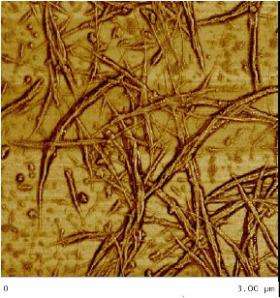
An atomic force microscope image of both metallic and semiconducting carbon nanotubes, before the cycloaddition process of removing the metallic tubes.


This mix is a major drawback in creating transistors from nanotubes, Malliaras said. The Cornell/DuPont team concentrated on a new, inexpensive way to eliminate the metallic tubes, preparing them for such applications as suspension in semiconducting ink for printing.

To do so, the researchers brought fluorine-based molecules into contact with the nanotubes. Through a process called cycloaddition, the fluorine molecules efficiently attacked or converted the metallic nanotubes, leaving the semiconducting tubes alone, and creating a perfect batch of solely semiconducting nanotubes.

"Our work suggests that careful control of the chemical reaction enables the complete conversion of metallic tubes without the degradation of semiconducting tubes," Blanchet said.

The work should lead to exploration of a wide range of devices, such as novel organic photovoltaic structures, Malliaras added.

For the past several years, scientists from Cornell and DuPont have worked together on a variety of projects involving flexible electronics. The research is funded by a grant from the U.S. Air Force for developing transistors from carbon nanotubes.

Provided by Cornell University


print this article email this article download pdf blog this article bookmark this article     Digg this Stumble it share on Facebook share on Reddit add to delicious save to Yahoo! bookmarks
5/5 after 5 votes


January 8th, 2009 all stories
Nanotechnology / Nanophysics

Comments: 0
Rank: 5/5 after 5 votes

  • Stumble this up

  • Digg this

  • Share it:
  • share on Facebook
  • share on MySpace
  • share on Slashdot
  • rss-newsfeed
  • share on Google
  • share on Reddit
  • add to delicious
  • save to Yahoo! bookmarks
  • share on Windows Live
  • Add to Mixx!
Rating: 5/5 after 5 votes

  • Related Stories

  • Scientists report significant advances in flexible electronics research
    created Jun 18, 2009 | popularity not rated yet | comments 0
  • Unzipping Carbon Nanotubes Can Make Graphene Ribbons
    created Apr 20, 2009 | popularity not rated yet | comments 0
  • Carbon nanotube avalanche process nearly doubles current
    created Feb 09, 2009 | popularity not rated yet | comments 0
  • Semiconducting Nanotubes Are 'Holy Grail' for Electronic Applications
    created Jan 21, 2009 | popularity not rated yet | comments 0
  • Bottoms up: Better organic semiconductors for printable electronics
    created Sep 04, 2008 | popularity not rated yet | comments 0


  • Physicists Demonstrate Quantum Memory with Matter Qubits
    Physicists Demonstrate Quantum Memory with Matter Qubits
    Physics / General Physics
    created Jul 03, 2009 | popularity 4.4 / 5 (17) | comments 1
  • 'Holey' Nanosheets for Wastewater Dye Removal
    Nanotechnology / Nanomaterials
    created Jul 01, 2009 | popularity 5 / 5 (5) | comments 1
  • Jellyfish Robot Swims Like its Biological Counterpart
    Jellyfish Robot Swims Like its Biological Counterpart
    Electronics / Robotics
    created Jun 26, 2009 | popularity 4.4 / 5 (8) | comments 1
  • Could Maxwell's Demon Exist in Nanoscale Systems?
    Could Maxwell's Demon Exist in Nanoscale Systems?
    Physics / General Physics
    created Jun 24, 2009 | popularity 4.4 / 5 (18) | comments 29
  • Living Safely with Robots, Beyond Asimov's Laws
    Living Safely with Robots, Beyond Asimov's Laws
    Electronics / Robotics
    created Jun 22, 2009 | popularity 4.6 / 5 (52) | comments 40
  • Other News

    A 'quantum of sol' -- how nanotechnology could hold the key to a solar-powered future

    A 'quantum of sol' -- how nanotechnology could hold the key to a solar-powered future

    Nanotechnology / Nanomaterials

    created Jun 30, 2009 | popularity 3.9 / 5 (15) | comments 17

    (PhysOrg.com) -- A new generation of 'nano-structured' millimetre-sized solar cells that could convert the sun's energy to electricity more than twice as efficiently as current technology, is the subject of ...


    Australian researchers are set to begin human trials of a tiny nano-cell that acts as a "Trojan horse" against cancer

    Hi-tech 'Trojan horse' can kill cancer cells: researchers

    Nanotechnology / Bio & Medicine

    created Jun 29, 2009 | popularity 4.7 / 5 (12) | comments 7

    Australian researchers are set to begin human trials of a tiny nano-cell that acts as a "Trojan horse" against cancer cells, a breakthrough they say may curb the need for debilitating chemotherapy.


    'Holey' Nanosheets for Wastewater Dye Removal

    Nanotechnology / Nanomaterials

    created Jul 01, 2009 | popularity 5 / 5 (5) | comments 1

    (PhysOrg.com) -- Researchers have discovered that extremely thin sheets of nickel oxide with hexagonally shaped holes can absorb hazardous dyes from wastewater nearly as well as the best traditional methods, but are recyclable. ...


    Harnessing Nanoparticles To Track Cancer Cell Changes

    Nanotechnology / Bio & Medicine

    created Jul 03, 2009 | popularity not rated yet | comments 1

    The more dots there are, the more accurate a picture you get when you connect them. Cancer researchers adopting that philosophy have developed a new imaging technology that could give scientists the ability to simultaneously ...


    Computer-Guided Nanoparticle Therapy Destroys Tumors

    Nanotechnology / Bio & Medicine

    created Jun 29, 2009 | popularity 4.9 / 5 (12) | comments 0

    Gold nanoshells are among the most promising new nanoscale therapeutics being developed to kill tumors, acting as antennas that turn light energy into heat that cooks cancer to death. Now, a multi-institutional research team ...