Soaring or snoring? Fruit fly's immune system responds differently when asleep
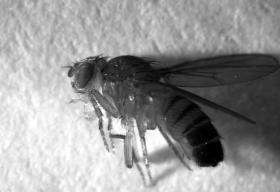
(PhysOrg.com) -- A fruit fly's immune system can tell time—and how hard it punches back against infections depends on whether the fly is snoozing or cruising. The discovery by medical school researchers could have implications for human health, too.
Working with jerry-rigged, light-bulb-laden shoeboxes to manipulate the flies' daily cycle and with syringes small enough to inject germs into the wee winged ones, the investigators have shown that the insects' immune response waxes and wanes with the diurnal oscillations called circadian rhythms. Mimi Shirasu-Hiza, PhD, a postdoctoral scholar in the laboratory of David Schneider, PhD, assistant professor of microbiology and immunology, presented the findings on Dec. 14 in San Francisco at the annual meeting of the American Society for Cell Biology.
Insects do not have the advanced artillery that characterizes vertebrate immune systems—antibody-secreting B-cells, and killer and helper T-cells that precisely target specific pathogens for attack. But they do share with vertebrate organisms a primitive, but critical, rough-and-ready response to unwanted microbes: the innate immune system. This all-important first line of defense, without which we wouldn't survive an infection for the week or two it takes for our more-sophisticated antibodies and T-cells to kick into high gear, whirls into action at once, based on its ability to recognize generic patterns that distinguish microbial pests.
One feature of the fruit fly's innate immune system is the presence of circulatory cells called phagocytes that, like our own white blood cells, engulf and digest bacteria. Shirasu-Hiza and Schneider found that phagocytes' activity oscillates throughout the day.
Like the mosquito, platypus and whitetail deer, fruit flies are crepuscular—they are most active at dawn and dusk, tend to roam a bit during the daytime, and engage in what passes for sleep during the nighttime. (Flies don't have eyelids, so it's hard to tell if they're really asleep. Researchers instead characterize cyclical patterns of rest and activity in terms of the number of movements per five-minute cycle.)
Shirasu-Hiza flummoxed flies into a 12-hour, circadian-rhythm phase shift by raising them in shoeboxes, wired by Schneider with timers that controlled batteries of light bulbs. This enabled the researchers to infect two sets of flies (from "nighttime" or "daytime" shoeboxes) in a single experimental session. This Shirasu-Hiza did, using syringes fashioned from glass capillary tubes heated and then stretched so that they were extremely thin, but still hollow.
Armed with these syringes—which are powered by a machine called a "Picospritzer"—Shirasu-Hiza spent hours on end in a dark room lit only by a red bulb (red light doesn't seem to perturb the daily rhythms of the flies) while injecting, one by one, multiple hundreds of tiny, week-old male flies (half of them sleeping, the other half awake) per session with precise volumes of solutions containing different pathogenic bacteria.
In previously published research, when Shirasu-Hiza and her colleagues had infected normal flies with measured doses of two noted human pathogens, Streptococcus pneumoniae or Listeria monocytogenes, the sickened flies' circadian rhythms were disturbed. They stumbled around more randomly, and stood still for relatively shorter periods. Moreover, mutants lacking circadian cycles of rest and activity died more quickly on infection with these pathogens than normal flies did.
In the new round of experiments, the researchers observed that, consistent with those earlier findings, the activity of phagocytes in normal fruit flies oscillates with their circadian rhythms.
Flies infected with S. pneumoniae or L. monocytogenes during resting periods ("nighttime") also survive significantly longer than those infected during active periods ("daytime"). Furthermore, by injecting fluorescently labeled dead bacteria into flies at different points in their circadian cycle, the investigators could see increased phagocyte function at night for those two pathogens: there was an increase in the number of bacteria ingested by phagocytes in flies infected during resting versus active phases. Likewise, circadian-mutant flies "trapped" in the active phase had decreased phagocyte function, demonstrating that phagocyte activity is subject to regulation by circadian proteins whose activity, in turn, is disrupted by these mutations.
Strangely, though, infecting the flies with a third bacterial pathogen, Burkholderia cepacia, produced the opposite result. Circadian-mutant flies coped better with the infection than did normal flies, suggesting that in this case, a disrupted circadian rhythm might actually be good for the flies.
That poses an intellectual challenge. Schneider said: "If a sick fruit fly were to walk into my office, and it were infected with Burkholderia, I would know that I should deprive it of sleep. But I don't know the rules for people. In hospitals, nurses and orderlies are going in and out all the time, and you never get any sleep. Is that good, or bad? There are probably conditions where that's going to make things much worse. But maybe there are some conditions where it's actually better for you to have your sleep continuously interrupted. We're trying to figure out the rules for the fly, and hopefully someone else can translate it into human biology: Do they put you in a quiet room, or do they keep coming in and fiddling with your IV on purpose?"
The work was funded by the National Institutes of Health.
Provided by Stanford University


