Dartmouth researchers find new protein function
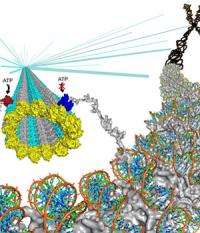
January 9, 2009 Dartmouth researchers find new protein function

Enlarge

Protein NOD at the end of a microtubule (illustration by Jared Cochran)

A group of Dartmouth researchers has found a new function for one of the proteins involved with chromosome segregation during cell division. Their finding adds to the growing knowledge about the fundamental workings of cells, and contributes to understanding how cell function can go wrong, as it does with cancerous cells.

The researchers studied a protein called NOD, distantly related to the motor proteins that power diverse cellular activities, including intracellular transport, signaling, and cell division. They used X-ray crystallography to determine its structure, and then they used enzyme kinetics to find out how it performed. While this protein is found in fruit flies, the results are helpful in determining how related proteins work in humans.

"This study on NOD provided evidence for a new way a kinesin motor could function," said Jared Cochran, a postdoctoral fellow at Dartmouth and the lead author on the study. "Rather than moving on its own, it hitches a ride on the ends of microtubules which results in a dynamic cross-linking between the arms of chromosomes and the cell's growing spindle of microtubules. If NOD doesn't function properly, then the two cells end up with either both or none of that particular chromosome, which is lethal [to the cell and the organism] in most cases."

With colleagues from Lawrence Berkeley National Laboratory, Stowers Institute for Medical Research in Kansas City, Missouri, and Kansas University Medical Center in Kansas City, Kansas, the Dartmouth group published their study in the Jan. 9, 2009, issue of the journal Cell. Their paper is titled, "ATPase Cycle of the Nonmotile Kinesin NOD Allows Microtubule End Tracking and Drives Chromosome Movement."

"Before this study, it had been shown that kinesin motors either walked along their microtubule tracks or functioned to break microtubules apart," says Jon Kull, the senior author on the paper, associate professor of chemistry at Dartmouth, and a 1988 Dartmouth graduate. "This work describes a novel mode for kinesin function, in which NOD does not walk, but rather alternates between grabbing on to and letting go of the end of the growing filament, thereby tracking the end as it grows. The diversity of function of these proteins is remarkable."

One of the authors on the paper, Natasha Mulko, is a 2007 Dartmouth graduate, and worked on this project as her senior honors thesis in chemistry. Mulko is currently a graduate student in dentistry at Creighton University. "Natasha's work was integral to this study as she worked on obtaining and improving the protein crystals necessary to solve the structure," says Kull, her thesis advisor.

Source: Dartmouth College


Rate this story - 4 /5 (1 vote)


January 9, 2009 all stories

Comments: 0

4 /5 (1 vote)

  • hide
  • Related Stories

  • Well-known drug (AAT) could overcome obstacles to islet transplantation
    created Oct 30, 2008 | popularity not rated yet | comments 0
  • Type 1 diabetes triggered by 'lazy' regulatory T-cells
    created Jan 14, 2008 | popularity not rated yet | comments 0
  • Study shows humans and plants share common regulatory pathway
    created Apr 09, 2007 | popularity not rated yet | comments 0
  • German researchers develop new tool to investigate ion channels
    created 21 minutes ago | popularity not rated yet | comments 0
  • Communication breakdown: What happens to nerve cells in Parkinson's disease
    created 5 hours ago | popularity not rated yet | comments 0


Other News

bee

Are bees also addicted to caffeine and nicotine?

Biology / Plants & Animals

created 27 minutes ago | popularity 5 / 5 (2) | comments 0 | with audio podcast

A study carried out at the University of Haifa has found that bees prefer nectar with a small concentration of caffeine and nicotine over nectar that does not comprise these substances at all. "This could ...


giant oarfish

Bizarre giant oarfish filmed (w/ Video)

Biology / Plants & Animals

created 4 hours ago | popularity 4.3 / 5 (4) | comments 0 | with audio podcast report

(PhysOrg.com) -- A rare giant oarfish, probably the largest bony fish in the ocean, has been filmed off the Gulf of Mexico. This is possibly the first time the fish has been observed in its natural environment.


Scientists crash test DNA's replication machinery

Biology / Cell & Microbiology

created 2 hours ago | popularity 5 / 5 (2) | comments 0 | with audio podcast

(PhysOrg.com) -- Important molecular machines routinely crash into one another while plying their trades on DNA. New research shows that the enzymes that copy DNA before cell division, called replisomes, are the kings of ...


Great tits: birds with character

Great tits: birds with character

Biology / Plants & Animals

created 17 hours ago | popularity 5 / 5 (3) | comments 3 | with audio podcast

(PhysOrg.com) -- In humans and animals alike, individuals differ in sets of traits that we usually refer to as personality. An important part of the individual difference in personality is due to variation ...


Benefits of badger culling not long lasting for reducing cattle TB, says study

Benefits of badger culling not long lasting for reducing cattle TB, says study

Biology / Ecology

created 3 hours ago | popularity not rated yet | comments 0

(PhysOrg.com) -- Badger culling is unlikely to be a cost-effective way of helping control cattle TB in Britain, according to research published today in PLoS ONE.