Too much of a good thing: Excessive DNA repair can lead to retinal degeneration
January 9, 2009 Too much of a good thing: Excessive DNA repair can lead to retinal degeneration

Enlarge

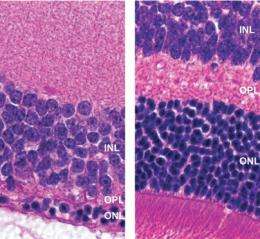
MIT researchers found that mice with normal DNA repair systems had more retinal degeneration upon exposure to environmental toxic agents than mice lacking a certain DNA repair system. At right, the cross section of the retina from a mouse lacking the repair system is normal. At left, mice with too much DNA repair have greatly reduced numbers of cells in the OPL (outer plexiform layer) and ONL (outer nuclear layer). Image courtesy / Samson Laboratory

(PhysOrg.com) -- A naturally occurring DNA repair system that normally protects cells from damage can cause retinal degeneration and blindness when overstimulated, according to a new study by MIT researchers.

The research team found that relatively low-level exposure to an environmental toxic agent provoked very active DNA repair that led to surprisingly high rates of retinal degeneration in mice -- much higher than in mice lacking the same DNA repair pathway. The work raises the possibility of developing treatments for retinal degeneration by blocking a particular DNA repair pathway.

"Under some circumstances, too much DNA repair is not a good thing and could actually be a bad thing," said Leona Samson, co-director of MIT's Center for Environmental Health Sciences, professor of biology and biological engineering, and senior author of a paper on the work appearing online in the Proceedings of the National Academy of Sciences this week.

Samson and her colleagues studied a pathway involving an enzyme called Aag. The enzyme has a human analogue called AAG that may play a role in retinitis pigmentosa (RP), a group of genetic eye disorders that lead to blindness and affect between 50,000 and 100,000 people in the United States.

Aag plays a critical role in DNA repair, snipping out DNA bases damaged by environmental toxic agents, such as those found in tobacco smoke and fuel exhaust. Later on, the damaged bases are replaced with new ones.

Under normal levels of environmental toxic agent exposure, the system functions effectively. However, the researchers found that if mice were exposed to a higher (but non-lethal) level of toxic agent, the system backfired. Aag cuts out so many bases that the rest of the DNA repair system cannot keep up, leading to death of the rod and cone cells that make up the retina.

This malfunction in the DNA repair pathway occurs only in certain body tissues, including the retina, and only in mice with normal Aag levels. Mice lacking Aag do not exhibit retinal degeneration, while mice with high Aag levels had even higher levels of retinal degeneration.

Lead author of the paper is Lisiane Meira, a former research scientist in the Center for Environmental Health Sciences (CEHS). Other authors are Catherine Moroski-Erkul, technical assistant in CEHS; Stephanie Green, former graduate student in biological engineering; Jennifer Calvo, research scientist in CEHS; Dharini Shah, postdoctoral associate in CEHS; and Roderick Bronson, veterinary pathologist at Harvard Medical School.

Provided by MIT


print this article email this article download pdf blog this article bookmark this article     Stumble it Digg this share on Facebook retweet share on Reddit add to delicious
Rate this story - 3.8 /5 (6 votes)

Rank Filter

Move the slider to adjust rank threshold, so that you can hide some of the comments.


Display comments: newest first


January 9, 2009 all stories

Comments: 1

3.8 /5 (6 votes)
  • Stumble this up

  • Digg this

  • share this

  • hide
  • Related Stories


  • hide
  • Relevant PhysicsForums posts

  • Improving the brain through chemistry
    created 9 hours ago
  • Sleep / REM Sleep and homeostasis
    created Nov 07, 2009
  • The Biceps Reflex
    created Nov 05, 2009
  • Consequenses of striking a Vein and an artery?
    created Nov 05, 2009
  • More from Physics Forums - Medical Sciences

Other News

House passes health care bill on close vote (AP)

Landmark health bill passes House on close vote

Medicine & Health / Health

created 3 hours ago | popularity 3 / 5 (4) | comments 0

(AP) -- The Democratic-controlled House has narrowly passed landmark health care reform legislation, handing President Barack Obama a hard won victory on his signature domestic priority.


Decision day for health care in the House (AP)

Decision day for health care in the House

Medicine & Health / Health

created 22 hours ago | popularity 1 / 5 (1) | comments 0

(AP) -- President Barack Obama is trying to close the deal in the House on his health care overhaul, facing a make-or-break vote that's certain to be seen as a test of his presidency.


Island village hit by suspected swine flu (AP)

Island village hit by suspected swine flu

Medicine & Health / Diseases

created 22 hours ago | popularity 5 / 5 (1) | comments 1

(AP) -- Suspected swine flu is sweeping a traditional Eskimo whaling village on a remote Alaska island - prompting an urgent medical mission to deliver help.


Turn On, Tune In, Develop?

Turn On, Tune In, Develop? Researchers Examine How Brain Benefits From Musical Training

Medicine & Health / Neuroscience

created Nov 06, 2009 | popularity 5 / 5 (10) | comments 4

For most people music is an enjoyable, although momentary, form of entertainment. But for those who seriously practiced a musical instrument when they were young, perhaps when they played in a school orchestra ...


Children who often drink full-fat milk weigh less

Medicine & Health / Health

created Nov 03, 2009 | popularity 5 / 5 (4) | comments 5

Eight-year-old children who drink full-fat milk every day have a lower BMI than those who seldom drink milk. This is not the case for children who often drink medium-fat or low-fat milk. This is one conclusion of a thesis ...