Nano 'balls' can be used to manipulate the properties of glass
January 9, 2009
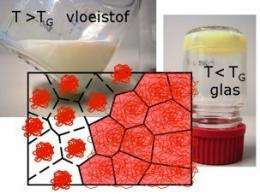
(PhysOrg.com) -- Liquid or glass, hard or soft -- researchers at the University of Twente, The Netherlands, are investigating a new 'model material' that can adopt a series of different properties. This is possible because of miniscule balls of knotted polymers which become enlarged as the temperature drops. It has interesting potential for research into the consequences of ageing in the properties of glass, which can serve as a model for the natural process of ageing. Researchers in the Physics of Complex Fluids group have published a paper on the subject in Physical Review Letters.
The size of the polymer balls is on a nano scale - at 40 degrees, their diameter is around 100 nanometres and at 20 degrees they become enlarged to about 200 nanometres and also increase in softness. The transition from liquid to solid (or glass-like) can be controlled in a number of ways, resulting in glass that varies in hardness. Just a few particles that have become significantly enlarged can occupy the same amount of space as many particles that have only enlarged slightly: in both cases the result is a solid material, but the glass in the first instance is softer than in the second.
These soft glass-like materials can serve as a model for a range of different natural processes as they are extremely sensitive to external stimuli. Age plays an important role in this. Older glass responds differently from glass that is young. If you press it, it takes longer to regain its original form: the older the glass, the longer it takes to re-establish its internal consistency. This depends on how easily the particles are able to move around each other. Softer particles can move around each other even when in contact, while harder particles block each other, as they are less capable of being compressed together.
As a result, this fascinating material also opens up new insights for biologists, for example, who can use it to learn about the processes at work in living matter.
The research was conducted by Prof. Frieder Mugele’s Physics of Complex Fluids group. The group is part of the University of Twente’s IMPACT and MESA+ research institutes.
The paper ‘Glass transition and aging in dense suspensions of thermosensitive microgel particles’ by Eko Purnomo, Dirk van den Ende, Siva Vanapalli and Frieder Mugele was published in Physical Review Letters: http://link.aps.or … t.101.238301
Provided by University of Twente
-
Glass implosion tests help design stronger neutrino detectors
Feb 22, 2011 |
4.5 / 5 (2) |
0
-
When worlds collide: Researchers harness supercomputers to understand solar storm, magnetosphere
Feb 07, 2012 |
3 / 5 (1) |
6
-
Learning about material integrity from statistical data
Feb 07, 2012 |
not rated yet |
0
-
Under the electron microscope -- A 3-D image of an individual protein
Jan 25, 2012 |
4.9 / 5 (12) |
0
-
Physicists develop nano-level sound detector
Jan 12, 2012 |
5 / 5 (2) |
2
-
Engineers build first sub-10-nm carbon nanotube transistor
Feb 01, 2012 |
4.9 / 5 (31) |
30
-
Something old, something new: Evolution and the structural divergence of duplicate genes
Jan 31, 2012 |
4.6 / 5 (7) |
1
-
The hidden nanoworld of ice crystals: Revealing the dynamic behavior of quasi-liquid layers
Jan 30, 2012 |
5 / 5 (3) |
1
-
Stock market network reveals investor clustering
Jan 27, 2012 |
3.9 / 5 (23) |
8
-
Of microchemistry and molecules: Electronic microfluidic device synthesizes biocompatible probes
Jan 26, 2012 |
5 / 5 (1) |
0
-
changing electric flux caused by a resistor
1 hour ago
-
Does path integral and loop integral in a Feynman diagram violate special relativity?
1 hour ago
-
Simple Torque from Gravity Problem
3 hours ago
-
Books To Inspire a Beginnig Physics Student
5 hours ago
-
Pith balls problem
6 hours ago
-
Electrostatics
6 hours ago
- More from Physics Forums - General Physics
More news stories
What lies beneath: Mapping hidden nanostructures
The ability to diagnose and predict the properties of materials is vital, particularly in the expanding field of nanotechnology. Electron and atom-probe microscopy can categorize atoms in thin sheets of material, ...
20 hours ago |
5 / 5 (3) |
1
New kind of solar cell could capture significantly more energy than current cells
New solar cells could increase the maximum efficiency of solar panels by over 25%, according to scientists from the University of Cambridge.
Feb 08, 2012 |
4.5 / 5 (12) |
14
|
Nanoshell whispering galleries improve thin solar panels
Visitors to Statuary Hall in the U.S. Capitol Building may have experienced a curious acoustic feature that allows a person to whisper softly at one side of the cavernous, half-domed room and for another on ...
Nanotechnology / Nanomaterials
Feb 07, 2012 |
4.3 / 5 (6) |
6
|
'Dark plasmons' transmit energy
Microscopic channels of gold nanoparticles have the ability to transmit electromagnetic energy that starts as light and propagates via "dark plasmons," according to researchers at Rice University.
Feb 09, 2012 |
4.8 / 5 (9) |
1
|
Revealing how a battery material works
Since its discovery 15 years ago, lithium iron phosphate (LiFePO4) has become one of the most promising materials for rechargeable batteries because of its stability, durability, safety and ability to deliver ...
Nanotechnology / Nanomaterials
Feb 08, 2012 |
5 / 5 (5) |
0
|
Anonymous knocks CIA website offline (Update)
The website of the Central Intelligence Agency was inaccessible on Friday after the hacker group Anonymous claimed to have knocked it offline.
New error-correcting codes guarantee the fastest possible rate of data transmission
Error-correcting codes are one of the triumphs of the digital age. Theyre a way of encoding information so that it can be transmitted across a communication channel such as an optical fiber o ...
Small modular reactor design could be a 'SUPERSTAR'
(PhysOrg.com) -- Though most of today's nuclear reactors are cooled by water, we've long known that there are alternatives; in fact, the world's first nuclear-powered electricity in 1951 came from a reactor ...
New power source discovered
(PhysOrg.com) -- Researchers at the Massachusetts Institute of Technology (MIT) and RMIT University have made a breakthrough in energy storage and power generation.
The power of estrogen -- male snakes attract other males
A new study has shown that boosting the estrogen levels of male garter snakes causes them to secrete the same pheromones that females use to attract suitors, and turned the males into just about the sexiest ...
Advanced power-grid model finds low-cost, low-carbon future in West
(PhysOrg.com) -- The least expensive way for the Western U.S. to reduce greenhouse gas emissions enough to help prevent the worst consequences of global warming is to replace coal with renewable and other ...