Scientists prove unconventional superconductivity in new iron arsenide compounds
January 9, 2009 Scientists prove unconventional superconductivity in new iron arsenide compounds

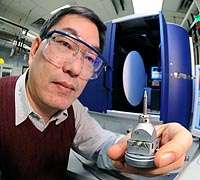
Materials engineer Duck Young Chung examines a sample of superconducting crystals before characterizing them in a X-ray diffractometer. The crystals signify the next generation of experiments utilizing neutron scattering to determine unconventional superconductivity.

(PhysOrg.com) -- Scientists at U.S. Department of Energy's Argonne National Laboratory used inelastic neutron scattering to show that superconductivity in a new family of iron arsenide superconductors cannot be explained by conventional theories.

"The normal techniques for revealing unconventional superconductivity don't work with these compounds," physicist Ray Osborn said. "Inelastic neutron scattering is so far the only technique that does."

Conventional superconductivity can be explained by a theory developed by Bardeen, Cooper and Schrieffer (BCS) in 1957. In BCS theory, electrons in a superconductor combine to form pairs, called Cooper pairs, which are able to move through the crystal lattice without resistance when an electric voltage is applied. Even when the voltage is removed, the current continues to flow indefinitely, the most remarkable property of superconductivity, and one that explains the keen interest in their technological potential.

Normally, electrons repel each other because of their similar charge, but, in superconductors, they coordinate with vibrations of the crystal lattice to overcome this repulsion. But scientists don't believe the vibrational mechanism in the iron arsenides is strong enough to make them superconducting. This has led theorists to propose that this superconductivity has an unconventional mechanism, perhaps like high-temperature copper-oxide superconductors. Some iron arsenides are antiferromagnetic, rather than superconducting, so magnetism rather than atomic vibrations might provide the electron glue.

In BCS superconductors, the energy gap between the superconducting and normal electronic states is constant, but in unconventional superconductors the gap varies with the direction the electrons are moving. In some directions, the gap may be zero. The puzzle is that the gap does not seem to vary with direction in the iron arsenides. Theorists have argued that, while the size of the gap shows no directional dependence in these new compounds, the sign of the gap is opposite for different electronic states. The standard techniques to measure the gap, such as photoemission, are not sensitive to this change in sign.

But inelastic neutron scattering is sensitive. Osborn, along with Argonne physicist Stephan Rosenkranz, led an international collaboration to perform neutron experiments using samples of the new compounds made in Argonne's Materials Science Division, and discovered a magnetic excitation in the superconducting state that can only exist if the energy gap changes sign from one electron orbital to another.

"Our results suggest that the mechanism that makes electrons pair together could be provided by antiferromagnetic fluctuations rather than lattice vibrations," Rosenkranz said. "It certainly gives direct evidence that the superconductivity is unconventional."

Inelastic neutron scattering continues to be an important tool in identifying unconventional superconductivity, not only in the iron arsenides, but also in new families of superconductors that may be discovered in the future.

A paper ("Unconventional superconductivity in Ba0.6K0.4Fe2As2 from inelastic neutron scattering") on Osborn's and Rosenkranz's work has been published in volume 456, pages 930-932, of Nature. Funding for this research was provided by the U.S. Department of Energy, Office of Science, Office of Basic Energy Sciences.

Provided by Argonne National Laboratory


print this article email this article download pdf blog this article bookmark this article     Stumble it Digg this share on Facebook retweet share on Reddit add to delicious
Rate this story - 4.8 /5 (13 votes)

Rank Filter

Move the slider to adjust rank threshold, so that you can hide some of the comments.


Display comments: newest first

  • Nartoon - Jan 09, 2009
    • Rank: not rated yet
    That's all very nice, but what temperature does this effect occur at?
  • Alexa - Jan 10, 2009
    • Rank: not rated yet
    Ba0.6K0.4Fe2As2 becomes a superconductor below 38K Is it cool, doesn't it?
  • Alexa - Jan 14, 2009
    • Rank: not rated yet
    so magnetism rather than atomic vibrations might provide the electron glue
    These electrons are attracted and compressed by presence of holes, i.e. by the atoms with prevailing positive charge. It's similar to situation, when you throw a gold coins into crowd - the people are attracted by money by long-distance interactions, so they will press round it, occasionally fighting each other here. The chaotic motion near holes converts Fermi fluid of electrons into superfluid in analogy to other high pressure superconductivity/supersolidity phenomena:

    http://aetherwave...ity.html

    The question rather is, why such mechanism in arsenides still differs slightly from one in cuprates, whose superconductivity band exhibits s-wave symmetry, having zero orbital angular momentum. The copper ions contains most of free electrons in s-orbitals, while the iron ions are utilizing spin coupled d-orbitals of lower symmetry degree.

    The BSC theory isn't still out of game completelly - it just applies onto pairs of spin entangled electron clusters instead of individual particle pairs, i.e. Cooper pairs are condensing into boson superfluid due the internal pressure of atom lattice.

January 9, 2009 all stories

Comments: 3

4.8 /5 (13 votes)
  • Stumble this up

  • Digg this

  • share this

  • hide
  • Related Stories

  • Puzzled Physicists Solve Decade-Long Discrepancies
    created Oct 09, 2009 | popularity not rated yet | comments 0
  • Magnetic Measurements Question Assumptions About High-Tc Superconductors
    created Aug 03, 2009 | popularity not rated yet | comments 0
  • Nanotechnologists Gain Powerful New Materials Probe
    created Feb 25, 2009 | popularity not rated yet | comments 0
  • Iron-based Materials May Unlock Superconductivity's Secrets
    created Nov 13, 2008 | popularity not rated yet | comments 0
  • Physicists report novel interaction between superconductivity and magnetism
    created Jan 11, 2008 | popularity not rated yet | comments 0


  • hide
  • Relevant PhysicsForums posts

Other News

Restored machine to explore mysteries of Big Bang (AP)

Restored machine to explore mysteries of Big Bang

Physics / General Physics

created 21 hours ago | popularity 4.5 / 5 (15) | comments 10

(AP) -- Scientists are preparing the world's largest atom smasher to explore the depths of matter after successfully restarting the $10 billion machine following more than a year of repairs.


nuclear power plant

Doubts raised on nuclear industry viability

Physics / General Physics

created Nov 19, 2009 | popularity 3.1 / 5 (20) | comments 19

(PhysOrg.com) -- The investment in nuclear power has been growing around the world over the last few years, being viewed as a means for countries to control their energy security, avoid the price fluctuations ...


Researchers Find Innate Correlations Among Different Power Law Phenomena

Researchers Find Innate Correlations Among Different Power Law Phenomena

Physics / General Physics

created Nov 17, 2009 | popularity 4.3 / 5 (15) | comments 14

(PhysOrg.com) -- Studying the patterns that emerge in natural and social phenomena is a popular area of research, although usually individual phenomena are studied separately from each other. In a recent study, ...


Scientists demonstrate 'universal' programmable quantum processor

Scientists demonstrate 'universal' programmable quantum processor

Physics / Quantum Physics

created Nov 15, 2009 | popularity 4.6 / 5 (21) | comments 11

Physicists at the National Institute of Standards and Technology have demonstrated the first "universal" programmable quantum information processor able to run any program allowed by quantum mechanics -- th ...


Proton's party pals may alter its internal structure

Proton's party pals may alter its internal structure

Physics / General Physics

created Nov 18, 2009 | popularity 4.6 / 5 (20) | comments 9

A recent experiment at the DOE's Thomas Jefferson National Accelerator Facility has found that a proton's nearest neighbors in the nucleus of the atom may modify the proton's internal structure.