Nose-Spray Vaccine Against Botulism Effective in Early Tests
(PhysOrg.com) -- A preclinical study found a new nasal spray vaccine to provide complete protection against a major botulism toxin, according to a study published today in the Nature journal Gene Therapy.
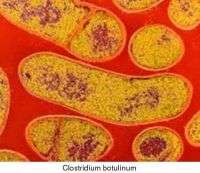
Botulism is caused by a bacterium, Clostridium botulinum, which produces toxins that cause paralysis and often death, as the muscles that control breathing fail. Out of an average of 145 U.S. cases each year, 65 percent are infant botulism (infants’ intestines, unlike adults, are vulnerable to spore-containing dust), 20 percent are wound botulism (bacteria colonizes the wounds of severely injured patients) and about 15 percent are food-borne (improperly stored food can harbor C. botulinum), according to the U.S. Centers for Disease Control and Prevention (CDC). Botulinum neurotoxins (BoNTs) have been designated Category A bioterrorism agents that pose a high risk to national security because they are deadly, easily prepared and could conceivably be spread by inhalation.
Researchers are working to design a botulism vaccine that adds a second layer of immune protection against exposure to BoNTs. When complete, it would prime the disease-fighting cells in mucous membranes lining the nose, those most likely to be exposed first, along with those in the blood. Standard vaccines, given by injection, prepare only the blood-based immune system to fight a given disease. Secondly, the hope is that a new, well-defined subunit vaccine will enable authorities to provide an effective vaccine without having to mass-produce the actual toxin, the hazardous first step in the manufacture of the current, stockpiled vaccine.
“In this study, we found that our vaccine could provide complete protection in one dose against one of the seven BoNTs, which strongly suggests that the same platform could be applied to build a multi-component vaccine against the remaining six,” said Mingtao Zeng, Ph.D., assistant professor within Department of Microbiology & Immunology at the University of Rochester Medical Center, principal investigator and corresponding author of the study. “With these findings, we believe the design of a safe and inexpensive subunit vaccine can now proceed rapidly.”
The study was in mice, but much of the evidence behind the current experimental vaccine was collected in animals as well. In a challenge common to many lines of vaccine research, it is “obviously unethical to test botulism vaccines in humans using the real pathogen.”
Dangerous To Make
Without causing an actual infection, vaccines introduce weakened or detoxified versions of disease-related proteins to the immune system, which remembers to destroy them upon their next encounter.
Once researchers confirm the kind of immune response needed to achieve protection, they can choose for inclusion in a multi-component vaccine the key antigenic proteins that trigger the strongest immune response. The immune system reacts, not to the presence of a whole bacterium, but instead to specific proteins residing on its surface, or secreted by it, and which reveal its nature as an invader.
There is currently no licensed vaccine for protection against botulism. The U.S. Food and Drug Administration has authorized the manufacture of an experimental, injectable vaccine consisting of detoxified versions of five types of BoNTs (serotype A, B, C, D, and E). The first step in its manufacture is to produce massive amounts of active toxins that are extremely dangerous to handle, adding greatly to cost and slowing the process.
Subunit vaccines like the one in the current study include nontoxic proteins that resemble those created by the bacteria, making them much safer to work with. A specific end-piece protein called heavy chain 50-kDa fragment (Hc50) has been identified as part of the mechanism that enables BoNT/C to enter the bloodstream. Once there, the toxin locks onto nerve endings in the brain and extremities, inhibiting their ability to releaseof the neurotransmitter acetylcholine and causing paralysis. In an important 1995 discovery, John Middlebrook, Ph.D., of the U.S. Army Medical Research Institute of Infectious Diseases (USAMRIID), found that Hc50 fragment of BoNTs, unlike the whole toxin used in the current vaccine, are not toxic when detached from the rest of the toxin, but still bring about the desired immune response.
To insert Hc50 and prime the immune system against it, researchers took a page from gene therapy, which uses disabled viruses as delivery vehicles into cells. Viruses are precision-designed by nature to invade cells and deliver therapeutic genes, and can do so safely once the viruses' own reproductive genes have been removed. Past studies have shown that adenoviruses expressing protein antigens can be delivered by the mucosal route. In addition, adenoviruses can be quickly and inexpensively mass produced, making them an attractive platform for researchers currently developing vaccines against HIV, bird flu, tuberculosis and anthrax, as well as against BoNTs. Zeng and colleagues are currently testing a nasal anthrax vaccine as well.
In the current study, the team used the virus to deliver BoNT/C Hc50 as a mucosal vaccine against botulism in a mouse model. A single dose of intranasal inoculation (nose spray) of the adenovirus vector brought about a high level of HC50-specific immune response as early as two weeks after vaccination.The response consisted of the activation of antibodies, immune cells in both mice and humans that attach to bacterial proteins like BoNTs to shut down their toxic effect. Antibodies classes start with the "Ig" prefix standing for immunoglobulin, another name for antibody, and the specific response to vaccine in the current study consisted of IgG, IgG1, and IgG2a activation in the blood and IgA activation in mucous membranes.
In mice injected with lethal doses of BoNT/C toxin, all mice (8/8, or 100 percent) that received larger dose (2 × 10⁷ pfu) of the BoNT/C-HC50 vaccine had survived by seven weeks after toxin challenge with no botulism symptoms, whereas none of the mice that received vector control without Hc50 survived. The protective immunity in mice could last for seven months after vaccination, researchers said.
Along with Zeng, the work was led in Rochester by Qingfu Xu, DVM, Ph.D., an instructor in the Department of Microbiology and Immunology at the University of Rochester School of Medicine and Dentistry. Lance Simpson, Ph.D., director of Center for Research on Bioterrorism and Biodefense at Thomas Jefferson University, Leonard Smith, Ph.D., chief of the Department of Molecular Biology, Integrated Toxicology Division at USAMRIID and Michael Pichichero, M.D., a partner at Legacy Pediatrics in Rochester, N.Y., were major contributors as well. The work was supported by the National Institute of Allergy and Infectious Diseases.
“We have demonstrated for the first time that a single, intranasal vaccination of an adenovirus-based vector encoding a humanized HC 50 of BoNT/C can provide full protection in vaccinated mice against botulinum neurotoxin type C,” Zeng said. “We look forward to finalizing a vaccine, the most likely candidates for which would be active military and emergency responding personnel in forward areas.”
Provided by University of Rochester


