Researchers Unlock Molecular Origin of Blood Stem Cells
January 9th, 2009 Researchers Unlock Molecular Origin of Blood Stem Cells

Enlarge

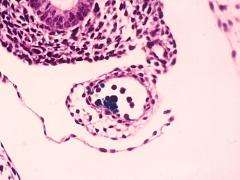
During development, a small number of endothelial cells express Runx1 (blue cells), signaling the production of grapelike clusters of hematopoietic (or blood) stem cells along the interior walls of several major blood vessels in the mouse embryo. This cluster of endothelial cells is in the lumen of the vitelline artery. Credit: Nancy Speck, PhD, University of Pennsylvania School of Medicine

(PhysOrg.com) -- A research team led by Nancy Speck, PhD, Professor of Cell and Developmental Biology at the University of Pennsylvania School of Medicine, has identified the location and developmental timeline in which a majority of bone marrow stem cells form in the mouse embryo. The findings, appearing online this week in the journal Nature, highlight critical steps in the origin of hematopoietic (or blood) stem cells (HSCs), says senior author Speck, who is also an Investigator with the Abramson Family Cancer Research Institute at Penn.

Because HSCs, found in the bone marrow of adult mammals, generate all of the blood cell types of the body, unlocking the secrets of their origin may help researchers to better manipulate embryonic stem cells to generate new blood cells for therapy.

“The ultimate goal for stem cell therapies is to take embryonic stem cells and push them down a particular lineage to replace diseased or dead cells in human adults or children,” says Speck. For instance, in theory embryonic stem cells could be tweaked in a lab to provide a patient with bone marrow failure a fresh supply of compatible HSCs.

To date, however, Speck says scientists have been unable to coax embryonic stem cells to become HSCs without significant genetic manipulations that are too risky for clinical therapies. First things first, Speck says: “You have to understand what's happening in the embryo.”

Previous studies hinted that HSCs originated from a small population of cells lining the blood vessels, called endothelial cells. But, it was unclear how endothelial cells transitioned to blood stem cells during early development.

Before joining Penn in September 2008, Speck, then at Dartmouth Medical School, led a team that confirmed that HSCs in bone marrow were originating from the endothelial cells and determined whether the activity of a protein called Runx1, which is known to be critical in the formation of blood cells, was responsible for this important transition.

First, the researchers inactivated the gene that codes for the protein Runx1 in the endothelial cells of mouse embryos. During development, some endothelial cells express Runx1, signaling the production of grapelike clusters of HSCs along the interior walls of several major blood vessels. Upon release from the vessel walls HSCs enter the blood circulation and travel to the fetal liver, and upon birth they relocate to the bone marrow.

By selectively blocking the ability of endothelial cells to express Runx1 during embryo development, the researchers halted HSC production, demonstrating that Runx1 is vital to the endothelial cell to HSC transition.

Next, Speck’s team shut off Runx1 expression in mouse embryos at day 11.5 of gestation -- a time when most newly born HSCs have detached from the vessel wall and migrated to the fetal liver. The researchers found that blocking Runx1 expression had no effect on HSC formation, suggesting while Runx1 is required for the transition from endothelium to HSCs, the process is complete by the end of the 11th day of gestation.

The researchers also showed that at least 95 percent of all adult HSCs (and therefore almost all adult blood) originate in the endothelium, during this short window of time during development.

“This study helps illustrate a very important step in the transitional stage from embryonic stem cells to HSCs - the need to move through endothelial cells as an intermediary,” Speck says.

Understanding the location and developmental timeline of the origin of blood stem cells will help guide future efforts to coax embryonic stem cells to produce mature blood cells, she says.

Co-authors include Michael Chen and Brandon Zeigler from Dartmouth Medical School (Departments of Biochemistry and Genetics) and Tomomasa Yokomizo and Elaine Dzierzak from Erasmus Medical Center in Rotterdam, Netherlands.

Provided by University of Pennsylvania


print this article email this article download pdf blog this article bookmark this article     Digg this Stumble it share on Facebook share on Reddit add to delicious save to Yahoo! bookmarks
5/5 after 4 votes

Rank Filter

Move the slider to adjust rank threshold, so that you can hide some of the comments.


Display comments: newest first

  • morpheus2012 - Jan 09, 2009
    • Rank: not rated yet
    great moving like snail in research doe

    but still ok

January 9th, 2009 all stories
Biology /

Comments: 1
Rank: 5/5 after 4 votes

  • Stumble this up

  • Digg this

  • Share it:
  • share on Facebook
  • share on MySpace
  • share on Slashdot
  • rss-newsfeed
  • share on Google
  • share on Reddit
  • add to delicious
  • save to Yahoo! bookmarks
  • share on Windows Live
  • Add to Mixx!
Rating: 5/5 after 4 votes

  • Related Stories

  • Safer stem cells for therapy
    created Jun 29, 2009 | popularity not rated yet | comments 0
  • Researchers edit genes in human stem cells
    created Jun 18, 2009 | popularity not rated yet | comments 0
  • Stem cell protein offers a new cancer target
    created Jun 01, 2009 | popularity not rated yet | comments 0
  • Gene therapy could expand stem cells' promise
    created May 21, 2009 | popularity not rated yet | comments 0
  • Stem Cell Research Made Safer with Latest Discovery
    created May 15, 2009 | popularity not rated yet | comments 0


  • Physicists Demonstrate Quantum Memory with Matter Qubits
    Physicists Demonstrate Quantum Memory with Matter Qubits
    Physics / General Physics
    created Jul 03, 2009 | popularity 4.4 / 5 (17) | comments 1
  • 'Holey' Nanosheets for Wastewater Dye Removal
    Nanotechnology / Nanomaterials
    created Jul 01, 2009 | popularity 5 / 5 (5) | comments 1
  • Jellyfish Robot Swims Like its Biological Counterpart
    Jellyfish Robot Swims Like its Biological Counterpart
    Electronics / Robotics
    created Jun 26, 2009 | popularity 4.4 / 5 (8) | comments 1
  • Could Maxwell's Demon Exist in Nanoscale Systems?
    Could Maxwell's Demon Exist in Nanoscale Systems?
    Physics / General Physics
    created Jun 24, 2009 | popularity 4.4 / 5 (18) | comments 29
  • Living Safely with Robots, Beyond Asimov's Laws
    Living Safely with Robots, Beyond Asimov's Laws
    Electronics / Robotics
    created Jun 22, 2009 | popularity 4.6 / 5 (53) | comments 40
  • Other News

    Battle of the sexes benefits offspring, says research

    Battle of the sexes benefits offspring, says research

    Biology / Plants & Animals

    created 44 minutes ago | popularity not rated yet | comments 0

    Parents compensate for a lazy partner by working harder to bring up their offspring, but not enough to completely make up for the lack of parenting, says research by bird biologists at the University of Bath.


    Researchers uncover the potential for super-sized abalone

    Biology / Microbiology

    created 4 hours ago | popularity not rated yet | comments 0

    (PhysOrg.com) -- Designer abalone could be an option in the foreseeable future, thanks to a project conducted at UQ's Heron Island Research Station and the St Lucia campus.


    Scientists 'rebuild' giant moa using ancient DNA

    Biology / Plants & Animals

    created Jul 01, 2009 | popularity 5 / 5 (10) | comments 12

    (PhysOrg.com) -- Scientists have performed the first DNA-based reconstruction of the giant extinct moa bird, using prehistoric feathers recovered from caves and rock shelters in New Zealand.


    Pacific Giant Salamander (Dicamptodon tenebrosus)

    Salamanders, regenerative wonders, heal like mammals, people

    Biology / Microbiology

    created Jul 01, 2009 | popularity 5 / 5 (20) | comments 11

    The salamander is a superhero of regeneration, able to replace lost limbs, damaged lungs, sliced spinal cord -- even bits of lopped-off brain. But it turns out that remarkable ability isn't so mysterious after ...


    California water plan aims to save Puget Sound orcas

    Biology / Ecology

    created 20 hours ago | popularity 4 / 5 (1) | comments 0

    A plan to restore salmon runs on California's Sacramento River also could help revive killer whale populations 700 miles to the north in Puget Sound, as federal scientists struggle to protect endangered species in a complex ...