Hydrocarbon afterglow reveals reproductive cheaters
(PhysOrg.com) -- An ‘honest indicator’ has been discovered by a scientific team at Arizona State University that reveals reproductive cheating. But before you run out to buy an infidelity identification kit, know that it only works for ants.
While it’s well-known that workers in ant colonies typically support one reproductive female - a queen, it turns out that cheating can be a problem, and not just for humans. Cheating is found in all sorts of animal and insect groups, including other highly organized social organisms, such as ants.
Humans cheat on their partners roughly 15-18 percent of the time (according to scientific studies), however, worker ants that stray from acceptable celibate social norms rarely, if ever, are successful. Cheaters are actively weeded out by other workers, and brought back into line, through a process called policing.
How can workers in an ant colony, with hundreds to thousands of sister-workers around them, locate one cheater in an ant hill?
Through fertility hydrocarbons, says Jürgen Liebig, an assistant professor in the School of Life Sciences and member of the Center for Social Dynamic and Complexity in ASU’s College of Liberal Arts and Sciences.
According to research findings published in the journal Current Biology on Jan. 8, hydrocarbons on the outside cuticle of fertile ants form “a particular chemical signature blend.” A cocktail that an ant apparently can’t deny, cover up, or lie about and which brands a cheater much like the red “A” on the bosom of Hester Prynne in Nathaniel Hawthorne’s “The Scarlet Letter.”
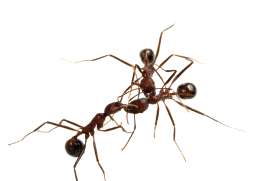
Social insects, such as ants, bees and wasps, rely heavily on chemical signals to communicate. While earlier studies indicated that chemical signatures are associated with fertility, it was ASU doctoral student Adrian Smith’s studies with Aphaenogaster cockerelli worker ants that established that these chemical signatures are what allow workers to locate and police cheaters. To do this, Smith painted a non-fertile (non-cheating) worker with a potent pentocosane (hydrocarbon), making her a reproductive mimic. When Smith placed the ant back within her colony, fellow workers sniffed out the “cheater,” biting and attacking her.
“While we knew for some time that fertility status in ants was correlated with particular blends of hydrocarbons on the surface of the cuticle, no one was able to demonstrate that this hydrocarbon blend served as an indicator of fertility status to other nest mates,” says ASU’s Bert Hölldobler, Pulitzer Prize winning author of “The Ants,” coauthored with Harvard Professor Emeritus Edward O. Wilson.
A second set of experiments, confirmed the group’s findings. In an ant colony that lacked a queen, and in which some workers were reproducing, colony members had no aggressive response to the chemically altered, fake fertiles.
“This discovery is strong evidence that these hydrocarbons are ‘honest indicators,’ meaning their expression on the cuticle is intimately coupled with the physiological processes that regulate fertility status,” says Hölldobler, a professor in ASU’s School of Life Sciences.
Fertility is signaled through hydrocarbon signatures on both the eggs and the cuticle of a worker ant. An A. cockerelli worker ant’s egg has the same fertility signal as the queen.
According to Smith, these hydrocarbons serve as a red-flag to other workers, announcing: “This one is capable of laying viable eggs.” Since egg surface hydrocarbons and cuticular hydrocarbons are physiologically linked, a change in one results in a change in the other.
Why are the hydrocarbons then especially suited to prevent reproductive cheating? Research shows that the chemicals don’t lie and worker ants cannot eliminate them to escape detection.
In order to be successful cheats, reproductive workers need to escape being identified. Yet, they still need to assure that their eggs escape detection. Hiding their eggs in plain sight, amongst those of the queen, would be the easiest solution. However, to achieve this, the worker’s eggs would need to express the fertility signal, like those of the queen.
“The dilemma is that if you do not produce the fertility signal on the cuticle you can escape detection, but if you don’t produce it on the egg, it won’t escape detection,” Liebig explains. “This seems to make cheating impossible, since they cannot solve both problems at the same time.”
The idea that ant colonies stabilize their social structure by maintaining a system for punishing miscreants, with a built-in mechanism for reliably identifying individuals as cheaters, is where work such as Smith, Hölldobler and Liebig’s finds application in other systems.
All animal societies share the common problem of individuals exploiting group resources for personal gain at a cost to the group. Smith points out that trying to understand how ant societies deal with this problem “gives us a basis for looking into the mechanisms used by other successful societies.”
“This paper opens a new window in our understanding of the social regulation and evolution of reproductive division of labor, a key trait in eusocial insects,” adds Hölldobler. In addition to this collaborative work, which will be highlighted in the journal Nature, Hölldobler’s nearly half-century study of insect societies has created a proliferation in many new areas of discovery. A book will be released in his honor by Harvard Press in February 2009, “Organization of Insect Societies: From Genome to Sociocomplexity.”
Provided by ASU


