Squashing Silane into Metal
January 9, 2009 by Kendra Snyder Squashing Silane into Metal

Enlarge

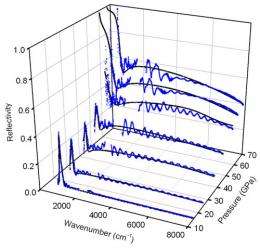
Room-temperature infrared reflectivity spectra of SiH4 at selected pressures up to 67.2 GPa. The blue squares are the measurement results. The solid lines represent model fits to the data. The small gap in the spectrum near 2000 cm-1 is due to diamond anvil absorption.

(PhysOrg.com) -- Squeeze it hard enough and hydrogen, the most abundant and lightest element in our Universe, strangely takes on a metallic nature. During this state, as it loses hold of its electrons, hydrogen is believed to display unique characteristics including high-temperature superconductivity and properties that could be useful in developing new methods of energy production using nuclear fusion and alternative fuels. Creating this drastic phase change, however, is difficult, requiring extremely high temperatures and pressures.

As a result, efforts to actually form and detect solid metallic hydrogen have been elusive. Recently, though, a team of researchers from the Carnegie Institution of Washington, South China University of Technology, and the University of Western Ontario, used the NSLS to study silane, a hydrogen-rich compound, to learn more about the leader of the period table.

“Recent studies have suggested that the metallization pressure of group IVa hydrides like methane, silane, and germane might not be not as high as it is for pure hydrogen,” said Xiaojia Chen, a physicist at the Carnegie Institution of Washington and South China University of Technology. “We thought silane would be good system to study in order to get a look at this phase transition at a pressure at which it’s easier to confirm the material’s changes.”

Most scientists believe that the recipe for creating metallic hydrogen involves heating it to 3000 degrees Kelvin (a little hotter than 2,700 degrees Celsius) and exposing it to about 1.4 million atmospheres of pressure (140 GPa). By comparison, the pressure inside the core of the Earth is 380 GPa. These conditions, however, are very difficult to reach and record in a laboratory.

Using two silane samples, the researchers found far less demanding pressure requirements for metallization: about 60 GPa. Their experiment offers the first example for the metallization of an IVa hydride. Members of this periodic group contain hydrogen that is already compressed in naturally occurring compounds.

In order to conduct the experiment, the researchers placed their silane samples in a special apparatus called a diamond anvil cell, a device that uses the polished faces of two diamonds to apply extremely high pressure. By applying a range of pressures and measuring the results through infrared reflectivity experiments at beamline U2A, the group found that silane undergoes three phase transitions before becoming opaque at 27-30 GPa. Above 60 GPa, the material shows an increase in reflectivity, indicating pressure-induced metallization.

Their results were published in the January 8, 2008 edition of the Proceedings of the National Academy of Sciences and confirmed by a group using electronic resistance measurements later that year.

Next, the researchers want to investigate the pressure dependence of the superconducting transition temperature of metallic silane and its structure at high pressure. They also hope to study the properties of another compound, germane, which is predicted to switch to a metallic state at even lower pressures than silane.

“There’s great interest in these materials in terms of energy applications and in trying to better understand many planets,” Chen said. “Some planets are mostly made of hydrogen in a very pressurized state just like what we make at the synchrotron. Understanding how this element functions in such an extreme condition could have a wide variety of implications.”

Other authors involved in the study include Muhtar Ahart, Alexander Goncharov, Russell Hemley, Zhenxian Liu, Ho-kwang Mao, and Viktor V. Struzhkin, all from the Carnegie Institution of Washington, and Yang Song, from Carnegie and the University of Western Ontario.

Publication: X. Chen, V. Struzhkin, Y. Song, A. Goncharov, M. Ahart, Z. Liu, H. Mao, R. Hemley, "Pressure-Induced Metallization of Silane", Proc Natl Acad Sci, 105(1), 20-23 (2008).

Provided by NSLS


print this article email this article download pdf blog this article bookmark this article     Stumble it Digg this share on Facebook retweet share on Reddit add to delicious
Rate this story - 4.7 /5 (19 votes)

Rank Filter

Move the slider to adjust rank threshold, so that you can hide some of the comments.


Display comments: newest first

  • LuckyBrandon - Jan 10, 2009
    • Rank: 5 / 5 (1)
    sweet so lets squeeze a bunch together and make us a new spaceship :)
  • Alexa - Jan 10, 2009
    • Rank: not rated yet
    it's much easier to squeeze a free electrons, then some poor silane..

    http://aetherwave...ity.html
  • theophys - Jan 10, 2009
    • Rank: not rated yet
    I think I remember an astronomy prof. saying that hydrogen near Jupiter's center is so condensed that it akes on metallic properties. Then he blew up a soda can for some reason. anyway, we could probably learn more about how mettalic hydrogen behaves in nature if we build a telescope that can get a lot of data from under all those clouds.
  • Alexa - Jan 10, 2009
    • Rank: not rated yet
    You cannot watch the metallic hydrogen by using of telescopes so easily, just because its formation requres a thick layer of nonmetallic hydrogen to compress it. In these experiment the thick layer hydrogen clouds was just replaced by thin and transparent layer of diamond anvil to be observed easier.
  • theophys - Jan 10, 2009
    • Rank: not rated yet
    Ignoring the financial issues, i don't see any reason why we couldn't send a little sattelite to go snoop around Jupiter.
  • Alexa - Jan 11, 2009
    • Rank: not rated yet
    You should dive such sattelite a few thousands of kilometers beneath Jupiter surface to study metallic hydrogen directly. And you cannot change conditions indirectly during this. You cannot measure spectra and NMR and neutron scattering.., etc.
  • theophys - Jan 11, 2009
    • Rank: not rated yet
    Diving a satellite into Jupiter's mass of turbulent gasses is a bad idea. What we could do is have probe device. Something very small, yet very durable. It could go down, take measurements and recordings directly, and then report back to the satellite. The sattelite would then beam all the information back to us on Earth, NASA would throw a little party and everyone would go home happy.
  • Alexa - Jan 11, 2009
    • Rank: not rated yet
    Silane experiments are motivated by preparation of room temperature superconductors, i.e. by much more practical target, then the understanding of Jupiter atmosphere.
  • theophys - Jan 11, 2009
    • Rank: not rated yet
    Well, I think it would be beneficial to see how it acts in nature. Of course, I'm a geek who gets all giddy inside whenever we send things to space and even more excited when we discover stuff in space. I'm a little biased toward exploring Jupiter a little more.
  • lomed - Jan 12, 2009
    • Rank: not rated yet
    Probes have been sent and dropped into Jupiter. The Galileo spacecraft studied the Jupiter system and dropped a probe into Jupiter before being de-orbited into Jupiter. The first link is to the wikipedia article about the Galileo mission, the second is to a graphic about the descent of the probe.

    http://en.wikiped...cecraft)

    http://en.wikiped...robe.jpg

    Of course, it would be nice to send a probe that could withstand extreme pressure. However, high-pressure probes (specifically, the materials necessary to withstand high pressure) tend to weigh a lot. Since a heavy spacecraft costs a lot to launch, it seems like a lot of money to spend on a piece of a spacecraft that is inevitably going to burn up after at most a few hours of data taking (assuming all goes well.)
  • maxmc - Jan 14, 2009
    • Rank: not rated yet
    Jupiter, ha! Is anyone here thinking about that fat ball of fire in the sky? Yeah the sun, the core of that beast probably easily soars into tetrapascals and don't get me started of temerature. Does this mean our sun has a metallic core? Or am I so stupid that this is already in textbooks.
  • theophys - Jan 16, 2009
    • Rank: not rated yet
    Jupiter, ha! Is anyone here thinking about that fat ball of fire in the sky? Yeah the sun, the core of that beast probably easily soars into tetrapascals and don't get me started of temerature. Does this mean our sun has a metallic core? Or am I so stupid that this is already in textbooks.

    The sun is too hot for a solid metal core. But, since the sun is mostly made up of hydrogen,which is a metal, i suppsoe the sun is in fact mostly metal.

January 9, 2009 all stories

Comments: 12

4.7 /5 (19 votes)
  • Stumble this up

  • Digg this

  • share this

  • hide
  • Related Stories


  • hide
  • Relevant PhysicsForums posts

  • Ionization vs. photo-generation - what is the difference?
    created 18 hours ago
  • Ising model
    created Nov 24, 2009
  • Photon replica
    created Nov 24, 2009
  • Planck's Radiation Law and Stefan's Law
    created Nov 24, 2009
  • More from Physics Forums - Atomic, Solid State, Comp. Physics

Other News

Bacteria

Plasma produces KO cocktail for MRSA

Physics / General Physics

created 1hour ago | popularity 5 / 5 (2) | comments 0

MRSA (methicillin-resistant Staphylococcus Aureus) and other drug-resistant bacteria could face annihilation as low-temperature plasma prototype devices have been developed to offer safe, quick, easy and un ...


Scientists react as they stand in front of a screen at CERN

First atoms reported smashed in Large Hadron Collider (Update)

Physics / General Physics

created Nov 23, 2009 | popularity 4.5 / 5 (30) | comments 21

Two circulating beams on Monday produced the first particle collisions in the world's biggest atom smasher, the Large Hadron Collider (LHC), three days after its restart, scientists announced.


Restored machine to explore mysteries of Big Bang (AP)

Restored machine to explore mysteries of Big Bang

Physics / General Physics

created Nov 21, 2009 | popularity 4.6 / 5 (18) | comments 26

(AP) -- Scientists are preparing the world's largest atom smasher to explore the depths of matter after successfully restarting the $10 billion machine following more than a year of repairs.


nuclear power plant

Doubts raised on nuclear industry viability

Physics / General Physics

created Nov 19, 2009 | popularity 3 / 5 (22) | comments 19

(PhysOrg.com) -- The investment in nuclear power has been growing around the world over the last few years, being viewed as a means for countries to control their energy security, avoid the price fluctuations ...


In the Brain, Seven Is A Magic Number

In the Brain, Seven Is A Magic Number

Physics / General Physics

created Nov 23, 2009 | popularity 4.5 / 5 (33) | comments 9

Having a tough time recalling a phone number someone spoke a few minutes ago or forgetting items from a mental grocery list is not a sign of mental decline; in fact, it's natural.