Researchers First to 'See' Reactive Oxygen Species in Vital Enzyme
January 10, 2009
Researchers First to 'See' Reactive Oxygen Species in Vital Enzyme

Enlarge

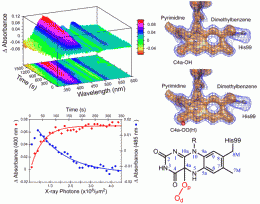
Two complementary types of data collected from the same crystal provide compelling evidence for the trapped reactive oxygen intermediate in choline oxidase. On the left are the spectroscopic changes observed in a single crystal of choline oxidase upon x-ray exposure at low temperature. It shows that the sample rapidly changes upon irradiation to x-rays. On the right are the unbiased 1.8 angstrom resolution electron density maps and the resulting interpretation of the atomic structures for the two possible reactive oxygen species. The electronic and atomic structures correlate almost perfectly within the crystal. In the absence of either part of the complementary experimental data, the interpretation of the results would have remained much more speculative.

(PhysOrg.com) -- Using two simultaneous light-based probing techniques at the U.S. Department of Energy's (DOE) Brookhaven National Laboratory, a team of researchers has illuminated important details about a class of enzymes involved in everything from photosynthesis to the regulation of biological clocks.

The interdisciplinary team has a broad interest in flavoproteins, which were first discovered in the 1930s and derive from riboflavin, or vitamin B2. These proteins are now known to catalyze a wide range of biochemical reactions, including those that use molecular oxygen (O2) to help convert food into energy in animals, plants, fungi, and in some types of bacteria - a process known as oxygen activation.

Although scientists have determined more than 1,200 crystal structures of flavoproteins, they've been blind to exactly what oxygen activation looks like within these enzymes. Specifically, researchers have been unable to determine the structure of the flavoprotein's reactive oxygen intermediate, a molecular complex that often forms halfway through important biochemical reactions. These intermediates possess high chemical potential energy, which is necessary to complete many critical but difficult-to-catalyze reactions in biology. Such intermediates typically have a lifetime of only a few milliseconds and are therefore very hard to observe using traditional synchrotron methods.

"Flavoproteins represent one of only a handful of ways that nature activates molecular oxygen, a process that's important for all life on the planet," said Brookhaven biophysicist Allen Orville. "We've determined structures of some oxygen intermediates involved in several important enzymes that assist in this process. But no one has ever seen an oxygen intermediate attached to the flavin. Until now."

As reported in the January 9, 2009, online edition of Biochemistry, Orville and colleagues from Georgia State University, Georgia Institute of Technology, and the University of Miami have used a new facility at Brookhaven's National Synchrotron Light Source (NSLS) to identify two possible oxygen intermediates in the flavoprotein, choline oxidase.

The researchers accomplished their work by combining two popular synchrotron techniques - x-ray diffraction and optical absorption spectroscopy - into one setup. By shining beams of powerful x-rays and visible light on the same region of the crystallized flavoprotein, two different but complementary sets of information are received. This allows the scientists to correlate the electronic structure of the enzyme - which gives details about chemical activities - with its three-dimensional atomic structure.

"The ability to collect multiple types of data from the same sample at the same time is a unique opportunity," Orville said. "It takes less time and it means you never have to move the sample and risk altering it in any way. It also removes many potential ambiguities that either technique alone cannot resolve."

To stabilize the flavoprotein intermediate, the researchers kept it at an extremely low temperature - about -280 degrees Fahrenheit. When exposed to the x-rays, the cold flavoprotein rapidly accepts electrons liberated in the sample by the x-ray beam. This starts the enzyme reaction, which progresses a bit further and then becomes trapped in its reactive intermediate state. Using the combined data, the group identified two possible intermediate structures. Further experiments will help determine which is the true intermediate.

Orville is installing additional complementary techniques at the NSLS. Planning also is underway for several beamlines with multiple complementary techniques at the National Synchrotron Light Source II, a new, proposed Brookhaven facility that will produce x-rays up to 10,000 times brighter than those at the NSLS. The hope is to provide a means for researchers to simultaneously obtain three or four different types of data from one sample.

Source: Brookhaven National Laboratory

Filter


Move the slider to adjust rank threshold, so that you can hide some of the comments.


Display comments: newest first

gmurphy
Jan 10, 2009

Rank: not rated yet
what i've always wondered about is how do these high intensity electromagnetic beams affect the behaviour of the protein constructs?
minorwork
Jan 10, 2009

Rank: not rated yet
I'm certainly not certain.
Rank 4 /5 (1 vote)
Relevant PhysicsForums posts

More news stories

Scientists discover molecular secrets of 2,000-year-old Chinese herbal remedy

For roughly two thousand years, Chinese herbalists have treated Malaria using a root extract, commonly known as Chang Shan, from a type of hydrangea that grows in Tibet and Nepal. More recent studies suggest that halofuginone, ...

Chemistry / Biochemistry

created 5 hours ago | popularity 4.7 / 5 (12) | comments 5 | with audio podcast

New method to examine batteries -- MRI from the inside

There is an ever-increasing need for advanced batteries for portable electronics, such as phones, cameras, and music players, but also to power electric vehicles and to facilitate the distribution and storage of energy derived ...

Chemistry / Analytical Chemistry

created 5 hours ago | popularity 5 / 5 (5) | comments 0 | with audio podcast

Hydrogen from acidic water: Researchers develop potential low cost alternative to platinum for splitting water

A technique for creating a new molecule that structurally and chemically replicates the active part of the widely used industrial catalyst molybdenite has been developed by researchers with the Lawrence Berkeley ...

Chemistry / Materials Science

created Feb 09, 2012 | popularity 4.8 / 5 (16) | comments 21 | with audio podcast

Fool's gold may prove an unlikely alternative to overexploited catalytic materials

Catalytic materials, which lower the energy barriers for chemical reactions, are used in everything from the commercial production of chemicals to catalytic converters in car engines. However, with current catalytic materials ...

Chemistry / Materials Science

created Feb 10, 2012 | popularity 4.4 / 5 (8) | comments 8 | with audio podcast

Research provides octagonal window of opportunity for carbon capture

(PhysOrg.com) -- Filtering carbon dioxide, a greenhouse gas, from factory smokestacks is a necessary, but expensive part of many manufacturing processes. However, a collaborative research team from the National ...

Chemistry / Materials Science

created Feb 08, 2012 | popularity 5 / 5 (2) | comments 5 | with audio podcast


Google might launch Drive for cloud storage soon

(PhysOrg.com) -- Google's next big move, according to the Wall Street Journal, is a cloud storage service called Drive. Hardly first to the plate, Google is simply catching up to introducing its cloud reposi ...

Overeating may double risk of memory loss

New research suggests that consuming between 2,100 and 6,000 calories per day may double the risk of memory loss, or mild cognitive impairment (MCI), among people age 70 and older. The study was released today and will be ...

Injured boomers beware: Know when to see doctor

(AP) -- It happened to nurse Jane Byron years after an in-line skating fall, business owner Haralee Weintraub while doing "men's" push-ups, and avid cyclist Gene Wilberg while lifting a heavy box.

Lab study raises questions over nano-particle impact

Tests involving chickens have raised questions about the impact on health from engineered nano-particles, the ultra-fine grains commonly used in drugs and processed foods, scientists said on Sunday.

A mitosis mystery solved: How chromosomes align perfectly in a dividing cell

Although the process of mitotic cell division has been studied intensely for more than 50 years, Whitehead Institute researchers have only now solved the mystery of how cells correctly align their chromosomes during symmetric ...

Starve a virus, feed a cure? Findings show how some cells protect themselves against HIV

A protein that protects some of our immune cells from the most common and virulent form of HIV works by starving the virus of the molecular building blocks that it needs to replicate, according to research published online ...