Nearly a century later, new findings support Warburg theory of cancer
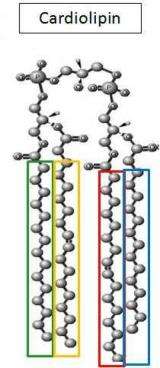
January 12, 2009 Cardiolipin Molecule

Enlarge

Researchers from Boston College and Washington University School of Medicine examined mitochondrial lipids in a diverse group of mouse brain tumors, specifically the complex lipid known as cardiolipin. Their new research, published in the Journal of Lipid Research, contends that cancer could arise from genomic mutations, environmental insults, or from epigenetic (gene-environmental) abnormalities, any of which could damage cardiolipin and ultimately produce irreversible injury to cellular respiration. Credit: Boston College

German scientist Otto H. Warburg's theory on the origin of cancer earned him the Nobel Prize in 1931, but the biochemical basis for his theory remained elusive.

His theory that cancer starts from irreversible injury to cellular respiration eventually fell out of favor amid research pointing to genomic mutations as the cause of uncontrolled cell growth.

Seventy-eight years after Warburg received science's highest honor, researchers from Boston College and Washington University School of Medicine report new evidence in support of the original Warburg Theory of Cancer.

A descendant of German aristocrats, World War I cavalry officer and pioneering biochemist, Warburg first proposed in 1924 that the prime cause of cancer was injury to a cell caused by impairment to a cell's power plant - or energy metabolism - found in its mitochondria.

In contrast to healthy cells, which generate energy by the oxidative breakdown of a simple acid within the mitochondria, tumors and cancer cells generate energy through the non-oxidative breakdown of glucose, a process called glycolysis. Indeed, glycolysis is the biochemical hallmark of most, if not all, types of cancers. Because of this difference between healthy cells and cancer cells, Warburg argued, cancer should be interpreted as a type of mitochondrial disease.

In the years that followed, Warburg's theory inspired controversy and debate as researchers instead found that genetic mutations within cells caused malignant transformation and uncontrolled cell growth. Many researchers argued Warburg's findings really identified the effects, and not the causes, of cancer since no mitochondrial defects could be found that were consistently associated with malignant transformation in cancers.

Boston College biologists and colleagues at Washington University School of Medicine found new evidence to support Warburg's theory by examining mitochondrial lipids in a diverse group of mouse brain tumors, specifically a complex lipid known as cardiolipin (CL). They reported their findings in the December edition of the Journal of Lipid Research.

Abnormalities in cardiolipin can impair mitochondrial function and energy production. Boston College doctoral student Michael Kiebish and Professors Thomas N. Seyfried and Jeffrey Chuang compared the cardiolipin content in normal mouse brain mitochondria with CL content in several types of brain tumors taken from mice. Bioinformatic models were used to compare the lipid characteristics of the normal and the tumor mitochondria samples. Major abnormalities in cardiolipin content or composition were present in all types of tumors and closely associated with significant reductions in energy-generating activities.

The findings were consistent with the pivotal role of cardiolipin in maintaining the structural integrity of a cell's inner mitochondrial membrane, responsible for energy production. The results suggest that cardiolipin abnormalities "can underlie the irreversible respiratory injury in tumors and link mitochondrial lipid defects to the Warburg theory of cancer," according to the co-authors.

These findings can provide insight into new cancer therapies that could exploit the bioenergetic defects of tumor cells without harming normal body cells.

The paper, "Cardiolipin and Electron Transport Chain Abnormalities in Mouse Brain Tumor Mitochondria: Lipidomic Evidence Supporting the Warburg Theory of Cancer," can be viewed at: http://www.jlr.org/cgi/content/full/49/12/2545

Source: Boston College


Rate this story - 4.9 /5 (12 votes)

Rank Filter

Move the slider to adjust rank threshold, so that you can hide some of the comments.


Display comments: newest first

  • E_L_Earnhardt - Jan 13, 2009
    • Rank: not rated yet
    Warburg has his day at last! He was RIGHT in his assumption but early in application. ONLY THE DEVELOPMENT OF THE "COLD PROBE" TO REMOVE ENERGY FROM
    MITOSING CELLS WILL STOP CANCER DEATHS!

January 12, 2009 all stories

Comments: 1

4.9 /5 (12 votes)

  • hide
  • Related Stories

  • Inhibiting serotonin in gut could cure osteoporosis
    created Feb 07, 2010 | popularity not rated yet | comments 0
  • Cancer studies with yeast yield excellent results
    created Feb 03, 2010 | popularity not rated yet | comments 0
  • Antibodies Against Abnormal Glycoproteins Identified as Possible Biomarkers for Cancer Detection
    created Feb 02, 2010 | popularity not rated yet | comments 0
  • Researchers propose novel theory for mammalian stem cell regulation
    created Jan 29, 2010 | popularity not rated yet | comments 0
  • The birth of the biological clock
    created Jan 27, 2010 | popularity not rated yet | comments 0


  • hide
  • Relevant PhysicsForums posts

Other News

IQ among strongest predictors of cardiovascular disease -- second only to cigarette smoking

Medicine & Health / Health

created 4 hours ago | popularity not rated yet | comments 6 | with audio podcast

as reflected by low results on written or oral tests of IQ - have been associated with a raised risk of cardiovascular disease, no study has so far compared the relative strength of this association with other established ...


Communication breakdown: What happens to nerve cells in Parkinson's disease

Medicine & Health / Neuroscience

created 4 hours ago | popularity not rated yet | comments 0 | with audio podcast

A new study from The Montreal Neurological Institute and Hospital - The Neuro - at McGill University is the first to discover a molecular link between Parkinson's disease and defects in the ability of nerve cells to communicate. ...


Whooping cough vaccine may be losing its punch: study

Medicine & Health / Diseases

created 1hour ago | popularity not rated yet | comments 0

(PhysOrg.com) -- Vaccination programs against whooping cough may not be fully effective because the bacteria that cause the disease have evolved new strains, a new study has found. A team of Australian scientists has ...


A common cholesterol drug fights cataracts, too

Medicine & Health / Medications

created 3 hours ago | popularity not rated yet | comments 1

Statins, a class of drugs used to lower cholesterol levels, have been successfully fighting heart disease for years. A new study from Tel Aviv University has now found that the same drugs cut the risks of cataracts in men ...


Changes proposed in how psychiatrists diagnose

Medicine & Health / Psychology & Psychiatry

created 3 hours ago | popularity not rated yet | comments 1

(AP) -- Don't say "mental retardation" - the new term is "intellectual disability." No more diagnoses of Asperger's syndrome - call it a mild version of autism instead. And while "behavioral addictions" will be new to doctors' ...