Giant bird feces records pre-human New Zealand
January 12th, 2009 Giant bird feces records pre-human New Zealand

Giant moa bird. Image courtesy iStockphoto.

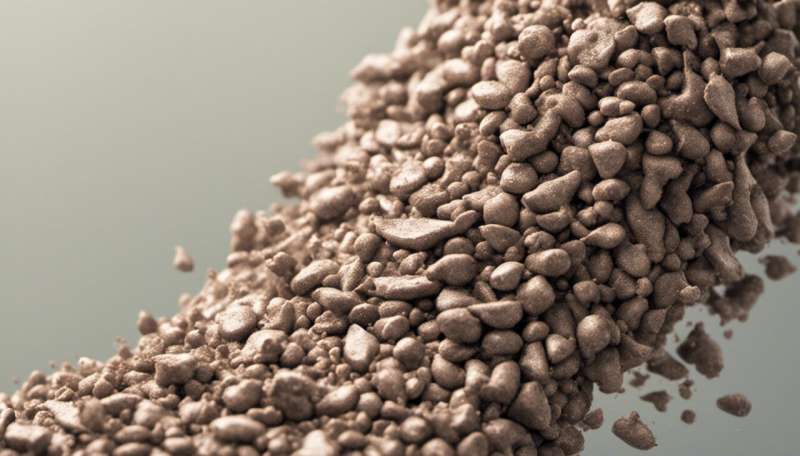
(PhysOrg.com) -- A treasure trove of information about pre-human New Zealand has been found in faeces from giant extinct birds, buried beneath the floor of caves and rock shelters for thousands of years.

A team of ancient DNA and palaeontology researchers from the University of Adelaide, University of Otago and the NZ Department of Conservation have published their analyses of plant seeds, leaf fragments and DNA from the dried faeces (coprolites) to start building the first detailed picture of an ecosystem dominated by giant extinct species.

Former PhD student Jamie Wood, from the University of Otago, discovered more than 1500 coprolites in remote areas across southern New Zealand, primarily from species of the extinct giant moa, which ranged up to 250 kilograms and three metres in height. Some of the faeces recovered were up to 15 centimetres in length.

'"Surprisingly for such large birds, over half the plants we detected in the faeces were under 30 centimetres in height," says Dr Wood. "This suggests that some moa grazed on tiny herbs, in contrast to the current view of them as mainly shrub and tree browsers. We also found many plant species that are currently threatened or rare, suggesting that the extinction of the moa has impacted their ability to reproduce or disperse."

"New Zealand offers a unique chance to reconstruct how a 'megafaunal ecosystem' functioned," says Professor Alan Cooper, Director of the Australian Centre for Ancient DNA, which performed the DNA typing.

"You can't do this elsewhere in the world because the giant species became extinct too long ago, so you don't get such a diverse record of species and habitats. Critically, the interactions between animals and plants we see in the poo provides key information about the origins and background to our current environment, and predicting how it will respond to future climate change and extinctions."

"When animals shelter in caves and rock shelters, they leave faeces which can survive for thousands of years if dried out," Professor Cooper says. "Given the arid conditions, Australia should probably have similar deposits from the extinct giant marsupials. A key question for us is 'where has all the Australian poo gone?' ".

The team's findings have recently been published in Quaternary Science Reviews, an international geological research journal.

Journal: http://www.elsevier.com/wps/find/journaldescription.cws_home/636/description#description

Provided by University of Adelaide


print this article email this article download pdf blog this article bookmark this article     Digg this Stumble it share on Facebook share on Reddit add to delicious save to Yahoo! bookmarks
4.6/5 after 11 votes

Rank Filter

Move the slider to adjust rank threshold, so that you can hide some of the comments.


Display comments: newest first

  • QubitTamer - Jan 12, 2009
    • Rank: not rated yet
    Holy ancient S&#^!
  • WolfAtTheDoor - Jan 12, 2009
    • Rank: not rated yet
    Dear "Former PhD student Jamie Wood, from the University of Otago",

    You should have studied Astrophysics, instead.
  • boredWithScience - Jan 12, 2009
    • Rank: 5 / 5 (1)
    Come on Australia, get your S&#^! together.
  • Sophos - Jan 12, 2009
    • Rank: not rated yet
    Wolf if Jamie can't get a Ph.D. in poo how can he make it in Astrophysics?
  • Mercury_01 - Jan 12, 2009
    • Rank: not rated yet
    Hey, any headline with the word feces in it is an instant winner in my book.
  • stirfry - Jan 12, 2009
    • Rank: not rated yet
    'where has all the Australian poo gone? - That's easy - http://www.imdb.c...0455824/
  • malapropism - Jan 12, 2009
    • Rank: not rated yet
    Sophos, the reference to Jamie Wood being a "former Ph.D student" does not indicate that s/he failed to gain a Doctorate, indeed, the immediately following paragraph refers to him/her as "Dr Wood". ("Jamie" is not necessarily exclusively a male name.)
  • Commentateur - Jan 12, 2009
    • Rank: 3 / 5 (2)
    Endangered Feces would seem to be a logical consequence, or at least an "end" result, of Endangered Species.
  • WolfAtTheDoor - Jan 13, 2009
    • Rank: not rated yet
    'where has all the Australian poo gone? - That's easy - http://www.imdb.c...0455824/

    *high five*
  • AMMBD - Jan 20, 2009
    • Rank: 1 / 5 (1)
    Endangered Feces would seem to be a logical consequence, or at least an "end" result, of Endangered Species.


    rotflmao. so needed that laugh on a monday. thx!

January 12th, 2009 all stories
Biology /

Comments: 10
Rank: 4.6/5 after 11 votes

  • Stumble this up

  • Digg this

  • Share it:
  • share on Facebook
  • share on MySpace
  • share on Slashdot
  • rss-newsfeed
  • share on Google
  • share on Reddit
  • add to delicious
  • save to Yahoo! bookmarks
  • share on Windows Live
  • Add to Mixx!
Rating: 4.6/5 after 11 votes

  • Related Stories

  • Scientists 'rebuild' giant moa using ancient DNA
    created Jul 01, 2009 | popularity not rated yet | comments 0
  • What limits the size of birds?
    created Jun 16, 2009 | popularity not rated yet | comments 0
  • New extinct lemur species discovered in Madagascar
    created May 26, 2009 | popularity not rated yet | comments 0
  • Geoscientist offers new evidence that meteorite did not wipe out dinosaurs
    created May 04, 2009 | popularity not rated yet | comments 0
  • Faced with global warming, can wilderness remain natural?
    created Apr 13, 2009 | popularity not rated yet | comments 0


  • Physicists Demonstrate Quantum Memory with Matter Qubits
    Physicists Demonstrate Quantum Memory with Matter Qubits
    Physics / General Physics
    created Jul 03, 2009 | popularity 4.4 / 5 (17) | comments 1
  • 'Holey' Nanosheets for Wastewater Dye Removal
    Nanotechnology / Nanomaterials
    created Jul 01, 2009 | popularity 5 / 5 (5) | comments 1
  • Jellyfish Robot Swims Like its Biological Counterpart
    Jellyfish Robot Swims Like its Biological Counterpart
    Electronics / Robotics
    created Jun 26, 2009 | popularity 4.4 / 5 (8) | comments 1
  • Could Maxwell's Demon Exist in Nanoscale Systems?
    Could Maxwell's Demon Exist in Nanoscale Systems?
    Physics / General Physics
    created Jun 24, 2009 | popularity 4.4 / 5 (18) | comments 29
  • Living Safely with Robots, Beyond Asimov's Laws
    Living Safely with Robots, Beyond Asimov's Laws
    Electronics / Robotics
    created Jun 22, 2009 | popularity 4.6 / 5 (52) | comments 40
  • Other News

    California water plan aims to save Puget Sound orcas

    Biology / Ecology

    created 13 hours ago | popularity not rated yet | comments 0

    A plan to restore salmon runs on California's Sacramento River also could help revive killer whale populations 700 miles to the north in Puget Sound, as federal scientists struggle to protect endangered species in a complex ...


    Scientists 'rebuild' giant moa using ancient DNA

    Biology / Plants & Animals

    created Jul 01, 2009 | popularity 5 / 5 (10) | comments 12

    (PhysOrg.com) -- Scientists have performed the first DNA-based reconstruction of the giant extinct moa bird, using prehistoric feathers recovered from caves and rock shelters in New Zealand.


    Pacific Giant Salamander (Dicamptodon tenebrosus)

    Salamanders, regenerative wonders, heal like mammals, people

    Biology / Microbiology

    created Jul 01, 2009 | popularity 5 / 5 (20) | comments 11

    The salamander is a superhero of regeneration, able to replace lost limbs, damaged lungs, sliced spinal cord -- even bits of lopped-off brain. But it turns out that remarkable ability isn't so mysterious after ...


    Genetically modified trees

    Anti-biotech groups obstruct forest biotechnology

    Biology / Biotechnology

    created Jun 30, 2009 | popularity 3.7 / 5 (7) | comments 5

    The potential of forest biotechnology to help address significant social and environmental issues is being "strangled at birth" by the rigid opposition of some groups and regulations that effectively preclude ...


    Super-sleepers could help super-sizers!

    Super-sleepers could help super-sizers!

    Biology / Plants & Animals

    created Jun 29, 2009 | popularity 5 / 5 (2) | comments 4

    Burrowing frogs can survive buried for several years without food or water. Scientists have discovered that the metabolism of their cells changes radically during the dormancy period allowing the frogs to ...