Dirty snow causes early runoff in Cascades, Rockies
January 12, 2009
Dirty snow causes early runoff in Cascades, Rockies

Enlarge

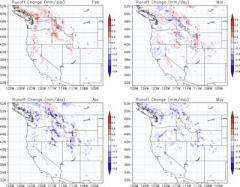
When soot from pollution settles on pristine snow, it can increase snowmelt in the winter month of February (top left, red) and decrease it in the late spring (May -- bottom right, blue). Credit: Pacific Northwest National Laboratory

Soot from pollution causes winter snowpacks to warm, shrink and warm some more. This continuous cycle sends snowmelt streaming down mountains as much as a month early, a new study finds. How pollution affects a mountain range's natural water reservoirs is important for water resource managers in the western United States and Canada who plan for hydroelectricity generation, fisheries and farming.

Scientists at the Department of Energy's Pacific Northwest National Laboratory conducted the first-ever study of soot on snow in the western states at a scale that predicted impacts along mountain ranges. They found that soot warms up the snow and the air above it by up to 1.2 degrees Fahrenheit, causing snow to melt.

"If we can project the future -- how much water we'll be getting from the rivers and when -- then we can better plan for its many uses," said atmospheric scientist Yun Qian. "Snowmelt can be up to 75 percent of the water supply, in some regions. These changes can affect the water supply, as well as aggravate winter flooding and summer droughts."

The soot-snow cycle starts when soot, a byproduct of burning fossil fuels, darkens snow it lands upon, which then absorbs more of the sun's energy than clean white snow. The resulting thinner snowpack reflects less sunlight back into the atmosphere and further warms the area, continuing the snowmelt cycle.

This study revealed regional changes to the snowpack caused by soot, whereas other studies looked at the uniform changes brought by higher air temperatures due to greenhouse gases.

Previous studies have examined the effect of airborne or snowbound soot on global climate and temperatures. Qian and his colleagues at PNNL used a climate computer model to zoom in on the Rocky Mountain, Cascade, and other western United States mountain ranges. They modeled how soot from diesel engines, power plants and other sources affected snowpacks it landed on.

They found that changes to snow's brightness results in its melting weeks earlier in spring than with pristine snow. In addition, less mountain snow going into late spring means reduced runoff in late spring and summer. They will report their findings in an upcoming issue of the Journal of Geophysical Research -- Atmospheres.

Making Snowhills from Mountains

Researchers know that soot settles on snow. And like an asphalt street compared to a concrete sidewalk, dirty snow retains more heat from the sun than bright white snow. Qian and colleagues wanted to determine to what degree dark snow contributes to the declining snowpack.

To get the kind of detail from their computer model that they needed, the PNNL team used a regional model called the Weather Research and Forecasting model -- or WRF, developed in part at the National Center for Atmospheric Research in Boulder, Colo. Compared to planet-scale models that can distinguish land features 200 kilometers apart, this computer model zooms in on the landscape, increasing resolution to 15 kilometers. At 15 kilometers, features such as mountain ranges and soot deposition are better defined.

Recently, PNNL researchers added a software component to WRF that models the chemistry of tiny atmospheric particles called aerosols and their interaction with clouds and sunlight. Using the WRF-chem model, the team first examined how much soot in the form of so-called black carbon would land on snow in the Sierra Nevada, Cascade and Rocky Mountains.

Then the team simulated how that soot would affect the snow's brightness throughout the year. Finally, they translated the brightness into snow accumulation and melting over time.

Gray Outlook

"Earlier studies didn't talk about snowpack changes due to soot for two reasons," said atmospheric scientist and co-author William Gustafson. "Soot hasn't been widely measured in snowpack, and it's hard to accurately simulate snowpack in global models. The Cascades have lost 60 percent of their snowpack since the 1950s, most of that due to rising temperatures. We wanted to see if we could quantify the impact of soot."

Their simulations compared well to data collected on snowpack distribution and water runoff. But their first experiment did not include all sources of soot, so they modeled what would happen if enough soot landed on snow to double the loss of brightness. In this computer simulation, the regional climate and snowpack changed significantly, and not in a simply predictable way.

Overall, doubling the dimming of the snow did not lead to twice as high temperature changes -- it led to an approximate 50 percent increase in the snow surface temperature. The drop in snow accumulation, however, more than doubled in some areas. Snowpack over the central Rockies and southern Alberta, for example, dropped two to 50 millimeters over the mountains during late spring and early winter. The most drastic changes occurred in March, the model showed.

The team also found that soot decreased snow's brightness in two ways. About half of soot's effect came from its dark color. The other half came indirectly from reducing the size of the snowpack, exposing the underlying darker earth.

Studies like this one start to unmask pollution's role in the changing climate. While greenhouse gases work unseen, soot bares its dark nature, with a cloak that slowly steals summertime's snow.

Paper: Reference: Yun Qian, William I. Gustafson Jr., L. Ruby Leung, Steven J. Ghan, Effects of soot-induced snow albedo change on snowpack and hydrological cycle in western U.S. based on WRF chemistry and regional climate simulations, Journal of Geophysical Research - Atmospheres, 2009, doi:10.1029/2008JD011039

Source: Pacific Northwest National Laboratory

4.2 /5 (5 votes)  

Filter


Move the slider to adjust rank threshold, so that you can hide some of the comments.


Display comments: newest first

freethinking
Jan 12, 2009

Rank: 4 / 5 (3)
Now soot causing a increase in melt is something that makes sense and something we can do something about. Does this mean less hype on Global Warming???
x646d63
Jan 12, 2009

Rank: 3 / 5 (4)
With Global Warming having become a religion and tax-generator, more and more people will recognize that it's not science.

Hopefully people will understand that the GW crowd was manufactured by big business and government to control real environmentalism. This report highlights some real environmental science.

Environmentalism was originally founded (arguably) around Silent Spring, which was a book about pollution! In the 70s and 80s the environmental movement was clear: clean up the rivers and air and stop letting big business and governments (and individuals) pollute our world.

In the 90s the real environmental movement was taken over by the GW fake movement and now has been lost, just as planned. Real environmentalists have been duped. Hopefully during this upcoming mini-ice age people will finally get it.
bobwinners
Jan 13, 2009

Rank: 4 / 5 (2)
Easy way to test this. Spread the dust from your fireplace onto the snow outside your home. It will melt the stuff considerably faster normal. Just don't spread it where you will be walking!
mikiwud
Jan 13, 2009

Rank: 2.5 / 5 (2)
Where does the soot come from? OH, I see, coal powered power stations. Excuse me for being cynical, but it looks like computer models being used as a sideways dig at "causes" of AGW.
Egnite
Jan 13, 2009

Rank: 3 / 5 (2)
About time we focused on something important (snow melting faster due to pollution) rather than the BS to generate money (CO2 causing every problem with climate change). Can they not just filter out the soot (and other pollutants) from the fumes caused by coal power? CO2 isn't even toxic so who cares how much is in the atmosphere! The plantlife will sort that out without any help from green taxation. Govenments should be focusing on reducing harmful pollution imo and not just thinking about thier wallets!!
mikiwud
Jan 13, 2009

Rank: 3 / 5 (2)
Egnite,
Most (all?) developed world coalfired power stations do filter most polution out. The main polluters are China, India and the old USSR. It's just the Warmists that have picked on CO2 (which is not a pollutant) for political reasons.
If we go into a cooling phase we will need anything we can get to warm the Earth. An ice age WILL be devastateing as opposed to warming which will be benificial.
Rank 4.2 /5 (5 votes)
Relevant PhysicsForums posts
  • Do some geologists actually act a lot like Randy Marsh?
    createdFeb 11, 2012
  • Discrepancy between oxygen and carbon-dioxide levels
    createdFeb 09, 2012
  • where gems are found in the world
    createdFeb 09, 2012
  • Wind Waves in Reservoir ~ Wind run-up and Wind set-up
    createdFeb 08, 2012
  • Balance of oxygen in the atmosphere
    createdFeb 01, 2012
  • The case for a methanol-based economy
    createdJan 30, 2012
  • More from Physics Forums - Earth

More news stories

With climate change, today's '100-year floods' may happen every three to 20 years: research

Last August, Hurricane Irene spun through the Caribbean and parts of the eastern United States, leaving widespread wreckage in its wake. The Category 3 storm whipped up water levels, generating storm surges ...

Space & Earth / Environment

created 4 minutes ago | popularity not rated yet | comments 0 | with audio podcast

New European rocket lifts off on maiden flight

A new lightweight rocket, Vega, lifted off from Europe's space base Monday carrying nine satellites on its inaugural flight, mission control said.

Space & Earth / Space Exploration

created 1 hour ago | popularity 5 / 5 (3) | comments 1

Climate change causes harmful algal blooms in North Atlantic: study

Warming oceans and increases in windiness could be causing of an abundance of harmful algal blooms in the North Atlantic Ocean and North Sea, according to new research.

Space & Earth / Environment

created 2 hours ago | popularity not rated yet | comments 0

Salvage workers begin pumping fuel from Italian shipwreck

Salvage workers Sunday began pumping fuel from the shipwrecked Italian cruise liner Costa Concordia, a day ahead of schedule, officials said.

Space & Earth / Environment

created 17 hours ago | popularity 5 / 5 (2) | comments 0

NASA budget will axe Mars deal with Europe: scientists

US President Barack Obama's budget proposal to be submitted next week for 2013 will cut NASA's budget by 20 percent and eliminate a major partnership with Europe on Mars exploration, scientists said Thursday.

Space & Earth / Space Exploration

created Feb 10, 2012 | popularity 5 / 5 (4) | comments 59


New molecule has potential to help treat genetic diseases and HIV

(PhysOrg.com) -- Chemists at The University of Texas at Austin have created a molecule that's so good at tangling itself inside the double helix of a DNA sequence that it can stay there for up to 16 days before ...

Social psychologist: Lust makes you smarter and evidence that seven deadly sins are good for you

(Medical Xpress) -- Good news for lovers on Valentine’s Day - the seven deadly sins, including Lust, are good for you. University of Melbourne social psychologist Dr Simon Laham uses modern research to make a compelling ...

The joy of cheques

An electronic cheque which eliminates the need for costly processing by banks but preserves the simplicity and ease of a traditional cheque book has been designed by a team of academics in the UK.

Research shows promise in converting camelina oil into jet fuel

(PhysOrg.com) -- Researchers at Montana State University-Northern have developed a process to convert camelina oil to jet fuel and other high-value chemicals. MSU has applied for a U.S. patent and research is ongoing.

Couples in the same place emotionally stay together, study says

(Medical Xpress) -- Despite life’s ups and downs, couples whose feelings are in sync consistently over time are more likely to stay together, says a University of California, Davis, study.

Researchers make breakthrough in stem cell research

(Medical Xpress) -- University of Queensland scientists have developed a world-first method for producing adult stem cells that will substantially impact patients who have a range of serious diseases.