Microscopic morphology adds to the scorpion family tree
January 12, 2009
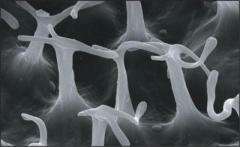
This is the ventral surface of book lung lamella with branched trabeculae in Opisthacanthus elatus (3 µm). Credit: C. Kamenz
Modern microscopy technology has allowed two scorpion biologists, Carsten Kamenz of the Humboldt University in Berlin and Lorenzo Prendini of the American Museum of Natural History, to study and document what is nearly invisible. Looking at tiny morphological features like the sculpting of the hair-like outgrowths on lamellae—structures that fold like the leaves of a book and give the scorpion respiratory system its name, the book lung—Kamenz and Prendini found a wealth of new variation that gives insight into the evolutionary relationships among scorpions. Their research, recently published in the Bulletin of the American Museum of Natural History, presents their raw data as an illustrated atlas of the book lungs of all major lineages of scorpions.
"The richness of morphology is a vast and still largely unexplored source of data for understanding the evolutionary relationships among organisms," says Prendini, Associate Curator in the Division of Invertebrate Zoology at the Museum. "We have not learned all we can because the more we look at morphology, the more we find."
Kamenz and Prendini revisited book lung morphology for the first time since 1926 to assess whether these organs illuminate the scorpion tree of life. Book lungs allow some arachnids, including all scorpions, most spiders, and whip scorpions, to breathe air. Scorpions were traditionally placed at the base of the phylogenetic tree, as a sister group to all other arachnids, but molecular data has complicated this picture by suggesting that scorpions move higher on the tree, closer to sun spiders and daddy long legs. Consequently, the question of whether the book lung evolved once, at the base of the arachnid phylogenetic tree, or more than once, as arachnids adapted to life out of water, is unresolved.
This study is the most complete review of scorpion breathing apparatus ever: 200 specimens from 100 genera in 18 scorpion families were examined. This sample represents all major scorpion lineages. Modern microscopy techniques—scanning electron microscopy—allowed Kamenz and Prendini to see detail measured in microns (or one millionth of a meter) that was impossible to observe 100 years ago.
Enlarge
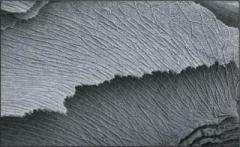
This is the surface of book lung lamella of Rhopalurus laticauda (100 µm). Credit: C. Kamenz
Three new traits were discovered by peering closely at the specimens: the surface sculpting of the respiratory lamellae (the leaves of the book); the edges of the leaves, within a chamber called an atrium (the pre-chamber of the book lung); and the processes on the posterior valve-like edges of the spiracles (the point at which the book lung opens to the atmosphere). The tremendous diversity of structures documented by Kamenz and Prendini is matched only by the respiratory organs of air-breathing crabs.
These structures contain phylogenetically important variation at multiple branches in the scorpion tree. One striking example is the sculpting on the surface of the book lung's leaves. While all nonbuthid scorpions have papillate trabeculae (simple or branched hair-like projections) on the leaves' surfaces, the buthids (the venomous thick-tailed scorpions) and chaerilids have reticulate venation (a network of veins), a fundamental difference between these scorpion lineages that is independently supported by external morphology and DNA.
The finding suggests that a significant change in the structure of the respiratory apparatus must have occurred early in the evolution of modern scorpions. Both conditions of the lamellar surface show additional variation that is informative higher up the branches of the scorpion tree. The data gathered by Kamenz and Prendini will be combined with DNA sequences and character traits from other parts of the scorpion anatomy to reconstruct the scorpion tree of life.
"The best way to understand the evolution of scorpions, like any group of organisms, is to investigate multiple lines of evidence, using the best techniques available. As the book lung study shows, we may not recognize the significance of something until we have the means to study it properly," says Prendini.
Kamenz, at the Humboldt University, agrees. "Future research will confirm the importance of book lungs and other sources of anatomical data, long neglected, for reconstructing the scorpion tree."
The research paper can be accessed for free at http://digitallibr … ry.amnh.org/
Source: American Museum of Natural History
-
Robots: our helpers in space
Dec 04, 2004 |
5 / 5 (1) |
0
-
Our Amorphophallus is smaller: New plant species from Madagascar smells like roadkill
Feb 07, 2012 |
5 / 5 (2) |
0
-
Examining evolution from a cellular perspective
Jan 25, 2012 |
not rated yet |
0
-
Tobacco industry dying? Not so fast, says Stanford expert
Dec 13, 2011 |
not rated yet |
4
-
'Southern Pine Beetle II': Current state of knowledge on an important forest pest
Oct 25, 2011 |
not rated yet |
0
-
Engineers build first sub-10-nm carbon nanotube transistor
Feb 01, 2012 |
4.9 / 5 (30) |
30
-
Something old, something new: Evolution and the structural divergence of duplicate genes
Jan 31, 2012 |
4.6 / 5 (7) |
1
-
The hidden nanoworld of ice crystals: Revealing the dynamic behavior of quasi-liquid layers
Jan 30, 2012 |
5 / 5 (3) |
1
-
Stock market network reveals investor clustering
Jan 27, 2012 |
3.9 / 5 (23) |
8
-
Of microchemistry and molecules: Electronic microfluidic device synthesizes biocompatible probes
Jan 26, 2012 |
5 / 5 (1) |
0
More news stories
Ultraviolet protection molecule in plants yields its secrets
Lying around in the sun all day is hazardous not just for humans but also for plants, which have no means of escape. Ultraviolet (UV) radiation from the sun can damage proteins and DNA inside cells, leading ...
6 hours ago |
5 / 5 (3) |
0
|
Deadly bird parasite evolves at exceptionally fast rate
A new study of a devastating bird disease that spread from poultry to house finches in the mid-1990s reveals that the bacteria responsible for the disease evolves at an exceptionally fast rate. What's more, ...
4 hours ago |
5 / 5 (2) |
0
|
Decoding the molecular machine behind E. coli and cholera
Scientists from Queen Mary, University of London have discovered the workings behind some of the bacteria that kill hundreds of thousands every year, possibly paving the way for new antibiotics that could treat infections ...
4 hours ago |
not rated yet |
0
|
New research reveals why fishermen keep fishing despite dwindling catches
Half of fishermen would not give up their livelihood in the face of drastically declining catches according to research led by the University of East Anglia (UEA).
4 hours ago |
not rated yet |
0
Deciding to go left or right: Researchers use device to determine that lower animals can navigate too
For decades, scientists have associated binary decision making opting to go left or right with higher-ranking animals, including humans. A team of Harvard researchers, however, is rewriting that ...
12 hours ago |
not rated yet |
2
|
'Dark plasmons' transmit energy
Microscopic channels of gold nanoparticles have the ability to transmit electromagnetic energy that starts as light and propagates via "dark plasmons," according to researchers at Rice University.
Hydrogen from acidic water: Researchers develop potential low cost alternative to platinum for splitting water
A technique for creating a new molecule that structurally and chemically replicates the active part of the widely used industrial catalyst molybdenite has been developed by researchers with the Lawrence Berkeley ...
FDA-approved drug rapidly clears amyloid from the brain, reverses Alzheimer's symptoms in mice
Neuroscientists at Case Western Reserve University School of Medicine have made a dramatic breakthrough in their efforts to find a cure for Alzheimer's disease. The researchers' findings, published in the journal Science, show t ...
Anyone can learn to be more inventive, cognitive researcher says
There will always be a wild and unpredictable quality to creativity and invention, says Anthony McCaffrey, a cognitive psychology researcher at the University of Massachusetts Amherst, because an "Aha moment" is rare and ...
New method makes culture of complex tissue possible in any lab
Scientists at the University of California, San Diego have developed a new method for making scaffolds for culturing tissue in three-dimensional arrangements that mimic those in the body. This advance, published online in ...
Cell biologists describes mechanism by which some people may be more susceptible to colon cancer
An international research team led by cell biologists at the University of California, Riverside has uncovered a new insight into colon cancer, the third leading cause of cancer-related deaths in the United ...