Researchers develop camera for the blind
January 12th, 2009 by Elizabeth A. Thomson MIT develops camera for the blind

Enlarge

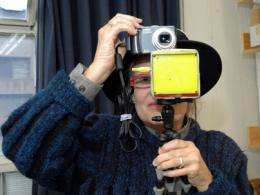
Elizabeth Goldring with the camera she developed. Photo / Donna Coveney

(PhysOrg.com) -- Elizabeth Goldring smiles as she shows a visitor photos she's taken — and can see — with her blind eye.

The demonstration comes more than 20 years after Goldring, a senior fellow at MIT’s Center for Advanced Visual Studies, and colleagues began work on a “seeing machine” that can allow some people who are blind or visually challenged to access the Internet, view the face of a friend and much more.

The team has moved from Goldring’s inspiration, a large diagnostic device costing some $100,000, to a $4,000 desktop version, to the current seeing machine, which is portable and inexpensive. “We can make one for under $500,” Goldring said.

Although the device can be connected to any visual source, such as a video camera or desktop computer, Goldring especially enjoys using it with a photo camera. “When someone has a diminished sense, the inability to express yourself with that sense can be frustrating,” she said. By taking photos, “I feel I’m able to express myself visually with my blind eye, and there’s value in that, I think.”

Further, “it’s light enough that I really want to take it with me when I go for a walk.” (Goldring, who is visually challenged, has enough sight in one eye to permit mobility.)

Goldring’s idea for the seeing machine began with a visit to her optometrist. At the time, she was completely blind.

To determine if she had any healthy retina left, technicians peered into her eyes with a scanning laser opthalmoscope, or SLO. With the machine they projected a simple image directly onto the retina of one eye, past the hemorrhages within the eye that contributed to her blindness.

She was indeed able to see the test image. So she asked if they could write the word “sun.” “And I was amazed that I was able to read a word!” Goldring said.

She went on to use the device for other visual experiences. For example, video of her doctor was transmitted through the SLO, and for the first time she saw his face.

But although the SLO held promise for the broader blind public, it had serious drawbacks — including its prohibitive cost. Goldring determined to develop a more practical, accessible machine.

She began collaborating with people such as Rob Webb, the SLO’s inventor and a senior scientist at the Schepens Eye Research Institute, Harvard University, and dozens of MIT students. Those involved in the current machine are Yifei Wu, an MIT senior who began the work as a freshman and has been instrumental in developing the seeing-machine camera; Brandon Taylor, a graduate student at the MIT Media Lab; and Quinn Smithwick, a postdoctoral associate in the same lab.

The portable device is relatively inexpensive in part because it replaces the laser of the SLO with light-emitting diodes (LEDs), another source of high-intensity light that is much cheaper.

Further, “everything in it is already mass-produced for other purposes,” said Taylor. He also noted that since the seeing-machine project began, “LCDs and other components have gotten much smaller and are readily available.”

The portable seeing machine is about five inches square and mounted on a flexible tripod that makes it easy to carry. A digital camera is attached to the top. The visual feed from the camera travels into the seeing machine to a Liquid Crystal Display (LCD) illuminated by LEDs. (This is the same kind of LCD common in cameras and TVs.)

The visual data is then focused into a single “point” that travels into the eye. “This is not magnification,” said Smithwick. “What makes this work is focusing the data into a tiny spot of light.”

What’s next? Goldring aims to show the new machine to other visually challenged people and looks forward to their feedback. Plans are underway to test it at the Low Vision Clinic at the Joslin Diabetes Center’s Beetham Eye Institute in Boston.

This work was supported by NASA and by MIT’s School of Architecture and Planning, Center for Advanced Visual Studies, Undergraduate Research Opportunities Program, and Council for the Arts.

Provided by MIT


print this article email this article download pdf blog this article bookmark this article     Digg this Stumble it share on Facebook share on Reddit add to delicious save to Yahoo! bookmarks
5/5 after 5 votes

Rank Filter

Move the slider to adjust rank threshold, so that you can hide some of the comments.


Display comments: newest first

  • Adriab - Jan 12, 2009
    • Rank: not rated yet
    A really cool further development of this would be something a blind, or visual-impaired person, could wear to see.
  • visual - Jan 13, 2009
    • Rank: not rated yet
    there have been some prototypes of electrode grid arrays used to stimulate the retina or other parts of the optical nerve pathways, and it has been known that light could be used for the same purpose instead of physical electrodes. so the idea is nothing new. research has been going on in this field for a long time now.
    it is very good to see someone actually taking the initiative to create a cheap and usable end-user device instead of just the theoretical research that's been going on till now... but the article skips on some important details about it. most importantly, what is its resolution and how precisely are the individual pixels aimed at the retina components?
    also it doesn't seem like they have yet performed trials with long-term usage of the device, so it is unknown if it will be comfortable or even safe for permanent vision replacement. the very fact that the creator of the device herself prefers to use it for still photos instead of motion video speaks tons, i'm afraid. this is too unpolished, even amateur.

January 12th, 2009 all stories
Technology / Engineering

Comments: 2
Rank: 5/5 after 5 votes

  • Stumble this up

  • Digg this

  • Share it:
  • share on Facebook
  • share on MySpace
  • share on Slashdot
  • rss-newsfeed
  • share on Google
  • share on Reddit
  • add to delicious
  • save to Yahoo! bookmarks
  • share on Windows Live
  • Add to Mixx!
Rating: 5/5 after 5 votes


  • Transform a ball into a rock -- or make it invisible -- using transformation optics
    Transform a ball into a rock -- or make it invisible -- using transformation optics
    Physics / General Physics
    created 9 hours ago | popularity 3 / 5 (2) | comments 0
  • Could a quantum motor do work?
    Physics / General Physics
    created Jul 07, 2009 | popularity 4 / 5 (12) | comments 0
  • Physicists Demonstrate Quantum Memory with Matter Qubits
    Physicists Demonstrate Quantum Memory with Matter Qubits
    Physics / General Physics
    created Jul 03, 2009 | popularity 4.5 / 5 (20) | comments 1
  • 'Holey' Nanosheets for Wastewater Dye Removal
    Nanotechnology / Nanomaterials
    created Jul 01, 2009 | popularity 5 / 5 (5) | comments 1
  • Jellyfish Robot Swims Like its Biological Counterpart
    Jellyfish Robot Swims Like its Biological Counterpart
    Electronics / Robotics
    created Jun 26, 2009 | popularity 4.4 / 5 (9) | comments 1
  • Other News

    synthetic tree

    Synthetic Tree Captures Carbon 1,000 Faster Than Real Trees

    Technology / Engineering

    created 3 hours ago | popularity 4 / 5 (4) | comments 5

    (PhysOrg.com) -- Scientists have designed a synthetic tree that traps carbon dioxide from the air in an attempt to combat growing emissions. The device looks less like a tree and more like a small building, ...


    Electric Raptor

    Raptor: An Electric Car Nearly Anyone Would Want to Drive

    Technology / Energy

    created 3 hours ago | popularity 5 / 5 (3) | comments 2

    I love my Prius, it's true. But sometimes, I look at the Dodge Charger (I'm watching Burn Notice this summer) and think, "What a cool car." And when we think of cool cars, it's hard to keep the image of a ...


    NY official: Tagged site stole identities

    Technology / Internet

    created 2 hours ago | popularity 5 / 5 (1) | comments 0

    (AP) -- New York's attorney general charged Thursday that Tagged.com stole the identities of more than 60 million Internet users worldwide - by sending e-mails that raided their private accounts.


    Google, Microsoft chairmen share laugh together (AP)

    Google, Microsoft chairmen share laugh together

    Technology / Business

    created 2 hours ago | popularity not rated yet | comments 0

    (AP) -- The escalating tension between Google and Microsoft didn't prevent the companies' chairmen from sharing a moment of levity Thursday at an exclusive media conference in the Idaho mountains.


    Massive earthquake simulation could lead to stronger, safer wooden buildings

    Massive earthquake simulation could lead to stronger, safer wooden buildings

    Technology / Engineering

    created 3 hours ago | popularity not rated yet | comments 0

    A destructive earthquake will strike a lone, wooden condominium in Japan next week, and Rensselaer Polytechnic Institute Professor Michael Symans will be on site to watch it happen.