Researchers Can Detect Tunnel Excavation With Fiber Optic Cables
January 12, 2009
Researchers Can Detect Tunnel Excavation With Fiber Optic Cables

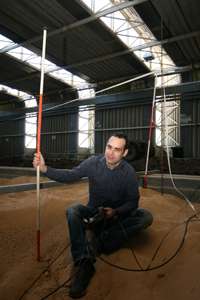
Dr. Assaf Klar of the Technion Faculty of Faculty of Civil and Environmental Engineering is developing a way to detect and pinpoint the excavation of tunnels, such as those used for smuggling weapons into Gaza.

(PhysOrg.com) -- With the same type of fiber optic cables used in telecommunications systems, researchers from the Technion-Israel Institute of Technology have developed a way to detect and pinpoint the excavation of tunnels during times of war, such as those used for smuggling weapons into Gaza. The findings will be presented at the Defense, Security and Sensing Conference of SPIE (an international society advancing light-based research) in April 2009 in Orlando, Florida.

Principal researchers Dr. Assaf Klar and Dr. Raphael Linker, both of the Technion Faculty of Civil and Environmental Engineering, say the system is capable of locating even narrow tunnels at depths greater than 60 feet with a limited number of false alarms.

"Tunnel excavation is accompanied by the release of stresses that cause permanent - though very tiny - displacements and strains in the ground," says Dr. Klar. "If you can measure these strains in the soil with sensitive equipment, you can find the tunnel's location." Tunnel excavation has a distinctive signal that is very different from those of disturbances, he adds.

The research lays the groundwork for the initial stages of an underground fence based on an existing technology called BOTDR (Brillouin optical time domain reflectometry) that makes it possible to measure fiber distortion along 15 miles using one device.

The proposed system is based on "wavelet decomposition" of the continuous BOTDR signal, a process that breaks down the signal profile into simpler shapes, and then filters out any irrelevant signals ("noise"). The signals that remain are then characterized by a neural network that has been trained to locate tunnels using computer simulation of tens of thousands of profiles, including disturbances not related to tunneling (examples include raindrops).

"The ability of the BOTDR approach to supply a continuous profile of soil distortions along the fiber optic line - and the ability of the neural network to identify the relevant profile that characterizes the excavation - are the keys to the system's success," says Dr. Linker.

Provided by Technion-Israel Institute of Technology

3.3 /5 (3 votes)  

Rank 3.3 /5 (3 votes)
Related Stories
Relevant PhysicsForums posts
  • How to tilt a object
    created4 hours ago
  • How to calculate total compressibility in liquid porous solid system
    created10 hours ago
  • Need help reading 3-D
    createdFeb 11, 2012
  • A way to send and receive wireless data
    createdFeb 11, 2012
  • Calling function with no input argument
    createdFeb 10, 2012
  • Force free body diagram problem on gym equipment
    createdFeb 10, 2012
  • More from Physics Forums - General Engineering

More news stories

Google might launch Drive for cloud storage soon

(PhysOrg.com) -- Google's next big move, according to the Wall Street Journal, is a cloud storage service called Drive. Hardly first to the plate, Google is simply catching up to introducing its cloud reposi ...

Technology / Internet

created 18 hours ago | popularity 4.8 / 5 (5) | comments 5 | with audio podcast report

Iran blocks email, restricts net access: reports

Iran has further restricted access to the Internet and blocked popular email services for the past few days, in a move a top lawmaker said could "cost the regime dearly," media reports said on Sunday.

Technology / Internet

created 11 hours ago | popularity 5 / 5 (2) | comments 5

Walney offshore wind farm is world's biggest (for now)

(PhysOrg.com) -- The Walney wind farm on the Irish Sea--characterized by high tides, waves and windy weather--officially opened this week. The farm is treated in the press as a very big deal as the Walney ...

Technology / Energy & Green Tech

created Feb 11, 2012 | popularity 4.1 / 5 (14) | comments 57 | with audio podcast weblog

Navy to begin tests on electromagnetic railgun prototype launcher

The Office of Naval Research (ONR)'s Electromagnetic (EM) Railgun program will take an important step forward in the coming weeks when the first industry railgun prototype launcher is tested at a facility ...

Technology / Engineering

created Feb 06, 2012 | popularity 4.6 / 5 (20) | comments 95 | with audio podcast

New power source discovered

(PhysOrg.com) -- Researchers at the Massachusetts Institute of Technology (MIT) and RMIT University have made a breakthrough in energy storage and power generation.

Technology / Energy & Green Tech

created Feb 10, 2012 | popularity 4.6 / 5 (51) | comments 51 | with audio podcast


Scientists discover molecular secrets of 2,000-year-old Chinese herbal remedy

For roughly two thousand years, Chinese herbalists have treated Malaria using a root extract, commonly known as Chang Shan, from a type of hydrangea that grows in Tibet and Nepal. More recent studies suggest that halofuginone, ...

New method to examine batteries -- MRI from the inside

There is an ever-increasing need for advanced batteries for portable electronics, such as phones, cameras, and music players, but also to power electric vehicles and to facilitate the distribution and storage of energy derived ...

A mitosis mystery solved: How chromosomes align perfectly in a dividing cell

Although the process of mitotic cell division has been studied intensely for more than 50 years, Whitehead Institute researchers have only now solved the mystery of how cells correctly align their chromosomes during symmetric ...

Lab study raises questions over nano-particle impact

Tests involving chickens have raised questions about the impact on health from engineered nano-particles, the ultra-fine grains commonly used in drugs and processed foods, scientists said on Sunday.

Starve a virus, feed a cure? Findings show how some cells protect themselves against HIV

A protein that protects some of our immune cells from the most common and virulent form of HIV works by starving the virus of the molecular building blocks that it needs to replicate, according to research published online ...

Researchers find extensive RNA editing in human transcriptome

In a new study published online in Nature Biotechnology, researchers from BGI, the world's largest genomics organization, reported the evidence of extensive RNA editing in a human cell line by analysis of RNA-seq data, demons ...