King tides -- a glimpse of future sea level rise
January 12, 2009
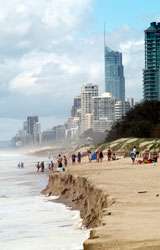
A combination of storms and high tides caused significant beach erosion on the Gold Coast last summer. Photo (c) Bruce Miller
(PhysOrg.com) -- Tomorrow, beach-goers will get a glimpse of what our coastlines may look like in 50 years, when New South Wales and South East Queensland experience the highest daytime ‘king tides’ forecast for 2009.
“By 2060 to 2070 we could be experiencing tides of at least this magnitude every month, rather than just twice a year due to climate-change induced sea level rise,” says a research scientist with CSIRO’s Climate Adaptation National Research Flagship, Dr Kathy McInnes.
King tides are natural events that happen twice a year. The tides predicted for many parts of the east coast between 8am and 10.30am on Monday morning are around 40 to 50 cm higher than the average ‘spring tide’ (the highest tide in the monthly moon cycle).
Dr McInnes says observing the king tide can assist communities to plan and prepare for the effects of climate change.
“This king tide is not caused by climate change, but it can help us picture what our coastlines might look like in the future.”
According to the Intergovernmental Panel on Climate Change, sea levels are projected to rise by between 18-79cm or more this century.
“Photographing or recording the effect of the king tide on seawalls, jetties, coastal infrastructure and foreshore areas creates a helpful visual record for use in adaptation planning,” Dr McInnes says.
“In New South Wales the State Government, local councils and community groups are coordinating a state-wide photographic survey of the king tide for this purpose.
“The actual height reached by the king tide will depend on local weather and ocean conditions on the day.”
Scientists from the CSIRO Climate Adaptation Flagship are working with communities, governments and industry to understand and prepare for the impacts of climate change.
Provided by CSIRO
-
Engineers build first sub-10-nm carbon nanotube transistor
Feb 01, 2012 |
4.9 / 5 (33) |
30
-
Something old, something new: Evolution and the structural divergence of duplicate genes
Jan 31, 2012 |
4.6 / 5 (7) |
1
-
The hidden nanoworld of ice crystals: Revealing the dynamic behavior of quasi-liquid layers
Jan 30, 2012 |
5 / 5 (4) |
1
-
Stock market network reveals investor clustering
Jan 27, 2012 |
3.9 / 5 (23) |
8
-
Of microchemistry and molecules: Electronic microfluidic device synthesizes biocompatible probes
Jan 26, 2012 |
5 / 5 (2) |
0
-
Do some geologists actually act a lot like Randy Marsh?
Feb 11, 2012
-
Discrepancy between oxygen and carbon-dioxide levels
Feb 09, 2012
-
where gems are found in the world
Feb 09, 2012
-
Wind Waves in Reservoir ~ Wind run-up and Wind set-up
Feb 08, 2012
-
Balance of oxygen in the atmosphere
Feb 01, 2012
-
The case for a methanol-based economy
Jan 30, 2012
- More from Physics Forums - Earth
More news stories
Latin America mining boom clashes with conservation
Latin America is experiencing a mining boom as prices rise fuelled by a hike in global demand, but the region is also being hit by a wave of violent protests, strikes and rallies by environmentalists.
22 hours ago |
5 / 5 (1) |
1
Salvage workers begin pumping fuel from Italian shipwreck
Salvage workers Sunday began pumping fuel from the shipwrecked Italian cruise liner Costa Concordia, a day ahead of schedule, officials said.
14 hours ago |
5 / 5 (2) |
0
Political leaders play key role in how worried Americans are by climate change: study
More than extreme weather events and the work of scientists, it is national political leaders who influence how much Americans worry about the threat of climate change, new research finds.
Feb 06, 2012 |
5 / 5 (8) |
76
NASA budget will axe Mars deal with Europe: scientists
US President Barack Obama's budget proposal to be submitted next week for 2013 will cut NASA's budget by 20 percent and eliminate a major partnership with Europe on Mars exploration, scientists said Thursday.
Space & Earth / Space Exploration
Feb 10, 2012 |
5 / 5 (4) |
58
Humans may have helped the decline of African rainforests 3000 years ago
(PhysOrg.com) -- Large areas of rainforests in Central Africa mysteriously disappeared over three thousand years ago, to be replaced by savannas. The prevailing theory has been that the cause was a change ...
Japan's Fukushima reactor may be reheating: operator
Temperature readings at one of the crippled Fukushima nuclear reactors have risen above Japan's stringent new safety standard but there was no immediate danger, its operator said Sunday.
Integrated pest management recommendations for the southern pine beetle
The southern pine beetle, Dendroctonus frontalis Zimmermann, is a chronic insect pest within pine forests in the southeastern United States. Under favorable environmental and host conditions, it is an agg ...
Botox developer rues missing out on billions
Botox developer Alan Scott says he rues the day he handed over rights to the best-selling wrinkle-smoothing drug to a US company for just $4.5 million, saying he might have become a billionaire.
Australian women reject 'I love u' texts
Australian women may have embraced the digital era, but they prefer a face-to-face declaration of affection to an "I love u" text and find men addicted to their mobile phones a major turnoff.
Many lung cancer patients get radiation therapy that may not prolong their lives
A new study has found that many older lung cancer patients get treatments that may not help them live longer. Published early online in CANCER, a peer-reviewed journal of the American Cancer Society, the findings suggest that p ...
Scientists discover molecular secrets of 2,000-year-old Chinese herbal remedy
For roughly two thousand years, Chinese herbalists have treated Malaria using a root extract, commonly known as Chang Shan, from a type of hydrangea that grows in Tibet and Nepal. More recent studies suggest that halofuginone, ...
Jan 12, 2009
Rank: 5 / 5 (3)
Jan 13, 2009
Rank: 4 / 5 (2)
Jan 13, 2009
Rank: 1 / 5 (4)
"Few seem to realise that the present IPCC models predict almost unanimously that by 2040 the average summer in Europe will be as hot as the summer of 2003 when over 30,000 died from heat. By then we may cool ourselves with air conditioning and learn to live in a climate no worse than that of Baghdad now. But without extensive irrigation the plants will die and both farming and natural ecosystems will be replaced by scrub and desert. What will there be to eat? The same dire changes will affect the rest of the world and I can envisage Americans migrating into Canada and the Chinese into Siberia but there may be little food for any of them." --Dr James Lovelock's lecture to the Royal Society, 29 Oct. '07
Jan 13, 2009
Rank: 5 / 5 (1)
It snowed in Baghdad last year.
Jan 13, 2009
Rank: 1 / 5 (4)
Jan 13, 2009
Rank: 3.4 / 5 (5)
If the ocean was rising there would be signs of it beyond typical satelite measured thermal expansion. There are not. There fore the article is a rather playful fiction with an interesting oceanic oddity attached.
Ask the New Zealanders how the King tide was this year. They'll probably tell you it was fairly pitiful seeing as all the warm water that typically causes it was redirected causing the ice melt that you guys clamored over.
Apr 01, 2009
Rank: 5 / 5 (1)
They are identical in thought process to Creationists who manufacture facts based on the Bible and ignore the most basic fundamental and empirically testable tenents of science and the scientific method with respect to the age of the earth and the processes of evolution.
The green religious zealots try the same thing, except the UN IPCC panel is their God and their bible is built from all of the politically motivated, anti-humanity, anti-capitalist, scaremongering tripe that is fed to them to keep them zealously hyperventilating for higher taxes and more restrictions on the freedoms of people everywhere to live their lives in modern comfort.