Clothing to crow about: Chicken feather suits and dresses
January 12, 2009 Fabric

Enlarge

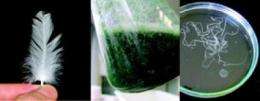
Scientists are reporting advances in making eco-friendly fabrics from renewable materials, such as chicken feathers. Credit: American Chemical Society

In the future, you may snuggle up in warm, cozy sweats made of chicken feathers or jeans made of wheat, enjoying comfortable, durable new fabrics that are "green" and environmentally friendly. Researchers in Australia are reporting that new advances are paving the way for such exotic new materials — made from agricultural waste or byproducts — to hit store shelves as environmentally-friendly alternatives to the estimated 38 million tons of synthetic fabrics produced worldwide each year.

They review research on the development of these next generation eco-friendly fibers, which will produce fabrics with a conventional feel, in the November 26, 2008 issue of ACS' Biomacromolecules.

In the article, Andrew Poole, Jeffrey Church and Mickey Huson note that scientists first produced commercial fabrics made of nontraditional materials — including milk proteins, peanuts, and corn — almost 50 years ago. Although these so-called "regenerated" fabrics had the look and feel of conventional protein-based fabrics such as wool and silk, they tended to perform poorly when wet. This problem, combined with the advent of petroleum-based synthetic fibers, caused the production of these unusual fabrics to stop, the researchers say.

Amid concerns about the environment and consumer demand for eco-friendly products, renewable fabrics made from nontraditional agricultural materials are now poised to make a comeback, the scientists say. Promising fabric sources include agricultural proteins, such as keratin from scrap chicken feathers and gluten from wheat, they say. The scientists describe advances in nanotechnology and chemical cross-linking that can improve the strength and biodegradability of these fabrics, paving the way for commercial production of eco-friendly clothing, furniture upholstery and other products.

Article: "Environmentally Sustainable Fibers from Regenerated Protein"
http://pubs.acs.org/stoken/presspac/presspac/full/10.1021/bm8010648

Source: ACS


print this article email this article download pdf blog this article bookmark this article     Stumble it Digg this share on Facebook retweet share on Reddit add to delicious
Rate this story - not rated yet


January 12, 2009 all stories

Comments: 0

not rated yet
  • Stumble this up

  • Digg this

  • share this

  • hide
  • Related Stories


Other News

Vibrations key to efficiency of green fluorescent protein

Vibrations key to efficiency of green fluorescent protein

Chemistry / Biochemistry

created 1hour ago | popularity not rated yet | comments 0

University of California, Berkeley, chemists have discovered the secret to the success of a jellyfish protein whose green glow has made it the darling of biologists and the subject of the 2008 Nobel Prize ...


Exploration by explosion: Studying the inner realm of living cells

Exploration by explosion: Studying the inner realm of living cells

Chemistry / Biochemistry

created 1hour ago | popularity not rated yet | comments 0

Scientists in Washington, DC, are reporting development and successful tests of a new way for exploring the insides of living cells, the microscopic building blocks of all known plants and animals. They explode ...


Energy-saving powder

Energy-saving powder: Converting methane to methanol

Chemistry / Other

created 2 hours ago | popularity 4 / 5 (2) | comments 1

It is currently estimated that natural gas resources will be exhausted in 130 years; however, those reserves where extraction is cost-effective will only flow for another 60 years or so.


New evidence that dark chocolate helps ease emotional stress

New evidence that dark chocolate helps ease emotional stress

Chemistry / Biochemistry

created 3 hours ago | popularity not rated yet | comments 0

The "chocolate cure" for emotional stress is getting new support from a clinical trial published online in ACS' Journal of Proteome Research.


Largest-ever database for liver proteins may lead to treatments for hepatitis

Largest-ever database for liver proteins may lead to treatments for hepatitis

Chemistry / Biochemistry

created 1hour ago | popularity not rated yet | comments 0

Scientists at a group of 11 research centers in China are reporting for the first time assembly of the largest-ever collection of data about the proteins produced by genes in a single human organ.