Hair of Tasmanian Tiger Yields Genes of Extinct Species
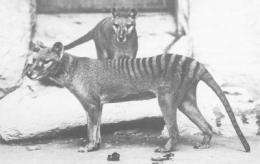
All the genes that the exotic Tasmanian Tiger inherited only from its mother will be revealed by an international team of scientists in a research paper to be published on 13 January 2009 in the online edition of Genome Research. The research marks the first successful sequencing of genes from this carnivorous marsupial, which looked like a large tiger-striped dog and became extinct in 1936. The research also opens the door to the widespread, nondestructive use of museum specimens to learn why mammals become extinct and how extinctions might be prevented.
"Our goal is to learn how to prevent endangered species from going extinct," said Webb Miller, a Penn State professor of biology and of computer science and engineering and a member of the research team that includes scientists from the United States, Sweden, Spain, Denmark, the United Kingdom, and Germany. "I want to learn as much as I can about why large mammals become extinct because all my friends are large mammals," Miller said. "However, I am expecting that publication of this paper also will reinvigorate discussions about possibly bringing the extinct Tasmanian Tiger back to life."
The team's research relies on new gene-sequencing technology and computational methods developed by Miller and Stephan C. Schuster, a professor of biochemistry and molecular biology at Penn State. The new methods involve extracting DNA from the hair of extinct specimens, not from bone, which has been used in previous studies of extinct species. The team's work reveals that hair is a powerful time capsule for preserving DNA over long periods and under a wide range of conditions. "I think of hair as a shrine for ancient DNA," Schuster said. "It is sealed so well that not even air or water are able to penetrate the DNA stored inside. Most importantly, bacteria cannot reach the DNA as long as the structure of the hair remains sound."
"Tasmanian Tiger" is a common name of the extinct thylacine species (Thylacinus cynocephalus), which is more closely related to kangaroos and koalas than to dogs or tigers. The last known specimen died in a Tasmanian zoo in 1936. Thylacines have played a central role in discussions about the possibility of bringing extinct species back to life, but despite the availability of many bones and other remains, previous attempts to read thylacine DNA had been unsuccessful.
Miller, Schuster, and their colleagues were the first to report the genome-wide sequence of an extinct animal, the woolly mammoth, in November 2008. They next collaborated with Anders Goetherstroem, at Uppsala University in Sweden, to target the Tasmanian Tiger because, like the mammoth, it was a coveted goal of ancient-DNA researchers, who considered its sequencing unfeasable due to the inadequate quality of the DNA available from specimens. "The speculation was that the only reason we were able to extract DNA from mammoth hair is that the mammoths had remained frozen in the Arctic permafrost, but our success with the Tasmanian Tiger shows that hair can protect DNA for long periods under a variety of environmental conditions," Schuster said.
In their new paper in Genome Research, Miller, Schuster, and their colleagues describe the completion of the mitochondrial genome sequences of two Tasmanian Tigers, one at the Smithsonian Museum and the other at the Swedish Museum of Natural History. One specimen was prepared by a taxidermist as a skin and the other one was submerged in ethanol. The team extracted DNA from small amounts of the hair of both specimens, then used their methods to sequence independent copies of each region of the DNA molecule from many different fragments of DNA in the hairs. The scientists assured the high fidelity of their results by independently determining each position in the sequences an average of 50 times.
The scientists sequenced all the DNA in the hair samples from the two Tasmanian Tigers, including mitochondrial DNA, which is the focus of the Genome Research paper, and nuclear DNA, which the team plans to analyze in future work. "This study, in which we sequenced the complete mitochondrial genome of the thylacine species, also shows that it is feasible to sequence its complete nuclear genome," Schuster said.
The new gene sequences permitted the team to accurately determine how the Tasmanian Tiger is related to other marsupials. They compared the sequences to a mitochondrial genome sequence they determined from a living reference species, a marsupial called a numbat. "The two thylacine sequences were extremely similar to each other, with only 5 differences in 15,492 nucleotides," Miller reports. The researchers say this similarity suggests that, as the species neared extinction, there was too little genetic diversity to resist bacterial and other environmental stresses. "Low genetic diversity is appearing as a common theme in the extinct species being studied by our team," Schuster said.
The research also revealed that two previous sequences in public databases, both labeled as Tasmanian Tiger mitochondrial genes, were incorrect. "Our Smithsonian specimen was the male offspring of the female animal named as the source of the earlier data, so the mitochondrial sequences, which are inherited only from the mother, should have been identical, but our analyses showed they are over 10 percent different," Schuster said.
The new study shows that the methods pioneered at Penn State are potentially useful for a new discipline involving the genome analysis of samples originating from museum archives, which Schuster calls "Museomics." "The collections dating back several hundred years and now housed in the world's museums of natural history are the treasure troves of science," Schuster said. "We hope to add DNA-sequence data to the taxonomic data provided by many of the important specimens that define the species we know today."
The team's experience in this study indicates that museum directors can be enthusiastic collaborators with genome scientists because the analysis of a specimen's hair does not damage the appearance of the museum's collections. "Whatever hairs fall off a specimen provide enough material for sequencing the animal's DNA," Schuster said. In contrast, sampling bone involves drilling holes in the museum's collection, which curators are understandably reluctant to permit. "The advantages of obtaining DNA from hair makes Museomics possible on a wide scale," Schuster said.
Miller and Schuster said their future research plans include studies of the world's only remaining large marsupial carnivore, the Tasmanian Devil. "Our preliminary genetic research with the Tasmanian Devil indicates that its genome may have alarmingly less genetic diversity than did the woolly mammoth and the Tasmanian Tiger when they became extinct, so we now have directed a portion of our research program to studying the Tasmanian Devil in the hope of preventing this magnificent mammalian species from becoming extinct."
Source: Penn State


