As super-predators, humans reshape their prey at super-natural speeds
January 12, 2009
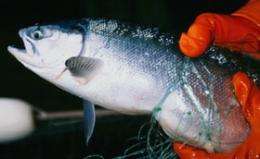
Gill nets capture large fish, leaving only smaller ones free to reproduce and pass on their genes. Photo by Andrew Hendry.
(PhysOrg.com) -- Fishing and hunting are having broad, swift impacts on the body size and reproductive abilities of fish and other commercially harvested species, potentially jeopardizing the ability of entire populations to recover, according to the results of a new study that will appear in the January 12, 2009, online issue of the Proceedings of the National Academy of Sciences.
Human predation is accelerating the rate of observable trait changes by 300 percent above the pace observed within natural systems, and 50 percent faster than in systems subject to other human influences, including pollution, according to Chris Darimont, the lead author of the paper entitled "Human Predators Outpace Other Agents of Trait Change in the Wild."
Not only fast, the changes are also dramatic in magnitude: Harvested populations are on average 20 percent smaller in body size than previous generations, and their age of first reproduction is on average 25 percent earlier, according to Darimont, a postdoctoral researcher in environmental studies at the University of California, Santa Cruz.
"Harvested organisms are the fastest-changing organisms of their kind in the wild, likely because we take such high proportions of a population and target the largest," said Darimont. "It's an ideal recipe for rapid trait change."
The study is the first to calculate the pace of evolution in commercially harvested organisms and compare the rates to other systems. The team calculated the rates of trait change with a metric appropriately called the 'Darwin,' which allowed the comparison of changes across traits and species among natural and human-modified systems, including 'human predator' systems. It builds on research by coauthor Michael Kinnison and colleagues that has documented the evolutionary impact of other human activities, such as pollution and the introduction of species to new environments.
Darimont's findings are based on a meta-analysis of 34 scientific studies that tracked 29 species in a total of 40 specific geographic systems. The bulk of the studies focused on impacts on fish populations, but other subjects included intertidal invertebrates such as limpets and snails, as well as bighorn sheep, caribou, and two plant species: Himalayan snow lotus and American ginseng.
By harvesting vast numbers and targeting large, reproductively mature individuals, human predation is quickly reshaping the wild populations that remain, leaving smaller individuals to reproduce at ever-earlier ages, said Darimont.
"The public knows we often harvest far too many fish, but the threat goes above and beyond numbers," said Darimont. "We're changing the very essence of what remains, sometimes within the span of only two decades. We are the planet's super-predator."
"The pace of changes we're seeing supercedes by a long shot what we've observed in natural systems, and even in systems that have been rapidly modified by humans in other ways," said Darimont. "As predators, humans are a dominant evolutionary force."
Darimont's findings also dramatically increase scientific understanding of the capacity of organisms to change. "These changes occur well within our lifetimes," said Darimont. "Commercial hunting and fishing has awoken the latent ability of organisms to change rapidly."
Some observed trait changes likely represent underlying genetic changes passed on from one generation to the next. In gill net fisheries, for example, evolution can favor smaller fish that pass through the mesh. Those smaller individuals are more likely to survive, reproduce, and pass on genes for smaller offspring, explained Darimont. By contrast, some trait changes likely do not involve genetic changes, a process called plasticity. For example, shifts to earlier reproduction can occur because of an abundance of food being shared by a much smaller population of fish. Whereas such plastic changes might be readily reversed if exploitation stops, this is likely not the case with genetic changes.
"Whatever the underlying process, shifts to earlier breeding spell trouble for populations," said Darimont. "Earlier breeders often produce far fewer offspring. If we take so much and reduce their ability to reproduce successfully, we reduce their resilience and ability to recover."
For example, commercial fishing has devastated the number of Atlantic cod on the eastern coast of Canada, where cod used to first reproduce at the age of six years. They now reproduce at an average age of five years, a shift that occurred in less than two decades.
Ironically, some wildlife and fish management policies contribute to the rapid pace of trait changes. "Fishing regulations often prescribe the taking of larger fish, and the same often applies to hunting regulations," said Darimont. "Hunters are instructed not to take smaller animals or those with smaller horns. This is counter to patterns of natural predation, and now we're seeing the consequences of this management." In Alberta, Canada, for example, hunters who are permitted to target the largest specimens of bighorn sheep have caused average horn length and body mass to drop by about 20 percent during the last 30 years.
"Although this is the first study of its kind, we assume this human impact is broad, because our predatory niche is so wide," he said. "While wolves might prey on 20 animals, humans prey on hundreds of thousands of species."
In addition, researchers don't know how these rapid changes will impact larger ecosystems, added Darimont. "Size really matters in nature, in terms of interactions with natural predators and competition for resources," he said. "Will ecological links unravel as exploited species continue to rapidly shrink?"
"This should be a wake-up call for resource managers," he said. "We should be mimicking natural predators, which take far less and target smaller individuals." Commercial fisheries often take half a given population per year; by contrast, competing natural predators might take only 10 percent of a population, he added.
However, more conservation-oriented policies would be no guarantee: "It's unknown how quickly the traits can change back, or if they will," noted Darimont, adding that consumers can also play a role by reducing the demand for seafood.
Finally, the results also sound an alarm about the viability of commercial industries. "By causing such abrupt and significant changes to their targets, many industries are harvesting away their future bounties," he said.
Source: University of California - Santa Cruz
-
Engineers build first sub-10-nm carbon nanotube transistor
Feb 01, 2012 |
4.9 / 5 (31) |
30
-
Something old, something new: Evolution and the structural divergence of duplicate genes
Jan 31, 2012 |
4.6 / 5 (7) |
1
-
The hidden nanoworld of ice crystals: Revealing the dynamic behavior of quasi-liquid layers
Jan 30, 2012 |
5 / 5 (3) |
1
-
Stock market network reveals investor clustering
Jan 27, 2012 |
3.9 / 5 (23) |
8
-
Of microchemistry and molecules: Electronic microfluidic device synthesizes biocompatible probes
Jan 26, 2012 |
5 / 5 (1) |
0
More news stories
The power of estrogen -- male snakes attract other males
A new study has shown that boosting the estrogen levels of male garter snakes causes them to secrete the same pheromones that females use to attract suitors, and turned the males into just about the sexiest ...
5 hours ago |
not rated yet |
0
|
Experts reveal how plants don't get sunburn
(PhysOrg.com) -- Experts at the University of Glasgow have discovered how plants survive the harmful rays of the sun.
5 hours ago |
5 / 5 (2) |
0
|
Grass to gas: Researchers' genome map speeds biofuel development
Researchers at the University of Georgia have taken a major step in the ongoing effort to find sources of cleaner, renewable energy by mapping the genomes of two originator cells of Miscanthus x giganteus, a large perenn ...
2 hours ago |
5 / 5 (2) |
0
|
Protein libraries in a snap
(PhysOrg.com) -- A Rice University undergraduate will depart with not only a degree but also a possible patent for his invention of an efficient way to create protein libraries, an important component of biomolecular ...
8 hours ago |
5 / 5 (2) |
0
|
Miami battling invasion of giant African snails
No one knows how they got there. But an invasion of African giant snails has southern Florida in a panic over potential crop damage, disease and general yuckiness surrounding the slimy gastropods.
9 hours ago |
not rated yet |
2
Human cognitive performance suffers following natural disasters, researchers find
Not surprisingly, victims of a natural disaster can experience stress and anxiety, but a new study indicates that it might also cause them to make more errors - some serious - in their daily lives. In their upcoming Human Fa ...
"Twisted Metal" gamers get shot at real gunplay
Fans of "Twisted Metal" will get to welcome a long-awaited sequel of the car-battle videogame with a real-world bang by blasting an ice cream truck to bits with a machine gun.
Putting the squeeze on planets outside our solar system
(PhysOrg.com) -- Using high-powered lasers, scientists at Lawrence Livermore National Laboratory and collaborators discovered that molten magnesium silicate undergoes a phase change in the liquid state, abruptly ...
Both maternal and paternal age linked to autism
Older maternal and paternal age are jointly associated with having a child with autism, according to a recently published study led by researchers at The University of Texas Health Science Center at Houston (UTHealth).
New error-correcting codes guarantee the fastest possible rate of data transmission
Error-correcting codes are one of the triumphs of the digital age. Theyre a way of encoding information so that it can be transmitted across a communication channel such as an optical fiber o ...
Curry spice component may help slow prostate tumor growth
Curcumin, an active component of the Indian curry spice turmeric, may help slow down tumor growth in castration-resistant prostate cancer patients on androgen deprivation therapy (ADT), a study from researchers ...
Jan 12, 2009
Rank: 2 / 5 (6)
Why is it "bad" just because humans do it? Are we some kind of supernatural eeeeevvviiiill force flung out of the void? Or are we merely another part of a natural system which is reacting naturally to us?
Jan 12, 2009
Rank: 3.5 / 5 (4)
Jan 12, 2009
Rank: 2.5 / 5 (2)
Humans have the ability to change our environment enough to make it unsuitable--or very challenging--for human life. This is what we should be concerned about.
Jan 12, 2009
Rank: 4 / 5 (2)
I am just curious: Is your statement scientific or political?
Jan 12, 2009
Rank: 3.7 / 5 (3)
Last I checked the species that have come out ahead in numerical terms are by far those that we desire to eat(e.g. sheep, wheat, corn, chicken). Fish is going the same route, with 30% of sea animals being farmed.
We could probably engineer salmon and other carnivorous fish to subsist on soy and corn(alternately engineering soy and corn to be suitable diet), we would be short-circuiting the food-chain and driving the price of grown fish far below that of wild fish.
(one of the big reasons for excessive fishing is subsidizing the hell out of struggling fisheries; typically fuel costs. If they had simply been allowed to go bankrupt we'd both be catching more fish and free up labour to do more productive things).
Jan 12, 2009
Rank: 4 / 5 (1)
My statement reflects my opinion that "Global Warming" has become political/religious and has detracted from real environmental concerns like the one this article addresses.
What was your point?
Jan 12, 2009
Rank: 4 / 5 (2)
Smaller animals and earlier reproduction in a species is a normal evolutionary reaction to increased predation. The same is observed in human populations where death (for whatever reason) comes at an earlier than "average" age.
So I could agree in general that humans are driving EVOLUTION in the animals we commercially or individually harvest, just as any other predator (or domesticator) of other animals does.... but not extinction. Not any more, at least. Sure there are plenty of examples to point out that it happened in the past, but I think we (the human species) are getting wiser to how small the world really is and how we can continue to harvest animals without dooming ourselves or other species to extinction.
Jan 13, 2009
Rank: not rated yet
Some of us. you are taking the point of view of a westerner who is environementally aware. Tell a third world citizent aht eh can't use an insecticide on his field because it'll kill of the rare mice that live on it. Heck, he'll use more insecticide just to get rid of more mice, sionce he's worried about survival, not harmonization with the surroundings.
Jan 13, 2009
Rank: 1 / 5 (1)
Well you said:
"Humans have the 'ability' to change our environment enough to make it unsuitable--or very challenging--for human life. This is what we should be concerned about."
Isn't that the point? The global warming is also caused by human changing the environment. If you burn all the Amazon forest and organic material,for example, how much CO2 would you introduce into the atmosphere? But the problem is not only CO2 but also many other gases such as methane. Humans are changing the environment as you have stated by just doing a lot of environmentally damaging activities. So, global warming could be happening because of us. There are a lot of very serious scientists worried about GW. So, I do not understand why you are saying that accepting the fact that GW is happening is religiously based although it needs to be politically involved, naturally.