Smart Lighting: New LED Drops the 'Droop'
January 12, 2009
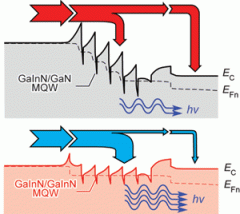
Band diagram of conventional GaInN/GaN active region and new polarization-matched GaInN/GaInN active region of a light-emitting diode.
(PhysOrg.com) -- Researchers at Rensselaer Polytechnic Institute have developed and demonstrated a new type of light emitting diode (LED) with significantly improved lighting performance and energy efficiency.
The new polarization-matched LED, developed in collaboration with Samsung Electro-Mechanics, exhibits an 18 percent increase in light output and a 22 percent increase in wall-plug efficiency, which essentially measures the amount of electricity the LED converts into light.
The new device achieves a notable reduction in “efficiency droop,” a well-known phenomenon that provokes LEDs to be most efficient when receiving low-density currents of electricity, but then to lose efficiency as higher density currents of electricity are fed into the device. The cause of this droop is not yet fully understood, but studies have shown that electron leakage is likely a large part of the problem.
“This droop is under the spotlight since today’s high-brightness LEDs are operated at current densities far beyond where efficiency peaks,” said project leader E. Fred Schubert, Wellfleet Senior Constellation Professor of Future Chips at Rensselaer, and head of the university’s National Science Foundation-funded Smart Lighting Engineering Research Center.
“This challenge has been a stumbling block, because reducing the current densities to values where LEDs are more efficient is unacceptable. Our new LED, however, which has a radically re-designed active region, namely a polarization-matched active region, tackles this issue and brings LEDs closer to being able to operate efficiently at high current densities,” Schubert said.
Results of the study are explained in a paper published online this week by Applied Physics Letters.
Focusing on the active region of LEDs where the light is generated, Schubert’s team discovered the region contained materials with mismatched polarization. The polarization mismatch likely causes electron leakage, and therefore a loss of efficiency, Schubert said.
The researchers discovered that the polarization mismatch can be strongly reduced by introducing a new quantum-barrier design. They replaced the conventional Gallium Indium Nitride/Gallium Nitride (GaInN/GaN) layer of the LED active region, and replaced it with Gallium Indium Nitride/ Gallium Indium Nitride (GaInN/GaInN). This substitution allows the layers of the active region to have a better matched polarization, and in turn reduce both electron leakage and efficiency droop.
The benefits seen by testing the new GaInN/GaInN LED were consistent with theoretical simulations showing polarization matching reducing electron leakage and efficiency droop.
Schubert expects that a new wave of lighting devices based on LEDs and solid-state lighting will supplant the common light bulb in coming years, leading to vast environmental, energy, and cost benefits as well as innovations in healthcare, transportation systems, digital displays, and computer networking.
Along with Schubert, co-authors on the paper include Rensselaer physics, Future Chips, and electrical engineering graduate students Jiuru Xu, Martin F. Schubert, and Ahmed N. Noemaun; Rensselaer Future Chips research assistant Di Zhu; Jong Kyu Kim, research assistant professor of electrical, computer, and systems engineering at Rensselaer; along with Samsung Electro-Mechanics researchers Min Ho Kim, Hun Jae Chung, Sukho Yoon, Cheolsoo Sone, and Yongjo Park.
Funding for the project was contributed by Samsung Electro-Mechanics, the U.S. National Science Foundation, the Rensselaer Smart Lighting Engineering Research Center, Sandia National Laboratories, Rochester Institute of Technology, U.S. Department of Energy, U.S. Department of Defense, Magnolia Optics, Crystal IS, Troy Research Corporation, and New York state.
For more information on Rensselaer’s Future Chips Constellation, visit: http://www.rpi.edu … ps/index.htm
Provided by Rensselaer Polytechnic Institute
-
Multitasking nanotechnology
Jul 10, 2008 |
4.8 / 5 (8) |
0
-
Fujitsu Develops Breakthrough Technology for Low-Cost Production of Gallium-Nitride HEMT
Dec 21, 2004 |
2.6 / 5 (5) |
0
-
Show Must Go On: Intel Keeps Moore's Law on Track with 65 nm Technology
Aug 30, 2004 |
1 / 5 (1) |
0
-
Ultrathin alternative to silicon for future electronics
Nov 22, 2010 |
4.6 / 5 (10) |
4
-
European Union aims to increase electronic efficiency and eliminate power consumption
Oct 27, 2010 |
not rated yet |
0
-
Engineers build first sub-10-nm carbon nanotube transistor
Feb 01, 2012 |
5 / 5 (21) |
19
-
Something old, something new: Evolution and the structural divergence of duplicate genes
Jan 31, 2012 |
4.6 / 5 (7) |
1
-
The hidden nanoworld of ice crystals: Revealing the dynamic behavior of quasi-liquid layers
Jan 30, 2012 |
5 / 5 (2) |
1
-
Stock market network reveals investor clustering
Jan 27, 2012 |
4.1 / 5 (21) |
8
-
Of microchemistry and molecules: Electronic microfluidic device synthesizes biocompatible probes
Jan 26, 2012 |
not rated yet |
0
-
E=mc2
1 hour ago
-
Are space and time things?
5 hours ago
-
Lock Magnet
9 hours ago
-
Neutrino interaction/detection?
12 hours ago
-
If an atom was scaled up to the size of a sports oval with a diameter of 150m...?
14 hours ago
-
Why no noise is added when we hear someone's voice from the other side of a wall?
16 hours ago
- More from Physics Forums - General Physics
More news stories
Renowned physicist invents microscope that can peer at living brain cells
(PhysOrg.com) -- Ever since scientists began studying the brain, theyve wanted to get a better look at what was going on. Researchers have poked and prodded and looked at dead cells under electron microscopes, ...
New kind of high-temperature photonic crystal could someday power everything from smartphones to spacecraft
A team of MIT researchers has developed a way of making a high-temperature version of a kind of materials called photonic crystals, using metals such as tungsten or tantalum. The new materials which ...
16 hours ago |
4.9 / 5 (12) |
4
|
Searching for a solid that flows like a liquid
(PhysOrg.com) -- A series of neutron scattering experiments at Oak Ridge National Laboratory and other research centers is exploring the key question about a long-sought quantum state of matter called supersolidity: ...
14 hours ago |
3 / 5 (1) |
7
|
Optics get magnetic powers
For decades, scientists have studied a class of materials called multiferroics in which static electric and magnetic structures are coupled to each other. This allows capabilities such as controlling ...
14 hours ago |
5 / 5 (1) |
0
Manipulating the texture of magnetism
Knowing how to control the combined magnetic properties of interacting electrons will provide the basis to develop an important tool for advancing spintronics: a technology that aims to harness these properties ...
14 hours ago |
5 / 5 (2) |
0
Amazon fungi found that eat polyurethane, even without oxygen
(PhysOrg.com) -- Until now polyurethane has been considered non-biodegradable, but a group of students from Yale University in the US has found fungi that will not only eat and digest it, they will do so even in the absence ...
Scientists chart high-precision map of Milky Way's magnetic fields
(PhysOrg.com) -- Scientists at the Naval Research Laboratory (NRL) are part of an international team that has pooled their radio observations into a database, producing the highest precision map to date of ...
Whole exome sequencing identifies cause of metabolic disease
Sequencing a patient's entire genome to discover the source of his or her disease is not routine yet. But geneticists are getting close.
Hearing metaphors activates brain regions involved in sensory experience
When a friend tells you she had a rough day, do you feel sandpaper under your fingers? The brain may be replaying sensory experiences to help understand common metaphors, new research suggests.
Hackers intercept FBI, Scotland Yard call (Update)
(AP) -- Trading jokes and swapping leads, investigators from the FBI and Scotland Yard spent the conference call strategizing about how to bring down the hacking collective known as Anonymous, responsible ...
Discovery of extremely long-lived proteins may provide insight into cell aging
One of the big mysteries in biology is why cells age. Now scientists at the Salk Institute for Biological Studies report that they have discovered a weakness in a component of brain cells that may explain ...
Jan 12, 2009
Rank: 2.7 / 5 (3)
Jan 12, 2009
Rank: 5 / 5 (3)
Jan 13, 2009
Rank: 3.3 / 5 (4)
Jan 13, 2009
Rank: 4.3 / 5 (4)
the Nazi's experimented with antigravity, but never succeeded. The were able to build a prototype craft that could make vertical take offs and certainly seemed like antigravity at the time, but it turns out it's just another way of generating thrust. a more effective way of getting the exact same results is hopping into a helicopter.
The only people I know who use the word, 'retard' as much as you are all between the ages of 13 and 16.
Also, it's, 'identify' not, 'edentify.' Normally I'm not picky, but you're extremely obnoxious.
Jan 13, 2009
Rank: 3 / 5 (2)
not ONE single example of actual flying!! so pathetic!
Jan 13, 2009
Rank: 3 / 5 (2)
Jan 13, 2009
Rank: 3 / 5 (2)
Jan 13, 2009
Rank: 1 / 5 (1)
Good suggestion. It's like a child who decides the best way to get attention is to scream. Ignore them until they either get tired or realize there are better ways of getting people to look at them.
Jan 16, 2009
Rank: 2 / 5 (1)
Just published in November 2008. A 400 page, highly documented piece of work from a man with 9 degrees, and multiple doctorates. He is nobody's fool. In it are detailed analysis of T. Townsend Brown's work, and that of the Rand CORP. The more secret military work in those areas is also covered.
It is an amazing book.
It is impossible to show you something if you do not have an open mind. One must also remember that the cutting edge of technology is not in books and society has many layers - you are merely in one of them. Open your mind and change your knowledge base.
It's up to you. Good Luck.
How 'bout them LED's? The technology involved does go right into these areas...........
Anti-gravitation is off the table and it will bring people and groups that you never knew existed down on your head like the the hammer of the gods in less than 48 hours. the situation is complex at best and part of the problem is that if you have anti-gravity you also have control over matter, energy, and time - so it's not a toy they want talking monkeys playing with.
Grow up first, please.
Jan 17, 2009
Rank: not rated yet
Ok, here's why I don't think anybody has figured out anti-gravitation yet. Because, according to our best current theories, gravty is merely a curvature of spacetime brought about by mass and energy. If a device were to have true anti-gravitational effects, it would have to either uncurve spacetime or completely reverse the actual type of curvature. Sorry, but we just don't have anything that can do that. I don't, however, have any problem believing that we have creating things that can fly arround and look like they are using anti-gravitational mechanics. Electromagnetism is an amazing thing and I don't doubt that somebody somewhere came up with a brilliant way to make things fly with it.
Also, I feel it neccesary to point out that anti-gravity will not give you control over matter and energy. At best, you could alter the movements of matter and energy. Actualy controlling them is a completely different story.
Jan 17, 2009
Rank: 1 / 5 (1)
All 'layers' of society....have their levels of acceptance and usage. Private, public, secret, personal, higher, lower, etc.
What makes you think that science is somehow exempted?
Think it through.
Anyway, in the end it is up to you to do the pondering and the assessing. Just remember to not limit your logic via feelings. And to understand that what we reach out with into the unknown..is with our feelings, not logic. And something that is deeply upsetting to the core..is going to engage feelings on the highest, deepest and most complete level. You run into some people who may be entirely logical but cannot 'get it' that their girlfriend who quit them 3 years back...that she does not want them...at all.
Imagine the task of trying to illustrate to an engineer, who thinks that the world is black and white, and is fixed solidly into place -by men who wrote theories over 100 years ago..to convince them to look elsewhere and with more open eyes. Not gonna happen. They'll kill you first. They'll kill you before they allow the frameworks of their lives to fall apart.
So no, what is real and/or possible is not in textbooks. Via this mechanism, this animalism deep in man...secrets -keep themselves- due to sheer human nature. And engineers are far more prone to keeping logic that scares them away from themselves..as their black and white worlds have no tolerance for things that upset them.
Sorry to sound like Morpheus, but there is some truth to it, you just have to look at it without any emotionally derived prejudice that color the logic and clouds the mind.
The methodology of logic as applied to the idea of science has been around long enough to have it's direction bastardized and shifted off course...by time and human nature..and this the area where it has become fucked- the emotional limits of the men within it, as a psychological grouping.
Engineers are not theoreticians, and they should not be listened to when it comes to expounding on the ideas of what is and what is not possible within extrapolations of theory and or new ideas. They are the LAST people to consult--as they are 'the gatekeepers of instruction books' - that are written in stone.
They may as well be versed in religion, for all that is new that they bring to the table. Technicians with glorified notes, is what they are.
So if an engineer tries to speak on what is possible in science and nature, don't forget to give them a good smack on the face or forehead -to set them to where they belong.
As for the forces being tied together as I have stated, yes-they are. The doorway to one-begets the other.
Think it through.
if you study this phenomena, of 'other science' literally gong 'underground'.. you WILL FIND IT.
Be honest with yourself and do a real search...and don't give in until it shows itself.
Good luck to you.
Jan 17, 2009
Rank: 4 / 5 (1)
Jan 18, 2009
Rank: not rated yet
phys·ics (f%u012Dz'%u012Dks) Pronunciation Key
n.
(used with a sing. verb) The science of matter and energy and of interactions between the two, grouped in traditional fields such as acoustics, optics, mechanics, thermodynamics, and electromagnetism, as well as in modern extensions including atomic and nuclear physics, cryogenics, solid-state physics, particle physics, and plasma physics.
I'm not sure why you brought up engineers. Physicists are telling you that the understanding of gravity is that you cannot simply "erase it" with some device. That is, antigravitation mechanisms are impossible. Since gravity is caused by a curvature of spacetime you can't simply make that go away at will. You can, however, generate enough thrust (force) to overcome the pull of gravity, thereby moving in a direction counter to gravity; to the naieve it looks like antigravity. But in fact this is no more antigravity than a car is an antifriction device.
Jan 22, 2009
Rank: not rated yet
Theoreticaly, you could reverse the curvature of spacetime and effectively create an area whithout the effects of gravity. I don't think that we are within a couple millenia of figuring out how to do that, though. You would have to be playing with energy in ways I can't even imagine.