XMM-Newton measures speedy spin of rare celestial object
January 13, 2009 XMM-Newton measures speedy spin of rare celestial object

Enlarge

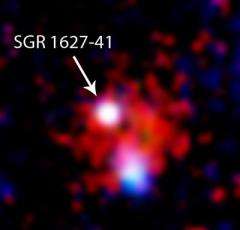
False colour X-ray image of the sky region around SGR 1627-41 obtained with XMM-Newton. The emission indicated in red comes from the debris of an exploded massive star. It covers a region more extended than that previously deduced from radio observations, surrounding the SGR. This suggests that the exploded star was the magnetar’s progenitor. Credits: ESA/XMM-Newton/EPIC (P. Esposito et al.)

(PhysOrg.com) -- XMM-Newton has caught the fading glow of a tiny celestial object, revealing its rotation rate for the first time. The new information confirms this particular object as one of an extremely rare class of stellar zombie - each one the dead heart of a star that refuses to die.

There are just five so-called Soft Gamma-ray Repeaters (SGRs) known, four in the Milky Way and one in our satellite galaxy, the Large Magellanic Cloud. Each is between 10 and 30 km across, yet contains about twice the mass of the Sun. Each one is the collapsed core of a large star that has exploded, collectively called neutron stars.

What sets the Soft Gamma-ray Repeaters apart from other neutron stars is that they possess magnetic fields that are up to 1000 times stronger. This has led astronomers to call them magnetars.

SGR 1627-41 was discovered in 1998 by NASA's Compton Gamma Ray Observatory when it burst into life emitting around a hundred short flares during a six-week period. It then faded before X-ray telescopes could measure its rotation rate. Thus, SGR 1627-41 was the only magnetar with an unknown period.

Last summer, SGR 1627-41 flared back into life. But it was located in a region of sky that ESA's XMM-Newton was unable to point at for another four months. This was because XMM-Newton has to keep its solar panels turned towards the Sun for power. So astronomers waited until Earth moved along its orbit, carrying XMM-Newton with it and bringing the object into view. During that time, SGR 1627-41 began fading fast. When it came into view in September 2008, thanks to the superior sensitivity of the EPIC instrument on XMM-Newton, it was still detectable.

A team of astronomers took the necessary observations and revealed that it rotates once every 2.6 seconds. "This makes it the second fastest rotating magnetar known," says Sandro Mereghetti, INAF/Istituto di Astrofisica Spaziale e Fisica Cosmica, Milan, one of the team.

Theorists are still puzzling over how these objects can have such strong magnetic fields. One idea is that they are born spinning very quickly, at 2-3 milliseconds. Ordinary neutron stars are born spinning at least ten times more slowly. The rapid rotation of a new-born magnetar, combined with convection patterns in its interior, gives it a highly efficient dynamo, which builds up such an enormous field.

With a rotation rate of 2.6 seconds, this magnetar must be old enough to have slowed down. Another clue to the magnetar's age is that it is still surrounded by a supernova remnant. During the measurement of its rotation rate, XMM-Newton also detected X-rays coming from the debris of an exploded star, possibly the same one that created the magnetar. "These usually fade to invisibility after a few tens of thousand years. The fact that we still see this one means it is probably only a few thousand years old", says Mereghetti.

If it flares again, the team plan to re-measure its rotation rate. Any difference will tell them how quickly the object is decelerating. There is also the chance that SGR 1627-41 will release a giant flare. Only three such events have been seen in the last 30 years, each from a different SGR, but not from SGR 1627-41.

These superflares can supply as much energy to Earth as solar flares, even though they are halfway across the Galaxy, whereas the Sun is at our celestial doorstep. "These are intriguing objects; we have much still to learn about them," says Mereghetti.

Provided by European Space Agency


print this article email this article download pdf blog this article bookmark this article     Stumble it Digg this share on Facebook retweet share on Reddit add to delicious
Rate this story - 4.3 /5 (4 votes)

Rank Filter

Move the slider to adjust rank threshold, so that you can hide some of the comments.


Display comments: newest first

  • yyz - Jan 17, 2009
    • Rank: 1 / 5 (1)
    Initially, I thought this object to have a Type Ia progenitor, a probable recurrent novae consisting of a white dwarf drawing matter off its' red giant companion & in the process spinning up the resultant neutron star & winding up its magnetic field as seen in magnetars. A reply to my comment (posted at Universe Today by GBendt( see this story & comments posted at Universe Today 1-13-09) lays out the case that this object was probably a Type II event( subtype non-specified) which implies a 'core-collapse' event by a single star. No mention was made in the ESA press release as to the progenitors' type (Note that a Type II event can also spin-up a neuron star-magnetar)(Thanks GBendt). But nowhere can I pin down exactly what type of SN event produced this SGR-magnetar. Colliding WD-NS and NS-NS scenarios also can't be ruled out. So my question is what was the leading theory for the progenitor(s) of this enigmatic object?

January 13, 2009 all stories

Comments: 1

4.3 /5 (4 votes)
  • Stumble this up

  • Digg this

  • share this

  • hide
  • Related Stories

  • First gamma-ray-only pulsar observation opens new window on stellar evolution
    created Oct 16, 2008 | popularity not rated yet | comments 0
  • Powerful explosions suggest neutron star missing link
    created Feb 21, 2008 | popularity not rated yet | comments 0
  • XMM-Newton finds the leader of the Magnificent Seven in a spin
    created Mar 09, 2007 | popularity not rated yet | comments 0
  • New technique improves estimates of pulsar ages
    created Jun 09, 2009 | popularity not rated yet | comments 0
  • A young pulsar shows its hand
    created Apr 03, 2009 | popularity not rated yet | comments 0


  • hide
  • Relevant PhysicsForums posts

  • The shape of our solar system's orbits.
    created Nov 07, 2009
  • Above or Below the Line of Nodes
    created Nov 07, 2009
  • Supernova vs. Nova?
    created Nov 07, 2009
  • Supernova's Gamma Rays and Comets
    created Nov 06, 2009
  • More from Physics Forums - General Astronomy

Other News

Deep creep means milder, more frequent earthquakes along Southern California's San Jacinto fault

Deep creep means milder, more frequent earthquakes along Southern California's San Jacinto fault

Space & Earth / Earth Sciences

created 15 hours ago | popularity 4.7 / 5 (3) | comments 0

With an average of four mini-earthquakes per day, Southern California's San Jacinto fault constantly adjusts to make it a less likely candidate for a major earthquake than its quiet neighbor to the east, the ...


Success in 'space elevator' competition (AP)

Success in 'space elevator' competition (Update 3)

Space & Earth / Space Exploration

created Nov 05, 2009 | popularity 4.3 / 5 (33) | comments 50

(AP) -- A robot powered by a ground-based laser beam climbed a long cable dangling from a helicopter on Wednesday to qualify for prize money in a $2 million competition to test the potential reality of the ...


In a Galaxy Far, Far Away...

In a Galaxy Far, Far Away...

Space & Earth / Astronomy

created Nov 06, 2009 | popularity 4.8 / 5 (5) | comments 17

(PhysOrg.com) -- Astronomers have published the discovery of the farthest known object in the cosmos: a star that exploded when the universe was only 630 million years old -- only 4.6% of its current age. ...


'Dropouts' pinpoint earliest galaxies

'Dropouts' pinpoint earliest galaxies

Space & Earth / Astronomy

created Nov 06, 2009 | popularity 4.2 / 5 (10) | comments 13

Astronomers, conducting the broadest survey to date of galaxies from about 800 million years after the Big Bang, have found 22 early galaxies and confirmed the age of one by its characteristic hydrogen signature ...


Space hotel taking bookings for 2012 opening

Space hotel taking bookings for 2012 opening

Space & Earth / Space Exploration

created Nov 05, 2009 | popularity 4.4 / 5 (21) | comments 11

(PhysOrg.com) -- The first orbiting space hotel is on track to open for its first customers in 2012, but hurry, as bookings are filling fast.