Scientists develop new tool to improve oral hygiene
January 13, 2009 Inspektor TC

Inspektor TC

(PhysOrg.com) -- Scientists at the University of Liverpool have developed a new dental product to identify plaque build-up in the mouth before it is visible to the human eye.

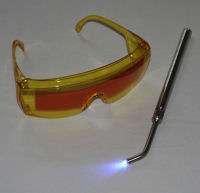
The toothbrush-sized product has a blue light at its tip, which, when shone around the mouth and viewed through yellow glasses with a red filter, allows plaque to be seen easily as a red glow. The device, produced in collaboration with dental and healthcare developers, Inspektor Research Systems BV, has been designed for everyday use in the home.

Dentists currently use disclosing agents in tablet form to uncover tooth decay and plaque but these often stain the mouth and taste unpleasant. The new product, known as Inspektor TC, will be particularly useful for those who are vulnerable to dental diseases such as children and the elderly.

Children in the UK have had an average of 2.5 teeth filled or removed by the age of 15 because of tooth decay. In young people alone £45 million is currently being spent every year on the problem.

Professor Sue Higham, from the University's School of Dental Sciences, said: "It is extremely difficult to get rid of all plaque in the mouth. Left undisturbed it becomes what we call 'mature' plaque and gets thicker. This is what leads to gingivitis, or bleeding gums, and decay.

"Early stage plaque is invisible, and so this device will show people the parts of the mouth that they are neglecting when they brush their teeth, enabling them to remove plaque before it becomes a problem.

"Inspektor TC is designed so that people can easily incorporate it into their daily dental hygiene routine at home. We now hope to work with industry partners to develop this prototype so that people can use it in the home to identify plaque before any serious dental work is needed."

The team has now received a Medical Futures Innovation Award for the product - a commendation which acknowledges significant innovation in science.

Provided by University of Liverpool


print this article email this article download pdf blog this article bookmark this article     Stumble it Digg this share on Facebook retweet share on Reddit add to delicious
Rate this story - 5 /5 (3 votes)

Rank Filter

Move the slider to adjust rank threshold, so that you can hide some of the comments.


Display comments: newest first

  • googleplex - Jan 13, 2009
    • Rank: not rated yet
    Sounds great. Is it normal blue light or cell mutating UV?
  • el_gramador - Jan 14, 2009
    • Rank: not rated yet
    It can't be cell mutating UV because then there would be anything to cause infection around the mouth. Remember, Blue is nice, but UV kills twice.

January 13, 2009 all stories

Comments: 2

5 /5 (3 votes)
  • Stumble this up

  • Digg this

  • share this

  • hide
  • Related Stories

  • Open wide and say 'zap'
    created Aug 18, 2009 | popularity not rated yet | comments 0
  • Diets bad for teeth are also bad for the body
    created Jul 09, 2009 | popularity not rated yet | comments 0
  • Oral/body inflammatory connection explained
    created Jul 09, 2009 | popularity not rated yet | comments 0
  • The more oral bacteria, the higher the risk of heart attack
    created Apr 01, 2009 | popularity not rated yet | comments 0
  • How to ... keep teeth whiter
    created Jan 23, 2009 | popularity not rated yet | comments 0


  • hide
  • Relevant PhysicsForums posts

Other News

Breast density associated with increased risk of cancer recurrence

Medicine & Health / Cancer

created 2 hours ago | popularity not rated yet | comments 0

A new study finds that women treated for breast cancer are at higher risk of cancer recurrence if they have dense breasts. Published in the December 15, 2009 issue of Cancer, a peer-reviewed journal of the American Cancer ...


Scientists uncover new key to the puzzle of hormone therapy and breast cancer

Scientists uncover new key to the puzzle of hormone therapy and breast cancer

Medicine & Health / Cancer

created 3 hours ago | popularity 5 / 5 (1) | comments 0

The use of postmenopausal hormone therapy has decreased over time in the United States, which researchers suggest may play a key role in the declining rate of atypical ductal hyperplasia, a known risk factor ...


Young tennis players who play only 1 sport are more prone to injuries

Young tennis players who play only one sport are more prone to injuries

Medicine & Health / Health

created 3 hours ago | popularity not rated yet | comments 0

Gifted young athletes are under increasing pressure to play only one sport year round.


Lawmaker wants probe of E. coli and school lunches

Medicine & Health / Diseases

created 3 hours ago | popularity not rated yet | comments 0

(AP) -- The chairman of the House Education and Labor Committee wants an investigation into the risk of deadly E. coli getting into school lunches.


Developmental delay could stem from nicotinic receptor deletion

Medicine & Health / Genetics

created 18 hours ago | popularity 4.7 / 5 (3) | comments 0

The loss of a gene through deletion of genetic material on chromosome 15 is associated with significant abnormalities in learning and behavior, said a consortium of researchers led by Baylor College of Medicine in a report ...