'Smart' fridges stay cool by talking to each other
January 13, 2009
'Smart' fridges stay cool by talking to each other

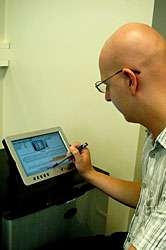
CSIRO's Sam West demonstrating the workings of the interactive management screen on one of the demonstration 'smart fridges'

(PhysOrg.com) -- 'Smart' fridges that run on renewable electricity and are capable of negotiating the most energy efficient way to keep food cold have been developed by researchers from CSIRO’s Energy Transformed Flagship.

CSIRO’s Intelligent Energy team have developed a fridge capable of maintaining its average temperature while regulating its power consumption from renewable-energy generators, such as solar panels (photovoltaics) or wind turbines.

CSIRO Engineer, Sam West, says the smart fridges work as a network of distributed fridges, each fitted with control technology that allows them to communicate with each other via a network to share and store the energy provided by renewable-power generators.

“The fridges are designed to talk to each other, negotiating when it’s a good time to consume electricity and when it’s better not to,” Mr West says. “These scheduling decisions improve the quality of electricity produced by renewables and can help increase renewable uptake in the energy market.”

During the day, for example, supplies of electricity generated from photovoltaics can be interrupted by cloud cover resulting in periods of variable power supply.

“These fluctuations are bad for the electricity grid,” Mr West says. “Rapid variations in electricity flow can destabilise the grid and result in blackouts and other unwanted side-effects, but your fridge can help smooth out these fluctuations if it turns on and off at the right time.

“The fridges work together to decide when to cool down, and thus consume power, based on how much surplus power will be available. They are able to anticipate power shortages and change their running schedules accordingly to use as little power as possible during these times. In short, the fridges are working cooperatively to use the available power supply efficiently.”

The fridges can also be used to store energy.

“The surplus electricity produced by solar panels can be used to lower the fridge temperature a few degrees more than necessary to create a thermal energy store which will keep the fridge’s contents cold during the night,” Mr West says. “Another benefit is that by reducing the amount of electricity required during peak-demand periods, we can avoid the need to build more network infrastructure such as new power stations.

“Using less electricity is always preferable to generating more and is the simplest way to reduce greenhouse gas emissions. Refrigeration can be very energy intensive but by harnessing renewable power this technology offers a low-emission solution to keeping food and other perishables cold.”

CSIRO is currently seeking commercial partners to further develop the technology.

Provided by CSIRO

Filter


Move the slider to adjust rank threshold, so that you can hide some of the comments.


Display comments: newest first

DGBEACH
Jan 13, 2009

Rank: not rated yet
Simply lowering the temp in your fridge a few degrees and then putting it on a timer, so it turns off during peek times, would have the same net affect. Besides, air conditioning and heating are the systems which consume the most in a household, not the refrigerator.
E_L_Earnhardt
Jan 13, 2009

Rank: not rated yet
Good work! The refrigerator takes the prize for averaging the greatest drain on power year-round!
Rank not rated yet
Relevant PhysicsForums posts
  • How to tilt a object
    created2 hours ago
  • How to calculate total compressibility in liquid porous solid system
    created8 hours ago
  • Need help reading 3-D
    createdFeb 11, 2012
  • A way to send and receive wireless data
    createdFeb 11, 2012
  • Calling function with no input argument
    createdFeb 10, 2012
  • Force free body diagram problem on gym equipment
    createdFeb 10, 2012
  • More from Physics Forums - General Engineering

More news stories

Google might launch Drive for cloud storage soon

(PhysOrg.com) -- Google's next big move, according to the Wall Street Journal, is a cloud storage service called Drive. Hardly first to the plate, Google is simply catching up to introducing its cloud reposi ...

Technology / Internet

created 16 hours ago | popularity 4.8 / 5 (5) | comments 5 | with audio podcast report

Iran blocks email, restricts net access: reports

Iran has further restricted access to the Internet and blocked popular email services for the past few days, in a move a top lawmaker said could "cost the regime dearly," media reports said on Sunday.

Technology / Internet

created 9 hours ago | popularity 5 / 5 (2) | comments 5

Love a click away in Indonesia's Twitter Republic

He was a geeky kid from Yogyakarta, she a glamorous city girl in Jakarta. In a country with one of the world's most vibrant social networking scenes they fell in love on Twitter.

Technology / Internet

created 17 hours ago | popularity 4 / 5 (1) | comments 0

Walney offshore wind farm is world's biggest (for now)

(PhysOrg.com) -- The Walney wind farm on the Irish Sea--characterized by high tides, waves and windy weather--officially opened this week. The farm is treated in the press as a very big deal as the Walney ...

Technology / Energy & Green Tech

created Feb 11, 2012 | popularity 4.1 / 5 (14) | comments 52 | with audio podcast weblog

Navy to begin tests on electromagnetic railgun prototype launcher

The Office of Naval Research (ONR)'s Electromagnetic (EM) Railgun program will take an important step forward in the coming weeks when the first industry railgun prototype launcher is tested at a facility ...

Technology / Engineering

created Feb 06, 2012 | popularity 4.5 / 5 (19) | comments 95 | with audio podcast


Scientists discover molecular secrets of 2,000-year-old Chinese herbal remedy

For roughly two thousand years, Chinese herbalists have treated Malaria using a root extract, commonly known as Chang Shan, from a type of hydrangea that grows in Tibet and Nepal. More recent studies suggest that halofuginone, ...

New method to examine batteries -- MRI from the inside

There is an ever-increasing need for advanced batteries for portable electronics, such as phones, cameras, and music players, but also to power electric vehicles and to facilitate the distribution and storage of energy derived ...

A mitosis mystery solved: How chromosomes align perfectly in a dividing cell

Although the process of mitotic cell division has been studied intensely for more than 50 years, Whitehead Institute researchers have only now solved the mystery of how cells correctly align their chromosomes during symmetric ...

Lab study raises questions over nano-particle impact

Tests involving chickens have raised questions about the impact on health from engineered nano-particles, the ultra-fine grains commonly used in drugs and processed foods, scientists said on Sunday.

Starve a virus, feed a cure? Findings show how some cells protect themselves against HIV

A protein that protects some of our immune cells from the most common and virulent form of HIV works by starving the virus of the molecular building blocks that it needs to replicate, according to research published online ...

Researchers find extensive RNA editing in human transcriptome

In a new study published online in Nature Biotechnology, researchers from BGI, the world's largest genomics organization, reported the evidence of extensive RNA editing in a human cell line by analysis of RNA-seq data, demons ...