Super Sensitive Gas Detector Goes Down the Nanotubes
January 13, 2009 Super Sensitive Gas Detector Goes Down the Nanotubes

Enlarge

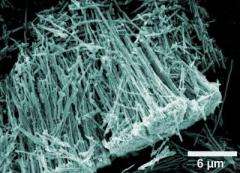
NIST researchers have developed a new technique to form nanotubes for use in gas sensing applications. One hundred to 1,000 times more sensitive than comparable sensors, their device could be used to study biological cell stress and cell communication. Credit: NIST

When cells are under stress, they blow off steam by releasing minute amounts of nitrogen oxides and other toxic gases. In a recent paper,* researchers at the National Institute of Standards and Technology described a new method for creating gas detectors so sensitive that some day they may be able to register these tiny emissions from a single cell, providing a new way to determine if drugs or nanoparticles harm cells or to study how cells communicate with one another. Based on metal oxide nanotubes, the new sensors are a hundred to 1,000 times more sensitive than current devices based on thin films and are able to act as multiple sensors simultaneously.

Gas sensors often operate by detecting the subtle changes that deposited gas molecules make in the way electricity moves through a surface layer. Thus, the more surface available, the more sensitive the sensor will be. Scientists are interested in developing gas sensors based on nanotubes because, having walls that are only a few nanometers thick, they are almost all surface.

Although nanotubes have proven to be well suited for gas sensing applications, fabricating the devices themselves is a difficult, imprecise and time-consuming process, according to Kurt Benkstein, an author of the paper. Older methods include randomly scattering free nanotubes on a surface with preformed electrical contacts (the hope being that a least a few of the nanotubes would tumble into place) or laying contacts over the top of the nanotubes after they had been dispersed, among others. These methods, though they can result in functional devices, preclude researchers from knowing where exactly the reactions are happening on the substrate. This makes it impossible to do multiple simultaneous tests. Also, these sensors are not as sensitive as they could be because there is no way to ensure that the gas is reacting with the interior of the tube.

To address these problems, the NIST group built upon another design using a sheet of aluminum oxide about the thickness of a human hair and perforated with millions of holes about 200 nanometers wide. With the nanosized pores serving as a mold, the researchers dipped the aluminum oxide sheet in a solution of tungsten ions, coating the interior of the pores and casting the nanotubes in place. After the nanotubes were formed, the team deposited thin layers of gold on the top and bottom of the aluminum oxide membrane to act as electrical contacts. View schematic of the nanotube sensor at http://patapsco.nist.gov/ImageGallery/details.cfm?imageid=620.

The sensor’s high sensitivity derives from its design, which ensures that any sensor response is the result of the gas interacting with the interior of the nanotube. The researchers also note that this same technique can easily be adapted to form nanotubes of other semiconductors and metal oxides so long as the ends of the nanotubes remain open.

Note:

* R. Artzi-Gerlitz, K. Benkstein, D. Lahr, J. Hertz, C. Montgomery, J. Bonevich, S. Semancik, M. Tarlov. Fabrication and gas sensing performance of parallel assemblies of metal oxide nanotubes supported by porous aluminum oxide membranes. Sensors and Actuators B: Chemical. Available online Nov. 11, 2008.

Source: National Institute of Standards and Technology


print this article email this article download pdf blog this article bookmark this article     Stumble it Digg this share on Facebook retweet share on Reddit add to delicious
Rate this story - not rated yet


January 13, 2009 all stories

Comments: 0

not rated yet
  • Stumble this up

  • Digg this

  • share this

  • hide
  • Related Stories

  • Engineers lay groundwork for 'vertically oriented nanoelectronics'
    created Aug 01, 2006 | popularity not rated yet | comments 0
  • Nanohelix structure provides new building block for nanoscale piezoelectric devices
    created Sep 08, 2005 | popularity not rated yet | comments 0
  • Tiny Music Player Made from Wire Bridge (w/ Video)
    created Nov 04, 2009 | popularity not rated yet | comments 0
  • New aluminum-water rocket propellant promising for future space missions
    created Oct 07, 2009 | popularity not rated yet | comments 0
  • Bringing solar power to the masses
    created Aug 05, 2009 | popularity not rated yet | comments 0


  • hide
  • Relevant PhysicsForums posts

  • Polymer Properties Question
    created 21 hours ago
  • Fatigue Properties of Chinese steel
    created Nov 04, 2009
  • Finding Hardness values
    created Nov 04, 2009
  • Fluid flow, pressure drop simulation in Comsol
    created Nov 04, 2009
  • More from Physics Forums - Materials & Chemical Engineering

Other News

Engineers image nanostructure of a solid acid catalyst and boost its catalytic activity

Nanotechnology / Nanomaterials

created 2 hours ago | popularity 5 / 5 (1) | comments 1

The catalytic processes that facilitate the production of many chemicals and fuels could become much more environmentally friendly thanks to a breakthrough achieved by researchers from Lehigh and Rice Universities.


New transparent insulating film could enable energy-efficient displays

New transparent insulating film could enable energy-efficient displays

Nanotechnology / Nanomaterials

created 6 hours ago | popularity 4.8 / 5 (6) | comments 0

Johns Hopkins materials scientists have found a new use for a chemical compound that has traditionally been viewed as an electrical conductor, a substance that allows electricity to flow through it. By orienting ...


Ideal nanoparticle cancer therapies surf the bloodstream

Nanotechnology / Bio & Medicine

created 6 hours ago | popularity 5 / 5 (1) | comments 0

Eric Shaqfeh studies blood at Stanford University, using computer models that simulate how the fluid and the cells it contains move around. On November 11 at a meeting of the scientific society AVS, he will present his latest ...


New Digital 'Electronics' Concept May Continue Moore's Law

New Digital 'Electronics' Concept May Continue Moore's Law

Nanotechnology / Nanophysics

created Nov 05, 2009 | popularity 4.6 / 5 (56) | comments 9

(PhysOrg.com) -- Computers of the future could be operating not on electrons, but on tiny waves traveling through an electron "fluid," if a new proposal is successful. The new circuit design, recently introduced ...


Findings show nanomedicine promising for treating spinal cord injuries

Findings show nanomedicine promising for treating spinal cord injuries

Nanotechnology / Bio & Medicine

created Nov 08, 2009 | popularity 4.5 / 5 (4) | comments 0

(PhysOrg.com) -- Researchers at Purdue University have discovered a new approach for repairing damaged nerve fibers in spinal cord injuries using nano-spheres that could be injected into the blood shortly ...