High-tech imaging of inner ear sheds light on hearing, behavior of oldest fossil bird
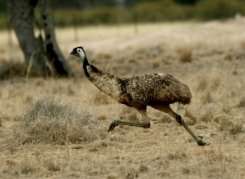
The earliest known bird, the magpie-sized Archaeopteryx, had a similar hearing range to the modern emu, which suggests that the 145 million-year-old creature — despite its reptilian teeth and long tail — was more birdlike than reptilian, according to new research published today.
Using innovative modern technology, a team of paleontologists and biologists from London, Munich and Ohio have shown for the first time how the length of the inner ear of birds and reptiles can be used to accurately predict their hearing ability and even aspects of their behavior.
"In modern living reptiles and birds we found that the length of the bony canal containing the sensory tissue of the inner ear is strongly related to their hearing ability," said study co-author Paul Barrett, a palaeontologist at London's Natural History Museum. "We were then able to use these results to predict how extinct birds and reptiles may have heard and found that Archaeopteryx had an average hearing range of approximately 2000 Hz. This means it had similar hearing to modern emus, which have some of the most limited hearing ranges of modern birds."
Researchers previously have only been able to estimate how prehistoric animals heard by examining the skulls of damaged fossils and relating brain region size to hearing ability, based on comparisons to the animals' modern relatives. Computed tomography or CT imaging, however, allowed the team to accurately reconstruct the inner ear anatomy of various intact bird and reptile specimens. Fifty-nine species were studied, including turtles, crocodiles, snakes and birds.
"By examining the three dimensional CT scans we were able to see for the first time the real relationship between hearing ability and behavior in extinct reptiles and birds," said Stig Walsh, Natural History Museum palaeontologist and lead author on the study. "The size of the cochlea duct (the bony part of the inner ear housing the hearing organ) in living birds and reptiles accurately predicts the hearing ranges of these animals. This simple measurement can therefore provide a direct means for determining hearing capabilities, and possibly behavior, in their extinct relatives, including Archaeopteryx."
The study, published in the latest issue of the journal Proceedings of the Royal Society B, also adds more information about how bird-like Archaeopteryx was, said Angela Milner, also from the Natural History Museum. "Our previous research has shown that the part of the ear that controls balance was just like that of modern birds, and now we know that Archaeopteryx had bird-like hearing too," she said.
Other team members included Geoff Manley from the Technical University of Munich, who is a leading scientist in the study of hearing in modern animals, and Lawrence Witmer of Ohio University's College of Osteopathic Medicine in Athens, Ohio. Witmer has studied the structure of the brain and inner ear in dozens of species of dinosaurs and modern and extinct birds, including Archaeopteryx.
"This delicate little inner ear has only recently become a player for those of us trying to interpret the past, because it's buried deep within the skull," said Witmer, whose research is funded by the National Science Foundation. "Thanks to CT scanning, we can now get a clear picture of its structure. It's turned out to be a pretty useful organ for deciphering the lives of extinct animals. My previous research has shown that inner ear structure also can tell us about eye movements, head posture, agility, and the relative importance of hearing, and this new study now shows that this sensory Swiss-army knife can tell us about sociality, vocal complexity and maybe even habitat preference."
Animals with a long cochlear duct tended to have the best hearing and vocal ability. Modern living bird species are known to possess relatively longer cochlear ducts than living reptiles. A long cochlear duct is also an indicator of an individual's complex vocal communication, living in groups and even habitat choice. This is true for both mammals and birds.
"Species that form large social groups have more complicated vocal communication, which is understandably influenced by an individual's ability to hear. Species living in a closed environment where visual communication is ineffective often posses more complex vocal abilities, so now we can more accurately predict the habitat types that extinct animals lived in by examining their ability to hear and communicate," Barrett said.
Source: Ohio University


