Giant Rockets Could Revolutionize Astronomy
In the game of astronomy, size matters. To get crisp, clear images of things billions of light years away, a telescope needs to be big.
"The bigger the better," says astronomer Harley Thronson, who leads advanced concept studies in astronomy at the Goddard Space Flight Center. And he thinks "NASA's new Ares V rocket is going to completely change the rules of the game."
Ares V is the rocket that will deliver NASA's next manned lunar lander to the moon as well as all the cargo needed for a lunar base. Its roomy shroud could hold about eight school buses, and the rocket will pack enough power to boost almost 180,000 kg (396,000 lbs -- about 16 or 17 school buses) into low Earth orbit. Ares V can haul six times more mass and three times the volume the space shuttle can.
"Imagine the kind of telescope a rocket like that could launch," says Thronson. "It could revolutionize astronomy."
Optical engineer Phil Stahl of the Marshall Space Flight Center offers this example: "Ares V could carry an 8-meter diameter monolithic telescope, something that we already have the technology to build. The risk would be relatively low, and there are some big cost advantages in not having to cram a large telescope into a smaller launcher."
For comparison, he points out that Hubble is only 2.4 meters wide.
An 8-meter monolithic telescope would see things more than three times as sharply as Hubble can. More importantly, in the same amount of observing time, the larger mirror would see objects that are about 11 times fainter than Hubble sees because the 8-meter telescope has 11 times the light collecting area.
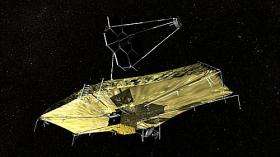
But Ares V can go yet bigger. It could transport a huge segmented telescope - one with several separate mirror panels that are folded up for transport like the James Webb Space Telescope--but three times the size!
The Space Telescope Science Institute's Marc Postman has been planning a 16-meter segmented optical/ultraviolet telescope called ATLAST, short for Advanced Technology Large-Aperture Space Telescope. The science from an aperture its size would be spectacular.
"ATLAST would be nearly 2000 times more sensitive than the Hubble Telescope and would provide images about seven times sharper than either Hubble or James Webb," says Postman. "It could help us find the long sought answer to a very compelling question -- 'Is there life elsewhere in the galaxy?'"
ATLAST's superior sensitivity would allow astronomers to hugely increase their sample size of stars for observation. Then, discovery of planets hospitable to life could be just around the corner!
"With our space-based telescope, we could obtain the spectrum of Earth-mass planets orbiting a huge number of nearby [60 - 70 light years from Earth] stars," says Postman. "We could detect any oxygen and water in the planets' spectral signatures. ATLAST could also precisely determine the birth dates of stars in nearby galaxies, giving us an accurate description of how galaxies assemble their stars."
This telescope could also probe the link between galaxies and black holes. Scientists know that almost all modern galaxies have supermassive black holes in their centers. "There must be a fundamental relationship between the formation of supermassive black holes and the formation of galaxies," explains Postman, "but we don't understand the nature of that relationship. Do black holes form first and act as seeds for the growth of galaxies around them? Or do galaxies form first and serve as incubators for supermassive black holes? A large UV/optical telescope could answer this question: If our telescope finds ancient galaxies that do not have supermassive black holes in their centers, it will mean galaxies can exist without them."
Dan Lester of the University of Texas at Austin envisions another 16-meter telescope, this one for detecting far-infrared wavelengths.
"The far-infrared telescope is quite different from, and quite complementary to, the optical telescopes of Stahl and Postman," says Lester. "In the far-infrared part of the spectrum, we generally aren't looking at starlight itself, but at the glow of warm dust and gas that surrounds the stars. In the very early stages of star formation, the proto-star is surrounded by layers of dust that visible light can't penetrate. Our telescope will allow us to see down into the innards of these giant dense clouds that are forming stars deep inside."
Observations in the far-infrared are especially challenging. These long wavelengths are hundreds of times larger than visible light, so it's hard to get a clear picture. "A very big telescope is necessary for good clarity at IR wavelengths," notes Lester.
Like the telescopes of Stahl and Postman, Lester's Single Aperture Far-Infrared Telescope ('SAFIR' for short), comes in two flavors for the Ares V: an 8-meter monolithic version and a 16-meter segmented version. Lester realized that, with an Ares V, he could launch an 8-meter telescope that didn't need complicated folding and unfolding. "But on the other hand, if we don't mind adding the complexity and cost of folding and still use an Ares V, we could launch a really mammoth telescope," says Lester.
In addition to all the above telescopes, Ares V could boost an 8-meter-class X-ray telescope into space. NASA's highly-successful Chandra X-ray Observatory has a 1 meter diameter mirror, so just imagine what an 8-meter Chandra might reveal!
Roger Brissenden of the Chandra X-ray Center is excited about the possibility of a future 8-meter-class X-ray telescope called Gen-X.
"Gen-X would be an extraordinarily powerful X-ray observatory that could open up new frontiers in astrophysics," he says. "This telescope will observe the very first black holes, stars and galaxies, born just a few hundred million years after the Big Bang, and help us determine how these evolve with time. Right now, the study of the young universe is almost purely in the realm of theory, but with Gen-X's extreme sensitivity (more than 1000 times that of Chandra) these early objects would be revealed."
Indeed, Ares V flings shutters open wide on our view of the cosmos. It shakes off the shackles of mass and volume constraints from science missions and sweeps us into deep space to view "...a hundred things/ You have not dreamed of."
"We could get incredible astronomy from this big rocket," says Thronson, a professional dreamer. "I can't wait."
Source: by Dauna Coulter, Science@NASA


