Exoplanet atmospheres detected from Earth for the first time
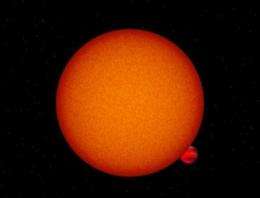
January 14th, 2009 Artist's Impression of the Star OGLE-TR-56 and its Planet

Enlarge

This is an artist's impression of the star OGLE-TR-56 and its planet, as the planet is passing behind the star. Credit: D. Sing (IAP) / A&A

(PhysOrg.com) -- Transiting exoplanets are routinely detected when they pass in front of their parent star as viewed from the Earth, which only happens by chance. The transit event causes a small drop in the observed starlight, which can then be detected. Fifty-five exoplanets have been detected this way since the observation of the first transiting planet HD 209458 b in 1999.

When the planet revolves around its star or when it goes behind, the light coming from the system also varies, though the resulting smaller modulation is much harder to detect. This is mostly due to the small amount of light emitted by these exoplanets which are believed to be as dark as coal and reflect little of the incoming starlight. Fortunately, some of these planets are very hot, thus emitting light, mostly at infrared wavelengths. Up to now, detections of this kind have only been made using the Spitzer infrared space telescope.

This week, Astronomy & Astrophysics is publishing the two first ground-based detections of thermal emission from transiting, hot-Jupiter exoplanets, from two independent teams of astronomers that used different approaches.

One team includes Ernst De Mooij and Ignas Snellen (University of Leiden, Netherlands) who used the William Hershel 4.2 meter telescope in La Palma (Canary Islands, Spain) to observe the star TrES-3 and its planet TrES-3b. To be able to detect the light coming from the planet, they observed the planet exactly at the time when it passes behind the star.

They observed the event at infrared wavelengths, where the planet is at its brightest compared to the star (even if the planet is still much fainter than the star!) As they detected the light coming from the planet, they estimated the temperature of its atmosphere to about 2000 Kelvins. This indicates that the day side of the planet is extremely hot.

The other team, involving David Sing (IAP, France) and Mercedes Lopez-Morales (Carnegie Institution of Washington, USA), had a different approach. They looked at a much fainter star and its planet, OGLE-TR-56b. This planet is one of the most irradiated planets known so far, both because the planet is very close to the star and because the star is very hot. To detect the slight modulation in light that occurs when the planet passes behind its star, they used the 8 meter Very Large Telescope (ESO, Chile) and the 6.5 meter Magellan Telescopes (Las Campanas, Chile) and were able to observe this event at visible wavelengths.

Indeed, the planet OGLE-TR-56b is heated so much by its star that it emits detectable amounts of light in the visible wavelengths, and not only in the infrared as TrES-3b does. Hence, Sing and Lopez-Morales measured the record-high temperature of a planetary atmosphere: 2700 Kelvins. As in the case of TrES-3b, such a high day-side temperature indicates that winds cannot redistribute the heat efficiently from the day side to the night side.

These two independent results are very interesting for astronomers and planetary scientists because they allow a direct probe of the temperature of these planetary atmospheres, and because they show that such measurements can be made from ground-based observatories, and not only when using space telescopes.

Provided by Astronomy & Astrophysics


print this article email this article download pdf blog this article bookmark this article     Digg this Stumble it share on Facebook share on Reddit add to delicious save to Yahoo! bookmarks
4.5/5 after 12 votes

Rank Filter

Move the slider to adjust rank threshold, so that you can hide some of the comments.


Display comments: newest first

  • el_gramador - Jan 15, 2009
    • Rank: 2 / 5 (1)
    Cue "burn baby burn"
  • yyz - Jan 17, 2009
    • Rank: 1 / 5 (1)
    Any chance that large Earth-bound observatories, HST or Spitzer may be able to unambiguously detect elements or hi-temp compounds in the atmospheres of these planets? I realize that disentangling these complex spectra will not be easy, but is it now possible to do so (however crudely), or will this have to await larger ground-based telescopes or the likes of the Webb Space Telescope?
  • theophys - Jan 17, 2009
    • Rank: 5 / 5 (1)
    Any chance that large Earth-bound observatories, HST or Spitzer may be able to unambiguously detect elements or hi-temp compounds in the atmospheres of these planets? I realize that disentangling these complex spectra will not be easy, but is it now possible to do so (however crudely),

    I don't see why not.
  • yyz - Jan 17, 2009
    • Rank: 1 / 5 (1)
    Would large radio telescope networks (VLBI comes to mind) be of any use with objects of this type? Could a radio interferometers' extremely high resolution be of any use, if not to chemically characterize atmospheric constituents, than to provide other useful properties of these transiting exoplanets (e.g. precise orbital predictions, magnetic fields (if any), debris disks, planet and atmospheric densities and more precise temperatures, etc)?

January 14th, 2009 all stories
Space & Earth / Astronomy

Comments: 4
Rank: 4.5/5 after 12 votes

  • Stumble this up

  • Digg this

  • Share it:
  • share on Facebook
  • share on MySpace
  • share on Slashdot
  • rss-newsfeed
  • share on Google
  • share on Reddit
  • add to delicious
  • save to Yahoo! bookmarks
  • share on Windows Live
  • Add to Mixx!
Rating: 4.5/5 after 12 votes

  • Related Stories

  • Global warming tactic cools climate but won’t help corals, say researchers
    created Jul 03, 2009 | popularity not rated yet | comments 0
  • Earth's most prominent rainfall feature creeping northward
    created Jul 01, 2009 | popularity not rated yet | comments 0
  • Shaken and Stirred: Lab Studies Ice From Frigid Worlds
    created Jun 17, 2009 | popularity not rated yet | comments 0
  • Global sunscreen won't save corals
    created Jun 16, 2009 | popularity not rated yet | comments 0
  • Scientists predict greater longevity for planets with life
    created Jun 13, 2009 | popularity not rated yet | comments 0


  • Physicists Demonstrate Quantum Memory with Matter Qubits
    Physicists Demonstrate Quantum Memory with Matter Qubits
    Physics / General Physics
    created Jul 03, 2009 | popularity 4.4 / 5 (17) | comments 1
  • 'Holey' Nanosheets for Wastewater Dye Removal
    Nanotechnology / Nanomaterials
    created Jul 01, 2009 | popularity 5 / 5 (5) | comments 1
  • Jellyfish Robot Swims Like its Biological Counterpart
    Jellyfish Robot Swims Like its Biological Counterpart
    Electronics / Robotics
    created Jun 26, 2009 | popularity 4.4 / 5 (8) | comments 1
  • Could Maxwell's Demon Exist in Nanoscale Systems?
    Could Maxwell's Demon Exist in Nanoscale Systems?
    Physics / General Physics
    created Jun 24, 2009 | popularity 4.4 / 5 (18) | comments 29
  • Living Safely with Robots, Beyond Asimov's Laws
    Living Safely with Robots, Beyond Asimov's Laws
    Electronics / Robotics
    created Jun 22, 2009 | popularity 4.6 / 5 (52) | comments 40
  • Other News

    Forty years ago man first walked on the moon

    Space & Earth / Space Exploration

    created 16 hours ago | popularity 4.3 / 5 (3) | comments 2

    Forty years ago on July 20, 1969, American astronaut Neil Armstrong realized the oldest dream of human civilizations when he became the first man to walk on the moon.


    The least sea ice in 800 years

    The least sea ice in 800 years

    Space & Earth / Earth Sciences

    created Jul 01, 2009 | popularity 4.2 / 5 (62) | comments 59

    New research, which reconstructs the extent of ice in the sea between Greenland and Svalbard from the 13th century to the present indicates that there has never been so little sea ice as there is now. The ...


    Gas around young galaxy

    Intense heat killed the Universe's would-be galaxies, researchers say

    Space & Earth / Astronomy

    created Jul 01, 2009 | popularity 3.4 / 5 (21) | comments 27

    (PhysOrg.com) -- Our Milky Way galaxy only survived because it was already immersed in a large clump of dark matter which trapped gases inside it, scientists led by Durham University's Institute for Computational ...


    Scientists' Drill Hits Magma: Only Third Time on Record

    Scientists' Drill Hits Magma: Only Third Time on Record

    Space & Earth / Earth Sciences

    created Jun 29, 2009 | popularity 4.7 / 5 (22) | comments 19

    (PhysOrg.com) -- Scientists drilling a borehole deep into Iceland’s rocky crust to explore new methods of using geothermal energy hit a major roadblock on Thursday: Their drill ran into molten rock at a depth ...


    NASA manager pitches a cheaper return-to-moon plan

    Space & Earth / Space Exploration

    created Jun 30, 2009 | popularity 4 / 5 (7) | comments 18

    (AP) -- Like a car salesman pushing a luxury vehicle that the customer no longer can afford, NASA has pulled out of its back pocket a deal for a cheaper ride to the moon.