Medical robotics expert explores the human-machine interface
January 14, 2009 Medical robotics expert explores the human-machine interface

Enlarge

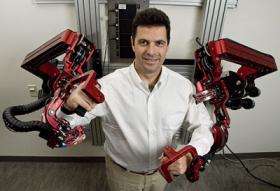
Jacob Rosen demonstrates the latest prototype of his exoskeleton arms, for which he envisions a variety of therapeutic uses. Photo by J. MacKenzie.

(PhysOrg.com) -- Jacob Rosen, associate professor of computer engineering at the Jack Baskin School of Engineering, University of California, Santa Cruz, is developing a wearable robotic "exoskeleton" that could enable a person to lift heavy objects with little effort. It's a bit like the robotic armor that has long been a staple of futuristic battle scenes in science fiction books and movies. But what excites Rosen is the device's potential to help people disabled by stroke or degenerative diseases.

"People with muscular dystrophy and other neuromuscular disabilities could use the exoskeleton to amplify their muscle strength, and it could also be used for rehabilitation and physical therapy," Rosen said.

"One of the major challenges in this field is to establish an effective human-machine interface, or 'bio-port,' between the operator and the wearable robot, such that the robot becomes a natural extension of the human body," he said. "This bio-port may be established at the neural level, allowing the human brain to control the wearable robot with the same type of signals that it uses to control its own actuators, the muscles."

Rosen joins a growing number of faculty members in Baskin Engineering who are using their expertise to tackle biomedical problems. Rosen's research focuses especially on the interface and interaction between humans and robots.

"Medical robotics is by definition a multidisciplinary field, and that's one reason I was so attracted to it," he said. "One of the most challenging issues in research and development of medical technology is to create a multidisciplinary group of clinicians and engineers that can effectively communicate and collaborate. We speak different languages, and we have to overcome these barriers in order to work together. But the opportunities to benefit people's lives are tremendous."

Rosen's current exoskeleton prototype, developed with a grant from the National Science Foundation, consists of two wearable robotic arms mounted on one wall of his UCSC laboratory. Inserting his arms into it, he notes that serious injury could result from a bad mismatch between the structure of the exoskeleton and the anatomical structure of the human arm.

Two innovations distinguish Rosen's prototype from other exoskeleton designs. One is a special design of the exoskeleton arms that allows the user to reach 95 percent of the natural range of motion, or "workspace," of the human arm. The other, which is still the subject of active research, is a method for using neurological signals to control the exoskeleton.

Rosen is also engaged in projects to develop robotic systems for performing surgical operations. "This is a huge challenge. I'll probably spend a large part of my career on this," he said.

Provided by University of California, Santa Cruz


print this article email this article download pdf blog this article bookmark this article     Stumble it Digg this share on Facebook retweet share on Reddit add to delicious
Rate this story - not rated yet


January 14, 2009 all stories

Comments: 0

not rated yet
  • Stumble this up

  • Digg this

  • share this

  • hide
  • Related Stories

  • Robot Suit May Help You Achieve a Perfect Golf Swing
    created Oct 31, 2007 | popularity not rated yet | comments 0
  • 21st-century pack mule: MIT's 'exoskeleton' lightens the load
    created Sep 19, 2007 | popularity not rated yet | comments 0
  • Eurobot makes a splash
    created Jul 06, 2007 | popularity not rated yet | comments 0
  • The Photonic Beetle: Nature Builds Diamond-Like Crystals For Future Optical Computers
    created May 20, 2008 | popularity not rated yet | comments 0
  • Cholera study provides exciting new way of looking at infectious disease
    created May 02, 2008 | popularity not rated yet | comments 0


  • hide
  • Relevant PhysicsForums posts

Other News

Posters promote Apple iPhones at a store in Beijing

iPhone disappoints in China launch: analysts

Electronics / Consumer & Gadgets

created 23 hours ago | popularity not rated yet | comments 0

The official launch of Apple's iPhone in China has been disappointing at best for mobile operator China Unicom, with the grey market still booming and competitors offering worthy alternatives, experts say.


Samsung launches a new vacuuming robot

Samsung launches a new vacuuming robot

Electronics / Consumer & Gadgets

created Nov 06, 2009 | popularity 4.4 / 5 (7) | comments 8

(PhysOrg.com) -- Samsung Electronics has launched its latest autonomous robot vacuum cleaner, the Tango, which is capable of vacuuming hardwood floors, carpets, and even beds without human assistance.


new iphone

Touchscreen smartphones being snatched up in US

Electronics / Consumer & Gadgets

created Nov 03, 2009 | popularity 2.7 / 5 (3) | comments 3

US smartphone buyers can't wait to get their hands on touchscreen devices, according to figures released Tuesday by industry tracker comScore.


Robot fish could monitor water quality

Robot fish could monitor water quality

Electronics / Robotics

created Nov 02, 2009 | popularity not rated yet | comments 2

Nature inspires technology for an engineer and an ecologist teamed up at Michigan State University. They're developing robots that use advanced materials to swim like fish to probe underwater environments.


Review: Motorola's Droid is a serious smart phone (AP)

Review: Motorola's Droid is a serious smart phone

Electronics / Consumer & Gadgets

created Nov 04, 2009 | popularity 4.6 / 5 (5) | comments 0

(AP) -- Since its debut in 2007, millions of people have gravitated toward Apple's iPhone, wooed by its sleek hardware, simple user interface and abundance of applications.