Now you see it, now you don't: Scientists unraveling the mystery of camouflage
January 15, 2009
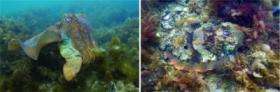
This pictture shows giant Australian cuttlefish, Sepia apama, in a conspicuous pattern while swimming, and then in a camouflaged pattern that combines "mottle" with "disruptive" coloration. Credit: Roger T. Hanlon
At Hogwarts, Harry Potter uses an invisibility cloak to hide from his enemies. In nature, animals like cuttlefish and chameleons use the awe-inspiring tricks of camouflage to hide from theirs.
Roger Hanlon, a senior scientist at the Marine Biological Laboratory (MBL), has spent 35 years studying animal camouflage, and in that time he has moved beyond awe at nature's disappearing tricks and discovered three broad classes of camouflage body patterns. He and his colleagues detail these three pattern classes, and how they achieve several mechanisms of visual deceit, in this week's issue of Philosophical Transactions of the Royal Society B. The issue is entirely devoted to camouflage.
"Camouflage is found throughout the animal kingdom, among big, small, wet, and dry animals, but it is probably one of the least-studied natural phenomena we know of," Hanlon says.
This video is not supported by your browser at this time.
This video shows dynamic camouflage change in the common Caribbean species Octopus vulgaris. The octopus is matching the pattern, color, brightness and texture of the algae in the background. Video: Roger T. Hanlon
This is one of the first efforts to quantify camouflage body patterns. "No one has successfully quantified, for instance, what is exactly meant by 'background matching,' which is when an animal visually blends into its environment," Hanlon says.
Although Hanlon and colleagues have begun to compare camouflage tactics in many animals—large primates, amphibians, reptiles, fishes, insects—this week's analysis focuses on the cephalopods, which include squid, octopus, and cuttlefish. Remarkably, these soft-bellied mollusks are able to dynamically produce all three classes of camouflage body patterns (termed uniform, mottled, and disruptive).
"Cephalopods are the most changeable animal on earth for camouflage," Hanlon says. "There is no animal group that can equal it for speed or diversity of disguise. They have the widest range of patterns and they have the fastest change. Therefore, they are a good model to help unravel the general principles of camouflage."
Hanlon is developing a mathematical description of camouflage patterns that can be used comparatively across the animal kingdom to better understand this biological phenomenon. To accomplish this, his team developed a software program that measures the degree of contrast and granularity (spatial scale) in the light and dark patches on the animal's body. These two metrics allow them to broadly sort all kinds of photographs of animal camouflage into the three classes of body patterns.
Uniform and mottle patterns are what most people recognize as camouflage. The patterns function by resembling the background. Such background matching is not so simple, however. In cephalopods, there are few high-fidelity matches to the background. More commonly, there are varying qualities of match in terms of color, intensity, pattern or 3-dimensional texture of the skin. How to measure these in terms of visual perception by the predator is still a daunting task.
The patterns in the third class, disruptive coloration, tend to obscure the outline of the animal against certain backgrounds. While a predator might easily detect the pattern, it won't recognize it as prey. Disruptive coloration is a controversial camouflage mechanism among vision scientists. "It's a counterintuitive notion," Hanlon says. An extreme example is a panda bear in a tree. If viewed by looking up into the brightly lit sky, the bear's large-scale black and white patches may not be recognized as animal skin, but rather as disjunctive areas of shadow and bright light. "Viewed against the right background, that body pattern is just an odd jigsaw puzzle. The pieces don't connect into an animal," Hanlon says. His research marshals evidence that strongly supports the notion that disruptive coloration is a bona fide mechanism of camouflage.
As a next step, Hanlon and colleagues plan to quantify camouflage body patterns in fish. "We hope that other investigators will pick up this technique to describe and quantify camouflage patterns in other animal groups," he says.
"Visual predator-prey interactions are one of the most widespread phenomena known in natural selection," Hanlon says. "In terms of being an evolutionary force, camouflage is one of the great defenses."
Citation: R.T. Hanlon, C.-C. Chiao, L.M. Mäthger, A. Barbosa, K.C. Buresch and C. Chubb (2008). Cephalopod dynamic camouflage: bridging the continuum between background matching and disruptive coloration. Phil. Trans. R. Soc. B, doi:10.1098/rstb.20008.0270.
Source: Marine Biological Laboratory
-
Researchers document caterpillars that mimic one another for survival
Dec 15, 2011 |
5 / 5 (1) |
0
-
140 new species described by California Academy of Sciences in 2011
Dec 15, 2011 |
3 / 5 (1) |
0
-
How can a colorblind animal change its colors to blend into the background?
May 16, 2011 |
3 / 5 (2) |
33
-
Fossil moths reveal their true colors
Oct 12, 2011 |
5 / 5 (2) |
0
-
Black, white and stinky: Explaining coloration in skunks and other boldly colored animals
May 30, 2011 |
5 / 5 (2) |
9
-
Engineers build first sub-10-nm carbon nanotube transistor
Feb 01, 2012 |
4.9 / 5 (32) |
30
-
Something old, something new: Evolution and the structural divergence of duplicate genes
Jan 31, 2012 |
4.6 / 5 (7) |
1
-
The hidden nanoworld of ice crystals: Revealing the dynamic behavior of quasi-liquid layers
Jan 30, 2012 |
5 / 5 (4) |
1
-
Stock market network reveals investor clustering
Jan 27, 2012 |
3.9 / 5 (23) |
8
-
Of microchemistry and molecules: Electronic microfluidic device synthesizes biocompatible probes
Jan 26, 2012 |
5 / 5 (2) |
0
More news stories
A mitosis mystery solved: How chromosomes align perfectly in a dividing cell
Although the process of mitotic cell division has been studied intensely for more than 50 years, Whitehead Institute researchers have only now solved the mystery of how cells correctly align their chromosomes during symmetric ...
1 hour ago |
5 / 5 (3) |
0
|
The proteins ensuring genome protection
Researchers from the University of Geneva (UNIGE), Switzerland, have discovered the crucial role of two proteins in developing a cell 'anti-enzyme shield'. This protection system, which operates at the level of molecular ...
1 hour ago |
5 / 5 (2) |
0
|
Researchers find extensive RNA editing in human transcriptome
In a new study published online in Nature Biotechnology, researchers from BGI, the world's largest genomics organization, reported the evidence of extensive RNA editing in a human cell line by analysis of RNA-seq data, demons ...
1 hour ago |
5 / 5 (3) |
0
|
Entire genome of extinct human decoded from fossil
(PhysOrg.com) -- In 2010, Svante Pääbo and his colleagues presented a draft version of the genome from a small fragment of a human finger bone discovered in Denisova Cave in southern Siberia. The ...
Feb 07, 2012 |
4.7 / 5 (58) |
48
|
Why are there so few fish in the Earth's oceans?
(PhysOrg.com) -- A Stony Brook University researcher has found that, contrary to popular belief, there are not plenty of fish in the sea.
Feb 08, 2012 |
4.3 / 5 (17) |
27
|
Scientists discover molecular secrets of 2,000-year-old Chinese herbal remedy
For roughly two thousand years, Chinese herbalists have treated Malaria using a root extract, commonly known as Chang Shan, from a type of hydrangea that grows in Tibet and Nepal. More recent studies suggest that halofuginone, ...
New method to examine batteries -- MRI from the inside
There is an ever-increasing need for advanced batteries for portable electronics, such as phones, cameras, and music players, but also to power electric vehicles and to facilitate the distribution and storage of energy derived ...
Lab study raises questions over nano-particle impact
Tests involving chickens have raised questions about the impact on health from engineered nano-particles, the ultra-fine grains commonly used in drugs and processed foods, scientists said on Sunday.
Google might launch Drive for cloud storage soon
(PhysOrg.com) -- Google's next big move, according to the Wall Street Journal, is a cloud storage service called Drive. Hardly first to the plate, Google is simply catching up to introducing its cloud reposi ...
Starve a virus, feed a cure? Findings show how some cells protect themselves against HIV
A protein that protects some of our immune cells from the most common and virulent form of HIV works by starving the virus of the molecular building blocks that it needs to replicate, according to research published online ...
Injured boomers beware: Know when to see doctor
(AP) -- It happened to nurse Jane Byron years after an in-line skating fall, business owner Haralee Weintraub while doing "men's" push-ups, and avid cyclist Gene Wilberg while lifting a heavy box.
Jan 25, 2009
Rank: not rated yet