Ancient rock's magnetic field shows that moon once had a dynamo in its core
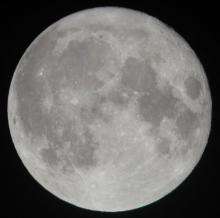
January 15, 2009 Moon

(PhysOrg.com) -- The collection of rocks that the Apollo astronauts brought back from the moon carried with it a riddle that has puzzled scientists since the early 1970s: What produced the magnetization found in many of those rocks?

The longstanding puzzle has now been solved by researchers at MIT, who carried out the most detailed analysis ever of the oldest pristine rock from the Apollo collection. Magnetic traces recorded in the rock provide strong evidence that 4.2 billion years ago the moon had a liquid core with a dynamo, like Earth's core today, that produced a strong magnetic field.

The particular moon rock that produced the new evidence was long known to be a very special one. It is the oldest of all the moon rocks that have not been subjected to major shocks from later impacts -- something that tends to erase all evidence of earlier magnetic fields. In fact, it's older than any known rocks from Mars or even from the Earth itself.

"Many people think that it's the most interesting lunar rock," said Ben Weiss, the Victor P. Starr Assistant Professor of Planetary Sciences in MIT's Department of Earth, Atmospheric and Planetary Sciences and senior author of a paper on the new finding being published in Science on Jan. 16. The rock was collected during the last lunar landing mission, Apollo 17, by Harrison "Jack" Schmidt, the only geologist ever to walk on the moon.

"It is one of the oldest and most pristine samples known," said graduate student Ian Garrick-Bethell, who was the lead author of the Science paper. "If that wasn't enough, it is also perhaps the most beautiful lunar rock, displaying a mixture of bright green and milky white crystals."

The team studied faint magnetic traces in a small sample of the rock in great detail. Using a commercial rock magnetometer that was specially fitted with an automated robotic system to take many readings "allowed us to make an order of magnitude more measurements than previous studies of lunar samples," Garrick-Bethell said. "This permitted us to study the magnetization of the rock in much greater detail than previously possible."

And those data enabled them to rule out the other possible sources of the magnetic traces, such as magnetic fields briefly generated by huge impacts on the moon. Those magnetic fields are very short lived, ranging from just seconds for small impacts up to one day for the most massive strikes. But the evidence written in the lunar rock showed it must have remained in a magnetic environment for a long period of time -- millions of years -- and thus the field had to have come from a long-lasting magnetic dynamo.

That's not a new idea, but it has been "one of the most controversial issues in lunar science," Weiss said. Until the Apollo missions, many prominent scientists were convinced that the moon was born cold and stayed cold, never melting enough to form a liquid core. Apollo proved that there had been massive flows of lava on the moon's surface, but the idea that it has, or ever had, a molten core remained controversial. "People have been vociferously debating this for 30 years," Weiss said.

The magnetic field necessary to have magnetized this rock would have been about one-fiftieth as strong as Earth's is today, Weiss said. "This is consistent with dynamo theory," and also fits in with the prevailing theory that the moon was born when a Mars-sized body crashed into the Earth and blasted much of its crust into space, where it clumped together to form the moon.

The new finding underscores how much we still don't know about our nearest neighbor in space, which will soon be visited by humans once again under current NASA plans. "While humans have visited the moon six times, we have really only scratched the surface when it comes to our understanding of this world," said Garick-Bethell.

The research, which also included MIT undergraduate student Jennifer Buz and David L. Shuster of the Berkeley Geochronology Center, was funded by the NASA Lunar Advanced Science and Exploration Research Program, as well as the Charles E. Reed Faculty Initiatives Fund, the Victor P. Starr Career Development Professorship, and the Ann and Gordon Getty Foundation.

Provided by MIT


print this article email this article download pdf blog this article bookmark this article     Stumble it Digg this share on Facebook retweet share on Reddit add to delicious
Rate this story - 4.9 /5 (11 votes)

Rank Filter

Move the slider to adjust rank threshold, so that you can hide some of the comments.


Display comments: newest first

  • morpheus2012 - Jan 15, 2009
    • Rank: 2.3 / 5 (3)
    the mooon is alien death star base

    to stabilize and monitor planets

    th emoon its older then our solar sytem itself
  • Thadieus - Jan 15, 2009
    • Rank: 5 / 5 (1)
    Morpheus2012,
    I've seen three of your comments on three stories. They all share the same thing in common:
    1. Your the first to comment.
    2. Your comments are all far fetched.
    3. Your comments are full of obvious spelling errors
    This makes you wonder if you are really stupid or you are smart and doing this for some other reason, hmmm......
  • MrGrynch - Jan 16, 2009
    • Rank: 1 / 5 (1)
    I wonder, with a rock the size of the moon would it have remained hot at the core long enough to leave this type of residual magnetism? Plasma cosmology has a different explanation for the magnetic fields of smaller bodies which does not require a dynamo. All that would be needed is an electric current present during the cooling process. Like permanent magnets on Earth, caused by lightning strikes. The presence of the charge forces of the lightning bolt cause the charged particles of the matter it interacts with to polarize during heating when the lattice loosens, and are then locked in when the material cools, resulting in a forced state of permanent electrostatic stress, resulting in permanent magnetism.
  • Modernmystic - Jan 16, 2009
    • Rank: 5 / 5 (1)
    Actually as far as the solar system goes the moon is not a small rocky body. I'm not surprised it retained heat long enough to see this kind of evidence.

    And I may be missing something, but a mars sized planet smashing into the Earth isn't exactly what I would classify as a "cold" beginning...
  • Scrap - Jan 16, 2009
    • Rank: 4 / 5 (1)
    The story says the moon rock was "older than any known rocks from the earth itself". If so, then why does the study assume that its origin reflects the moon's origin? It must have come from somewhere else - and if so, wouldn't its composition reflect that distant origin rather than the origin of the moon?
  • Modernmystic - Jan 16, 2009
    • Rank: not rated yet
    The story says the moon rock was "older than any known rocks from the earth itself". If so, then why does the study assume that its origin reflects the moon's origin? It must have come from somewhere else - and if so, wouldn't its composition reflect that distant origin rather than the origin of the moon?


    Good point...

    However it might be that it's more of a "older than any rocks [yet found] from the Earth" situation.

    After all the Earth is still an geologically active planet, the moon has been dead for quite some time. It's harder to find "original rocks" here than there I think.
  • Ramael - Jan 19, 2009
    • Rank: 1 / 5 (1)
    Although I'm not a supporter of the following idea, this article does kind of remind me of a theory proposed by Zecharia Sitchin regarding his interpretation Sumerian and Babylonian creation stories.

    According to Zecharia Sitchin, the story illustrates a large planetary body passing through our solar system sometime in the distant past. The planetary body however caused our solar system some gravitational distress, resulting in the destruction of a fifth rocky planet, what remained of which is the asteroid belt beyond mars. A portion of this planet collided into the earth, creating the moon and finally seeding life on the earth.

    Again, I'm not a supporter of this theory, but it is an interesting idea to entertain.
  • SongDog - Jan 20, 2009
    • Rank: not rated yet
    Does Sitchin say how humans witnessed this? ;-)
  • Modernmystic - Jan 20, 2009
    • Rank: not rated yet
    Does Sitchin say how humans witnessed this? ;-)


    Time travel?

January 15, 2009 all stories

Comments: 9

4.9 /5 (11 votes)
  • Stumble this up

  • Digg this

  • share this

  • hide
  • Related Stories

  • Moon potential goldmine of natural resources
    created Jul 16, 2009 | popularity not rated yet | comments 0
  • Lunar Reconnaissance Orbiter to Help Astronauts Survive in Infinity
    created Apr 17, 2009 | popularity not rated yet | comments 0
  • Mt. Redoubt Gives Alaskans a Taste of the Moon
    created Apr 06, 2009 | popularity not rated yet | comments 0
  • NASA Prepares for New Juno Mission to Jupiter
    created Nov 24, 2008 | popularity not rated yet | comments 0
  • Novel spots found on Jupiter
    created Mar 17, 2008 | popularity not rated yet | comments 0


  • hide
  • Relevant PhysicsForums posts

  • The shape of our solar system's orbits.
    created Nov 07, 2009
  • Above or Below the Line of Nodes
    created Nov 07, 2009
  • Supernova vs. Nova?
    created Nov 07, 2009
  • Supernova's Gamma Rays and Comets
    created Nov 06, 2009
  • Our Moon
    created Nov 06, 2009
  • Question about a Carl Zeiss lens
    created Nov 05, 2009
  • More from Physics Forums - General Astronomy

Other News

The GOES-12 satellite sees Large Hurricane Ida nearing landfall

The GOES-12 satellite sees Large Hurricane Ida nearing landfall

Space & Earth / Earth Sciences

created 44 minutes ago | popularity not rated yet | comments 0

Residents of the U.S. Gulf coast thought they were getting a break this hurricane season until Ida showed up. Today, November 9, Ida is a hurricane and is headed for a landfall in the western Florida Panhandle ...


NASA's TRMM Satellite sees most of Ida's heaviest rain stayed off coasts

NASA's TRMM Satellite sees most of Ida's heaviest rain stayed off coasts

Space & Earth / Earth Sciences

created 35 minutes ago | popularity not rated yet | comments 0

NASA and the Japanese Space Agency's Tropical Rainfall Measuring Mission (TRMM) satellite flew over Ida and captured her rainfall when she passed by Nicaragua, Honduras and Belize this weekend. TRMM data revealed ...


Scientists seek safe carbon dioxide storage for 'greener' power generation (w/ Video)

Space & Earth / Environment

created 1hour ago | popularity not rated yet | comments 1

The U.S. Department of Energy (DOE) has announced plans to fund research at the University of Alabama at Birmingham (UAB) School of Engineering on technologies that would help reduce greenhouse gas emissions through the capture ...


Antarctica glacier retreat creates new carbon dioxide store

Antarctica glacier retreat creates new carbon dioxide store

Space & Earth / Earth Sciences

created 4 hours ago | popularity 5 / 5 (1) | comments 1

Large blooms of tiny marine plants called phytoplankton are flourishing in areas of open water left exposed by the recent and rapid melting of ice shelves and glaciers around the Antarctic Peninsula. This ...


Success in 'space elevator' competition (AP)

Success in 'space elevator' competition (Update 3)

Space & Earth / Space Exploration

created Nov 05, 2009 | popularity 4.3 / 5 (33) | comments 53

(AP) -- A robot powered by a ground-based laser beam climbed a long cable dangling from a helicopter on Wednesday to qualify for prize money in a $2 million competition to test the potential reality of the ...