Dust around a primitive star sheds new light on universe's origins
January 15, 2009 Dust around a primitive star sheds new light on universe's origins

Enlarge

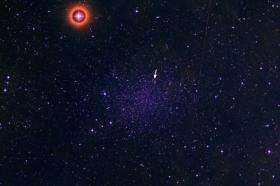
The Sculptor Dwarf galaxy, with the position of carbon star MAG 29 noted. Palomar Digitized Sky Survey

(PhysOrg.com) -- A Cornell-led team of astronomers has observed dust forming around a dying star in a nearby galaxy, giving a glimpse into the early universe and enlivening a debate about the origins of all cosmic dust.

The findings are reported in the Jan. 16 issue of the journal Science (Vol. 323, No. 5912). Cornell research associate Greg Sloan led the study, which was based on observations with NASA's Spitzer Space Telescope. The researchers used Spitzer's Infrared Spectrograph, which was developed at Cornell.

Dust plays a key role in the evolution of such galaxies as our Milky Way. Stars produce dust - rich with carbon or oxygen - as they die. But less is known about how and what kind of dust was created in galaxies as they formed soon after the big bang.

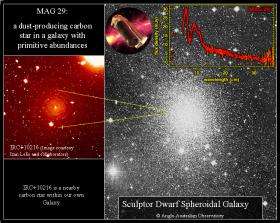
Sloan and his colleagues observed dust forming around the carbon star MAG 29, located 280,000 light years away in a smaller nearby galaxy called the Sculptor Dwarf. Stars more massive than the sun end their lives as carbon stars, which in our galaxy are a rich source of dust.
MAG 29
Enlarge

MAG 29. Credit: Anglo Australian Observatory

The Sculptor Dwarf contains only 4 percent of the carbon and other heavy elements in our own galaxy, making it similar to primitive galaxies seen at the edge of the universe. Those galaxies emitted the light we now see soon after they and the universe formed.

"What this tells us is that carbon stars could have been pumping dust soon after the first galaxies were born," Sloan said.

Scientists have debated where the dust in the early universe comes from. Supernovae have been a favorite suspect, but they may destroy more dust than they create.

"While everyone is focused on the questions of how much and what kind of dust supernovae make, they may not have appreciated that carbon stars can make at least some of the dust we are seeing," Sloan said. "The more we can understand the quantity and composition of the dust, the better we can understand how stars and galaxies evolve, both in the early universe and right next door."

Observing such stars as MAG 29 is not unlike using a time machine, Sloan said, in which astronomers can catch glimpses of what the universe looked like billions of years ago.

"We haven't seen carbon-rich dust in this primitive of an environment before," Sloan said.

Provided by Cornell University


print this article email this article download pdf blog this article bookmark this article     Stumble it Digg this share on Facebook retweet share on Reddit add to delicious
Rate this story - 4 /5 (6 votes)


January 15, 2009 all stories

Comments: 0

4 /5 (6 votes)
  • Stumble this up

  • Digg this

  • share this

  • hide
  • Related Stories

  • Scientists Reproduce a Building Block of Life in Laboratory
    created Nov 06, 2009 | popularity not rated yet | comments 0
  • Astronomers use gamma-ray burst to probe star formation in the early universe
    created Jan 06, 2009 | popularity not rated yet | comments 0
  • Distant ball of dust not dusty enough
    created Jun 06, 2006 | popularity not rated yet | comments 0
  • Spitzer Finds Life Components in Young Universe
    created Jul 29, 2005 | popularity not rated yet | comments 0
  • A dust factory around a dead star
    created Feb 24, 2009 | popularity not rated yet | comments 0


  • hide
  • Relevant PhysicsForums posts

  • The shape of our solar system's orbits.
    created Nov 07, 2009
  • Above or Below the Line of Nodes
    created Nov 07, 2009
  • Supernova vs. Nova?
    created Nov 07, 2009
  • Supernova's Gamma Rays and Comets
    created Nov 06, 2009
  • More from Physics Forums - General Astronomy

Other News

Planetary Society plans new 'solar sail'

Space & Earth / Space Exploration

created 3 hours ago | popularity 5 / 5 (1) | comments 0

(AP) -- Four years after its first solar sail ended up in the ocean instead of orbit, The Planetary Society announced Monday that by the end of 2010 it will try again to launch a spacecraft that will be propelled by the ...


L-R: Chiwetel Ejiofor, Amanda Peet and John Cusack at the premiere of "2012"

NASA on crusade to debunk 2012 apocalypse myths

Space & Earth / Space Exploration

created 8 hours ago | popularity 4 / 5 (1) | comments 1

The world is not coming to an end on December 21, 2012, the US space agency insisted Monday in a rare campaign to dispel widespread rumors fueled by the Internet and a new Hollywood movie.


Australian scientists call for urgent 'global cooling' to save coral reefs

Space & Earth / Environment

created 4 hours ago | popularity 3 / 5 (2) | comments 0

(PhysOrg.com) -- Australian marine scientists have issued an urgent call for massive and rapid worldwide cuts in carbon emissions, deep enough to prevent atmospheric CO2 levels rising to 450 parts per million (ppm).


Antarctica glacier retreat creates new carbon dioxide store

Antarctica glacier retreat creates new carbon dioxide store

Space & Earth / Earth Sciences

created 13 hours ago | popularity 3.5 / 5 (4) | comments 0

Large blooms of tiny marine plants called phytoplankton are flourishing in areas of open water left exposed by the recent and rapid melting of ice shelves and glaciers around the Antarctic Peninsula. This ...


NASA satellites see Ida spreading out before landfall

NASA satellites see Ida spreading out before landfall

Space & Earth / Earth Sciences

created 4 hours ago | popularity not rated yet | comments 0

NASA's Aqua and Terra satellites are keeping a close eye on Tropical Storm Ida, and both have instruments aboard that show her clouds and rains are already widespread inland over the U.S. Gulf coast states. ...