Next generation cloaking device demonstrated
January 15, 2009 The Cloak

Enlarge

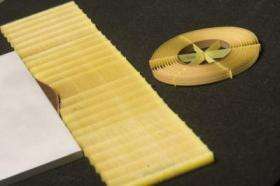
Pictured is the new cloak with bump, left, and the prototype, right. Credit: Duke University

A device that can bestow invisibility to an object by "cloaking" it from visual light is closer to reality. After being the first to demonstrate the feasibility of such a device by constructing a prototype in 2006, a team of Duke University engineers has produced a new type of cloaking device, which is significantly more sophisticated at cloaking in a broad range of frequencies.

The latest advance was made possible by the development of a new series of complex mathematical commands, known as algorithms, to guide the design and fabrication of exotic composite materials known as metamaterials. These materials can be engineered to have properties not easily found in natural materials, and can be used to form a variety of "cloaking" structures. These structures can guide electromagnetic waves around an object, only to have them emerge on the other side as if they had passed through an empty volume of space.

The results of the latest Duke experiments were published Jan. 16 in the journal Science. First authors of the paper were Duke's Ruopeng Liu, who developed the algorithm, and Chunlin Li. David R. Smith, William Bevan Professor of electrical and computer engineering at Duke, is the senior member of the research team.

Once the algorithm was developed, the latest cloaking device was completed from conception to fabrication in nine days, compared to the four months required to create the original, and more rudimentary, device. This powerful new algorithm will make it possible to custom-design unique metamaterials with specific cloaking characteristics, the researchers said.

"The difference between the original device and the latest model is like night and day," Smith said. "The new device can cloak a much wider spectrum of waves — nearly limitless — and will scale far more easily to infrared and visible light. The approach we used should help us expand and improve our abilities to cloak different types of waves."

Cloaking devices bend electromagnetic waves, such as light, in such a way that it appears as if the cloaked object is not there. In the latest laboratory experiments, a beam of microwaves aimed through the cloaking device at a "bump" on a flat mirror surface bounced off the surface at the same angle as if the bump were not present. Additionally, the device prevented the formation of scattered beams that would normally be expected from such a perturbation.

The underlying cloaking phenomenon is similar to the mirages seen ahead at a distance on a road on a hot day.

"You see what looks like water hovering over the road, but it is in reality a reflection from the sky," Smith explained. "In that example, the mirage you see is cloaking the road below. In effect, we are creating an engineered mirage with this latest cloak design."

Smith believes that cloaks should find numerous applications as the technology is perfected. By eliminating the effects of obstructions, cloaking devices could improve wireless communications, or acoustic cloaks could serve as protective shields, preventing the penetration of vibrations, sound or seismic waves.

"The ability of the cloak to hide the bump is compelling, and offers a path towards the realization of forms of cloaking abilities approaching the optical," Liu said. "Though the designs of such metamaterials are extremely complex, especially when traditional approaches are used, we believe that we now have a way to rapidly and efficiently produce such materials."

With appropriately fine-tuned metamaterials, electromagnetic radiation at frequencies ranging from visible light to radio could be redirected at will for virtually any application, Smith said. This approach could also lead to the development of metamaterials that focus light to provide more powerful lenses.

The newest cloak, which measures 20 inches by 4 inches and less than an inch high, is actually made up of more than 10,000 individual pieces arranged in parallel rows. Of those pieces, more than 6,000 are unique. Each piece is made of the same fiberglass material used in circuit boards and etched with copper.

The algorithm determined the shape and placement of each piece. Without the algorithm, properly designing and aligning the pieces would have been extremely difficult, Smith said.

Source: Duke University


print this article email this article download pdf blog this article bookmark this article     Stumble it Digg this share on Facebook retweet share on Reddit add to delicious
Rate this story - 4.6 /5 (19 votes)

Rank Filter

Move the slider to adjust rank threshold, so that you can hide some of the comments.


Display comments: newest first

  • grahf - Jan 15, 2009
    • Rank: 4.5 / 5 (2)
    If these materials bend light so that it appears that nothing is there, could it bend light so that it looks like something is there when there isn't? More interestingly, could it capture incoming light and focus it into one spot like, say, a solar cell? Or could it be used as a focusing device for a directed energy weapon? The possibilities seem endless.
  • el_gramador - Jan 15, 2009
    • Rank: 2.3 / 5 (3)
    F'in awesome doesn't begin to describe this. The wave potential is even more awesome. Though I can only wonder how people who don't understand technology like this would see it in the future.
  • Bob_Kob - Jan 15, 2009
    • Rank: 5 / 5 (4)
    More interestingly, could it capture incoming light and focus it into one spot like, say, a solar cell? Or could it be used as a focusing device for a directed energy weapon? The possibilities seem endless.


    Its called a lens.
  • Velanarris - Jan 16, 2009
    • Rank: 1 / 5 (1)
    Its called a lens.

    Beat me to it and laughs were had by all.

    Rube Goldberg jokes aside, this is a powerful and potentially life altering breakthrough if it can do as they say.

    Just imagine the potential applications in structural engineering and electrical engineering in regard to vibration and em. Effectively you have a bulletproof EM shield and a perfect vibrational dampener.
  • DGBEACH - Jan 16, 2009
    • Rank: 4 / 5 (1)
    ...and a perfect vibrational dampener.

    Great NASA can use it to keep the future astronauts from being shaken to death by their new rocket :)
  • theophys - Jan 16, 2009
    • Rank: not rated yet
    Coolio. But it looks like it only cloaks an object from one direction. Could we engineer it to cloak from all sides? Also, could this device be engineered on a large scale to control what type of light hits Earth and at what quantities? Theoreticaly of course. It would take trillions of dollar to do something like that now and really wouldn't be that cost effective. But it's and interesting concept none the less.
  • Towchain - Jan 16, 2009
    • Rank: not rated yet
    How about scientists cure hair loss THEN invent cloaking devices. We need to set priorities people! :-D
  • grahf - Jan 16, 2009
    • Rank: not rated yet
    More interestingly, could it capture incoming light and focus it into one spot like, say, a solar cell? Or could it be used as a focusing device for a directed energy weapon? The possibilities seem endless.


    Its called a lens.


    Lenses have defects, and scatter more light than they focus (if they didn't scatter light, they would appear black). They also only draw on light from only one direction. In all, this would probably constitute a tenfold increase in the ability to capture light at the very least. Take some of this material and surround an incandescent light bulb, and focus all the light and heat that is produced, and focus it on a 1mm^2 spot, and you've got yourself quite a handy little cutting torch.

    Come to think of it, I wonder what kind of efficiency these materials have at light movement? If it is 100% or close to that, could one make a closed loop and just keep dumping photons in there? Energy storage anyone? Talk about your rapid release energy storage.
  • Geggamojja - Jan 18, 2009
    • Rank: not rated yet
    COuld a device like this be used to make my penis appear longer?


    No, it does not work on objects that small.
  • Sunnydips - Jan 23, 2009
    • Rank: not rated yet
    Soon my dreams of becoming a truely invisible peeping tom will become real! ehhheh

January 15, 2009 all stories

Comments: 10

4.6 /5 (19 votes)
  • Stumble this up

  • Digg this

  • share this

  • hide
  • Related Stories


  • hide
  • Relevant PhysicsForums posts

  • Photoelectric effect
    created 1hour ago
  • Ranges of coherence lengths for......
    created 3 hours ago
  • Has einsteins experient with time been proven, why hasn't it been applied or used
    created 5 hours ago
  • Drop of Water
    created 5 hours ago
  • Generalized Coordinate Systems
    created 6 hours ago
  • Electromagnet design
    created 8 hours ago
  • More from Physics Forums - General Physics

Other News

Stars Fueled by Dark Matter Could Hold Secrets to the Universe

Stars Fueled by Dark Matter Could Hold Secrets to the Universe

Physics / General Physics

created Nov 03, 2009 | popularity 4.5 / 5 (51) | comments 41

(PhysOrg.com) -- The first stars in the universe may have been very different from the stars we see today, yet they may hold clues to understanding some of the mysterious features of the universe. These "dark ...


Second Law of Thermodynamics May Explain Economic Evolution

Second Law of Thermodynamics May Explain Economic Evolution

Physics / General Physics

created Nov 02, 2009 | popularity 4.3 / 5 (31) | comments 28

(PhysOrg.com) -- Terms such as the "invisible hand," laissez-faire policy, and free-market principles suggest that economic growth and decline in capitalist societies seem to be somehow self-regulated. Now, ...


High-performance plasmas may make reliable, efficient fusion power a reality

High-performance plasmas may make reliable, efficient fusion power a reality

Physics / Plasma Physics

created Nov 02, 2009 | popularity 4.7 / 5 (40) | comments 34

In the quest to produce nuclear fusion energy, researchers from the DIII-D National Fusion Facility have recently confirmed long-standing theoretical predictions that performance, efficiency and reliability ...


'Teapot effect' solved

Solving Teapot Effect

Physics / General Physics

created Nov 02, 2009 | popularity 4.9 / 5 (11) | comments 10

(PhysOrg.com) -- A team of scientists from France have worked out why teapots dribble at low flow rates, and how to stop them. The effect is called the "teapot effect", and solving it could finally put an ...


Laser accelerated protons to the highest energies so far

Researchers use trident laser to accelerate protons to record energies

Physics / General Physics

created Nov 02, 2009 | popularity 4.7 / 5 (6) | comments 10

An international team of physicists at Los Alamos National Laboratory has succeeded in using intense laser light to accelerate protons to energies never before achieved. Using this technique, scientists can ...