Easy assembly of electronic biological chips
January 15, 2009 Assembled Nanowires

Enlarge

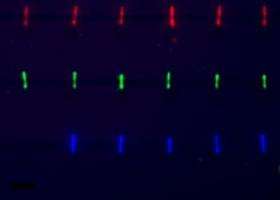
These nanowires, tagged with DNA are assembled, and have been exposed to complementary DNA that is tagged with fluorescent dyes. The complementary DNA attached to the nanowires showing that the wires assembled in the proper locations. Credit: Penn State

(PhysOrg.com) -- A handheld, ultra-portable device that can recognize and immediately report on a wide variety of environmental or medical compounds may eventually be possible, using a method that incorporates a mixture of biologically tagged nanowires onto integrated circuit chips, according to Penn State researchers.

"Probably one of the most important things for connecting to the circuit is to place the wires accurately," says Theresa S. Mayer, professor of electrical engineering and director of Penn State's Nanofabrication Laboratory. "We need to control spatial placement on the chip with less than a micron of accuracy."

Using standard chip manufacturing, each type of nanowire would be placed on the board in a separate operation. Using the researchers' bottom-up method, they can place three different types of DNA-coated wires where they wanted them, with an error rate of less than 1 percent.

FLV player

This is an edited movie of the automatic assembly of wires into wells. A real time movie is available.


"This approach can be used to simultaneously detect different pathogens or diseases based on their nucleic acid signatures," says Christine D. Keating, associate professor of chemistry.

"Device components such as nanowires can be synthesized from many different materials and even coated with biological molecules prior to assembling them onto a chip," the researchers note in today's (Jan. 16) issue of Science. They add that positioning the nanowires accurately is still difficult using conventional methods.

Using their assembly method, the researchers can place specific nanowires in assigned areas. They begin with a chip with tiny rectangular depressions in the places they wish to place the nanowires. They then apply an electrical field between electrodes that define the area where they want the nanowires to assemble. The Penn State researchers inject a mixture of the tagged nanowires and a liquid over the top of the chip. The nanowires are attracted to the area with an electric field and they fall into the proper tiny wells.
Nanowire Pile
Enlarge

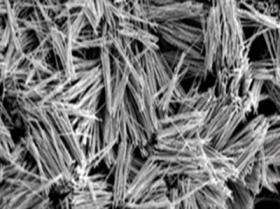
This is a pile of nanowires before assembly. Credit: Penn State

"We do not need microfluidic channels to control where each nanowire type goes," says Mayer. "We can run the solution over the whole chip and its wires will only attach where they are supposed to attach. This is important for scale-up."

The researchers then move the electric field and position the next tagged nanowires. In this proof-of-concept experiment, the different tagged wires were placed in rows, but the researchers say that they could be placed in a variety of configurations.

After all the wires are in place, they can be made into a variety of devices including resonators or field effect transistors that can be used to detect nucleic acid targets.

While the researchers have not yet connected each individual device to the underlying circuitry, they did test their chip to ensure that the wires assembled in the proper locations. They immersed the chip in a solution containing DNA sequences complementary to the three virus-specific sequences on the nanowires. Because they tagged the complimentary DNA with three differently colored fluorescent dyes, the attached DNA showed that the wires were in the proper places.

The researchers believe that their assembly method is extremely flexible, capable of placing a variety of conducting and non-conducting wires with a wide array of coatings.

"The eventual idea would be to extend the method to more nanowire types, such as different DNA sequences or even proteins, and move from fluorescence to real-time electrical detection on the chip," says Keating.

Provided by Penn State


print this article email this article download pdf blog this article bookmark this article     Stumble it Digg this share on Facebook retweet share on Reddit add to delicious
Rate this story - 3 /5 (2 votes)


January 15, 2009 all stories

Comments: 0

3 /5 (2 votes)
  • Stumble this up

  • Digg this

  • share this

  • hide
  • Related Stories

  • Researchers develop new lab-on-a-chip technique
    created Oct 07, 2009 | popularity not rated yet | comments 0
  • Nanotechnology gets a new light touch
    created Oct 02, 2009 | popularity not rated yet | comments 0
  • Microchip can detect type and severity of cancer
    created Sep 28, 2009 | popularity not rated yet | comments 0
  • Using Nanotubes in Computer Chips
    created Sep 10, 2009 | popularity not rated yet | comments 0
  • Researchers grow nanowire crystals for 3-D microchips
    created Aug 26, 2009 | popularity not rated yet | comments 0


  • hide
  • Relevant PhysicsForums posts

Other News

New transparent insulating film could enable energy-efficient displays

New transparent insulating film could enable energy-efficient displays

Nanotechnology / Nanomaterials

created 3 hours ago | popularity 4.8 / 5 (5) | comments 0

Johns Hopkins materials scientists have found a new use for a chemical compound that has traditionally been viewed as an electrical conductor, a substance that allows electricity to flow through it. By orienting ...


Ideal nanoparticle cancer therapies surf the bloodstream

Nanotechnology / Bio & Medicine

created 3 hours ago | popularity 5 / 5 (1) | comments 0

Eric Shaqfeh studies blood at Stanford University, using computer models that simulate how the fluid and the cells it contains move around. On November 11 at a meeting of the scientific society AVS, he will present his latest ...


New Digital 'Electronics' Concept May Continue Moore's Law

New Digital 'Electronics' Concept May Continue Moore's Law

Nanotechnology / Nanophysics

created Nov 05, 2009 | popularity 4.6 / 5 (56) | comments 9

(PhysOrg.com) -- Computers of the future could be operating not on electrons, but on tiny waves traveling through an electron "fluid," if a new proposal is successful. The new circuit design, recently introduced ...


Findings show nanomedicine promising for treating spinal cord injuries

Findings show nanomedicine promising for treating spinal cord injuries

Nanotechnology / Bio & Medicine

created Nov 08, 2009 | popularity 4.5 / 5 (4) | comments 0

(PhysOrg.com) -- Researchers at Purdue University have discovered a new approach for repairing damaged nerve fibers in spinal cord injuries using nano-spheres that could be injected into the blood shortly ...


Nanoparticles for gene therapy improve

Nanoparticles for gene therapy improve

Nanotechnology / Bio & Medicine

created Nov 06, 2009 | popularity 5 / 5 (5) | comments 3

(PhysOrg.com) -- About five years ago, Professor Janet Sawicki at the Lankenau Institute in Pennsylvania read an article about nanoparticles developed by MIT's Robert Langer for gene therapy, the insertion ...