New study resolves mystery of how massive stars form
January 15, 2009 New study resolves mystery of how massive stars form

Enlarge

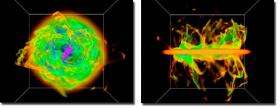
Volume renderings of the density field in a region of the simulation at 55,000 years of evolution. The left panel shows a polar view, and the right panel shows an equatorial view. The fingers feeding the equatorial disk are clearly visible.

(PhysOrg.com) -- Theorists have long wondered how massive stars--up to 120 times the mass of the Sun--can form without blowing away the clouds of gas and dust that feed their growth. But the problem turns out to be less mysterious than it once seemed. A study published this week by Science shows how the growth of a massive star can proceed despite outward-flowing radiation pressure that exceeds the gravitational force pulling material inward.

The new findings also explain why massive stars tend to occur in binary or multiple star systems, said lead author Mark Krumholz, an assistant professor of astronomy and astrophysics at the University of California, Santa Cruz. The formation of companion stars emerged unexpectedly from the sophisticated computer simulations the researchers used to explore the physics of massive star formation.

"We didn't set out to solve that question, so it was a nice side benefit of the study," Krumholz said. "The main finding is that radiation pressure does not limit the growth of massive stars."
New study resolves mystery of how massive stars form
Enlarge

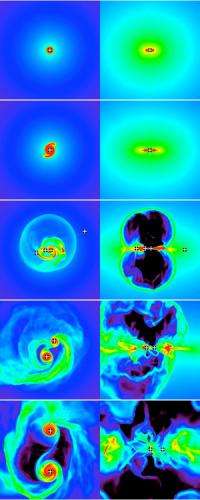
Computer simulation of the formation of a massive star yielded these snapshots showing stages in the process over time. Panels on the left represent a polar view (the axis of rotation is perpendicular to the plane of the image), and panels on the right represent an equatorial view. Plus signs indicate projected positions of stars. Colors represent density. Images by Krumholz et al.

Radiation pressure is the force exerted by electromagnetic radiation on the surfaces it strikes. This effect is negligible for ordinary light, but it becomes significant in the interiors of stars due to the intensity of the radiation. In massive stars, radiation pressure is the dominant force counteracting gravity to prevent the further collapse of the star.

"When you apply the radiation pressure from a massive star to the dusty interstellar gas around it, which is much more opaque than the star's internal gas, it should explode the gas cloud," Krumholz said. Earlier studies suggested that radiation pressure would blow away the raw materials of star formation before a star could grow much larger than about 20 times the mass of the Sun. Yet astronomers observe stars much more massive than that.

Krumholz and his coauthors at UC Berkeley and Lawrence Livermore National Laboratory have spent years developing complex computer codes for simulating the processes of star formation. Combined with advances in computer technology, their latest software (called ORION) enabled them to run a detailed three-dimensional simulation of the collapse of an enormous interstellar gas cloud to form a massive star. The project required months of computing time at the San Diego Supercomputer Center.

The simulation showed that as the dusty gas collapses onto the growing core of a massive star, with radiation pressure pushing outward and gravity pulling material in, instabilities develop that result in channels where radiation blows out through the cloud into interstellar space, while gas continues falling inward through other channels.

"You can see fingers of gas falling in and radiation leaking out between those fingers of gas," Krumholz said. "This shows that you don't need any exotic mechanisms; massive stars can form through accretion processes just like low-mass stars."

The rotation of the gas cloud as it collapses leads to the formation of a disk of material feeding onto the growing "protostar." The disk is gravitationally unstable, however, causing it to clump and form a series of small secondary stars, most of which end up colliding with the central protostar. In the simulation, one secondary star became massive enough to break away and acquire its own disk, growing into a massive companion star. A third small star formed and was ejected into a wide orbit before falling back in and merging with the primary star.

When the researchers stopped the simulation, after allowing it to evolve for 57,000 years of simulated time, the two stars had masses of 41.5 and 29.2 times the mass of the Sun and were circling each other in a fairly wide orbit.

"What formed in the simulation is a common configuration for massive stars," Krumholz said. "I think we can now consider the mystery of how massive stars are able to form to be solved. The age of supercomputers and the ability to simulate the process in three dimensions made the solution possible."

The paper describing these results is being published by Science on the Science Express web site on January 15, 2009.

Provided by University of California - Santa Cruz


print this article email this article download pdf blog this article bookmark this article     Stumble it Digg this share on Facebook retweet share on Reddit add to delicious
Rate this story - 4.5 /5 (4 votes)


January 15, 2009 all stories

Comments: 0

4.5 /5 (4 votes)
  • Stumble this up

  • Digg this

  • share this

  • hide
  • Related Stories

  • Scientists Elucidate the Origin of the Darkest Galaxies in the Universe
    created Feb 14, 2007 | popularity not rated yet | comments 0
  • The Case for Habitable Exoplanet Moons
    created Apr 27, 2006 | popularity not rated yet | comments 0
  • Most Powerful Eruption in the Universe Discovered
    created Jan 05, 2005 | popularity not rated yet | comments 0
  • Trifid triple threat
    created Aug 26, 2009 | popularity not rated yet | comments 0
  • Scientists predict greater longevity for planets with life
    created Jun 13, 2009 | popularity not rated yet | comments 0


  • hide
  • Relevant PhysicsForums posts

  • Sideral question
    created 17 hours ago
  • Doppler shifted blackbody spectrum
    created 20 hours ago
  • Earth v. Moon
    created 22 hours ago
  • help me with coordinates and orbits
    created 22 hours ago
  • basic 'our universe' question..
    created Nov 20, 2009
  • deriving keplers law
    created Nov 19, 2009
  • More from Physics Forums - General Astronomy

Other News

Astronauts finish another spacewalk, still no baby (AP)

Astronauts finish another spacewalk, still no baby

Space & Earth / Space Exploration

created 9 hours ago | popularity 3 / 5 (2) | comments 0

(AP) -- A spacewalking astronaut put aside the impending birth of his daughter and blazed through his first-ever venture outside the International Space Station on Saturday.


Unseasonably hot and dry weather combined with strong winds to fan scores of blazes in the country's southeastern states

Australia issues 'catastrophic' alerts as fires rage

Space & Earth / Environment

created 15 hours ago | popularity 4.5 / 5 (2) | comments 0

Australia has issued "catastrophic" alerts after record-breaking temperatures and wild lightning storms sparked more than 100 fires across the country, officials said Saturday.


Commuters wait on the platform shrouded by fog in London

Climate change not man-made, say majority of Britons: poll

Space & Earth / Environment

created Nov 15, 2009 | popularity 3.3 / 5 (15) | comments 46

Less than half of Britons believes that human activity is to blame for global warming, according to a poll carried out for The Times newspaper and published on Saturday.


Mysteriously warm times in Antarctica

Mysteriously warm times in Antarctica

Space & Earth / Earth Sciences

created Nov 18, 2009 | popularity 4.2 / 5 (21) | comments 28

(PhysOrg.com) -- A new study of Antarctica's past climate reveals that temperatures during the warm periods between ice ages (interglacials) may have been higher than previously thought. The latest analysis ...


UN: Fight climate change with free condoms (AP)

UN: Fight climate change with free condoms

Space & Earth / Environment

created Nov 18, 2009 | popularity 3.1 / 5 (11) | comments 24

(AP) -- The battle against global warming could be helped if the world slowed population growth by making free condoms and family planning advice more widely available, the U.N. Population Fund said Wednesday.