Martian Methane Reveals the Red Planet is not a Dead Planet
January 15, 2009 by Bill Steigerwald
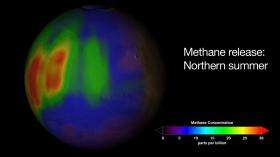
This image shows concentrations of Methane discovered on Mars. Credit: NASA
(PhysOrg.com) -- Mars today is a world of cold and lonely deserts, apparently without life of any kind, at least on the surface. Worse still, it looks like Mars has been cold and dry for billions of years, with an atmosphere so thin, any liquid water on the surface quickly boils away while the sun's ultraviolet radiation scorches the ground.
But there is evidence of a warmer and wetter past -- features resembling dry riverbeds and minerals that form in the presence of water indicate water once flowed through Martian sands. Since liquid water is required for all known forms of life, scientists wonder if life could have risen on Mars, and if it did, what became of it as the Martian climate changed.
New research reveals there is hope for Mars yet. The first definitive detection of methane in the atmosphere of Mars indicates the planet is still alive, in either a biologic or geologic sense, according to a team of NASA and university scientists.
Enlarge
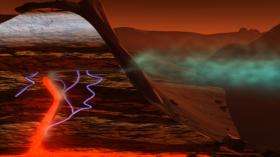
Scientists don't yet know enough to say with certainty what the source of the Martian methane is, but this artist's concept depicts a possibility. In this illustration, subsurface water, carbon dioxide and the planet's internal heat combine to release methane. Although we don’t have evidence on Mars of active volcanoes today, ancient methane trapped in ice "cages" might now be released. Credit: NASA/Susan Twardy
"Methane is quickly destroyed in the Martian atmosphere in a variety of ways, so our discovery of substantial plumes of methane in the northern hemisphere of Mars in 2003 indicates some ongoing process is releasing the gas," said Dr. Michael Mumma of NASA's Goddard Space Flight Center in Greenbelt, Md. "At northern mid-summer, methane is released at a rate comparable to that of the massive hydrocarbon seep at Coal Oil Point in Santa Barbara, Calif."Methane -- four atoms of hydrogen bound to a carbon atom -- is the main component of natural gas on Earth. It's of interest to astrobiologists because organisms release much of Earth's methane as they digest nutrients. However, other purely geological processes, like oxidation of iron, also release methane. "Right now, we don’t have enough information to tell if biology or geology -- or both -- is producing the methane on Mars," said Mumma. "But it does tell us that the planet is still alive, at least in a geologic sense. It's as if Mars is challenging us, saying, hey, find out what this means." Mumma is lead author of a paper on this research appearing in Science Express Jan. 15.
If microscopic Martian life is producing the methane, it likely resides far below the surface, where it's still warm enough for liquid water to exist. Liquid water, as well as energy sources and a supply of carbon, are necessary for all known forms of life.
"On Earth, microorganisms thrive 2 to 3 kilometers (about 1.2 to 1.9 miles) beneath the Witwatersrand basin of South Africa, where natural radioactivity splits water molecules into molecular hydrogen (H2) and oxygen. The organisms use the hydrogen for energy. It might be possible for similar organisms to survive for billions of years below the permafrost layer on Mars, where water is liquid, radiation supplies energy, and carbon dioxide provides carbon," said Mumma.
"Gases, like methane, accumulated in such underground zones might be released into the atmosphere if pores or fissures open during the warm seasons, connecting the deep zones to the atmosphere at crater walls or canyons," said Mumma.
"Microbes that produced methane from hydrogen and carbon dioxide were one of the earliest forms of life on Earth," noted Dr. Carl Pilcher, Director of the NASA Astrobiology Institute which partially supported the research. "If life ever existed on Mars, it's reasonable to think that its metabolism might have involved making methane from Martian atmospheric carbon dioxide."
However, it is possible a geologic process produced the Martian methane, either now or eons ago. On Earth, the conversion of iron oxide (rust) into the serpentine group of minerals creates methane, and on Mars this process could proceed using water, carbon dioxide, and the planet's internal heat. Although we don’t have evidence on Mars of active volcanoes today, ancient methane trapped in ice "cages" called clathrates might now be released.
The team found methane in the atmosphere of Mars by carefully observing the planet over several Mars years (and all Martian seasons) with NASA's Infrared Telescope Facility, run by the University of Hawaii, and the W. M. Keck telescope, both at Mauna Kea, Hawaii.
The team used spectrometer instruments attached to the telescopes to make the detection. Spectrometers spread light into its component colors, like a prism separates white light into a rainbow. The team looked for dark areas in specific places along the rainbow (light spectrum) where methane was absorbing sunlight reflected from the Martian surface. They found three such areas, called absorption lines, which together are a definitive signature of methane, according to the team. They were able to distinguish lines from Martian methane from the methane in Earth's atmosphere because the motion of the Red Planet shifted the position of the Martian lines, much as a speeding ambulance causes its siren to change pitch as it passes by.
"We observed and mapped multiple plumes of methane on Mars, one of which released about 19,000 metric tons of methane," said Dr. Geronimo Villanueva of the Catholic University of America, Washington, D.C. Villanueva is stationed at NASA Goddard and is co-author of the paper. "The plumes were emitted during the warmer seasons -- spring and summer -- perhaps because the permafrost blocking cracks and fissures vaporized, allowing methane to seep into the Martian air. Curiously, some plumes had water vapor while others did not," said Villanueva.
According to the team, the plumes were seen over areas that show evidence of ancient ground ice or flowing water. For example, plumes appeared over northern hemisphere regions such as east of Arabia Terra, the Nili Fossae region, and the south-east quadrant of Syrtis Major, an ancient volcano 1,200 kilometers (about 745 miles) across.
It will take future missions, like NASA's Mars Science Laboratory, to discover the origin of the Martian methane. One way to tell if life is the source of the gas is by measuring isotope ratios. Isotopes are heavier versions of an element; for example, deuterium is a heavier version of hydrogen. In molecules that contain hydrogen, like water and methane, the rare deuterium occasionally replaces a hydrogen atom. Since life prefers to use the lighter isotopes, if the methane has less deuterium than the water released with it on Mars, it's a sign that life is producing the methane. The research was funded by NASA's Planetary Astronomy Program and the NASA Astrobiology Institute.
Provided by NASA's Goddard Space Flight Center
-
Engineers build first sub-10-nm carbon nanotube transistor
Feb 01, 2012 |
4.9 / 5 (30) |
30
-
Something old, something new: Evolution and the structural divergence of duplicate genes
Jan 31, 2012 |
4.6 / 5 (7) |
1
-
The hidden nanoworld of ice crystals: Revealing the dynamic behavior of quasi-liquid layers
Jan 30, 2012 |
5 / 5 (3) |
1
-
Stock market network reveals investor clustering
Jan 27, 2012 |
3.9 / 5 (23) |
8
-
Of microchemistry and molecules: Electronic microfluidic device synthesizes biocompatible probes
Jan 26, 2012 |
5 / 5 (1) |
0
-
Titan's lack of impact craters
12 hours ago
-
Real pictures of black hole eating a star?
Feb 08, 2012
-
Hypothetical way to travel faster than light, but not technically exceed lightspeed
Feb 06, 2012
-
How do scientists monitor the Sun's activity?
Feb 05, 2012
-
Search patterns in observational studies
Feb 05, 2012
-
Derivation of Pogson's law
Feb 03, 2012
- More from Physics Forums - General Astronomy
More news stories
Deconstructing a mystery: What caused Snowmaggedon?
In the quiet after the storms, streets and cars had all but disappeared under piles of snow. The U.S. Postal Service suspended service for the first time in 30 years. Snow plows struggled to push the evidence ...
Space & Earth / Earth Sciences
8 hours ago |
4.7 / 5 (3) |
1
|
Ocean microbe communities changing, but long-term environmental impact is unclear
As oceans warm due to climate change, water layers will mix less and affect the microbes and plankton that pump carbon out of the atmosphere but researchers say it's still unclear whether these processes ...
Space & Earth / Earth Sciences
10 hours ago |
5 / 5 (2) |
2
|
Researchers create 3-D laser maps that show how earthquake changes landscape
Geologists have a new tool to study how earthquakes change the landscape down to a few inches, and it's giving them insight into how earthquake faults behave. In the Feb. 10 issue of the journal Science, a team ...
Space & Earth / Earth Sciences
10 hours ago |
5 / 5 (4) |
0
|
New views show old NASA Mars landers
(PhysOrg.com) -- The High Resolution Imaging Science Experiment (HiRISE) camera on NASA's Mars Reconnaissance Orbiter recorded a scene on Jan. 29, 2012, that includes the first color image from orbit showing ...
Space & Earth / Space Exploration
16 hours ago |
4.9 / 5 (7) |
5
|
Black holes and star formation
(PhysOrg.com) -- It has long been recognized that galaxy mergers or even close interactions can play a vital role in shaping the morphology of galaxies. One way they can do so, it is thought, is by triggering ...
15 hours ago |
4 / 5 (6) |
3
|
'Dark plasmons' transmit energy
Microscopic channels of gold nanoparticles have the ability to transmit electromagnetic energy that starts as light and propagates via "dark plasmons," according to researchers at Rice University.
Hydrogen from acidic water: Researchers develop potential low cost alternative to platinum for splitting water
A technique for creating a new molecule that structurally and chemically replicates the active part of the widely used industrial catalyst molybdenite has been developed by researchers with the Lawrence Berkeley ...
FDA-approved drug rapidly clears amyloid from the brain, reverses Alzheimer's symptoms in mice
Neuroscientists at Case Western Reserve University School of Medicine have made a dramatic breakthrough in their efforts to find a cure for Alzheimer's disease. The researchers' findings, published in the journal Science, show t ...
Ultraviolet protection molecule in plants yields its secrets
Lying around in the sun all day is hazardous not just for humans but also for plants, which have no means of escape. Ultraviolet (UV) radiation from the sun can damage proteins and DNA inside cells, leading ...
Anyone can learn to be more inventive, cognitive researcher says
There will always be a wild and unpredictable quality to creativity and invention, says Anthony McCaffrey, a cognitive psychology researcher at the University of Massachusetts Amherst, because an "Aha moment" is rare and ...
Flexible paper robots
(PhysOrg.com) -- These inexpensive robots can stretch, bend and twist under control, and lift objects up to 120 times their own weight. Being soft, they can apply gentle and even pressure, and adapt to varied ...
Jan 15, 2009
Rank: 1.7 / 5 (6)
moron new this for few decandes
not to mention the usa secret space program has bases tehre since the 60ths like on the moon
http://www.youtub...HzHi3dF0
Jan 15, 2009
Rank: 5 / 5 (4)
You forgot to talk about the secret Nazi base in Antarctica and South America!!
Jan 15, 2009
Rank: 4 / 5 (1)
Jan 15, 2009
Rank: 4 / 5 (1)
Jan 16, 2009
Rank: 3 / 5 (1)
Jan 16, 2009
Rank: 2 / 5 (1)
"Assault on Eternity: Richard E. Byrd and the Exploration of Antarctica 1946-1947" by Lisle Abbott Rose (Naval Institute Press). This is the Navy-authorized story of Operation Highjump, a hastily organized and poorly executed "exploration" that resembled a classic "pincers" movement attack. On what? A Nazi base? Who knows? Byrd's diaries are still classified.
Jan 16, 2009
Rank: 2.5 / 5 (2)
It's classified because it was a resource scouting operation. The laws on classification state that all resource op materials remain classified until presidential writ declassifies the docs.
Jan 16, 2009
Rank: 1 / 5 (1)
Feb 10, 2009
Rank: not rated yet