A fantastic voyage brought to life
January 15, 2009
A fantastic voyage brought to life

Enlarge

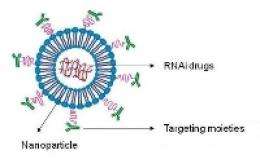
A nanoparticle decorated with targeting agents that guide it to a specific cell type, leaving healthy cells untouched. Credit: AFTAU

Ever since the 1966 Hollywood movie, doctors have imagined a real-life Fantastic Voyage -- a medical vehicle shrunk small enough to "submarine" in and fix faulty cells in the body. Thanks to new research by Tel Aviv University scientists, that reality may be only three years away.

The blueprints for the submarine and a map of its proposed maiden voyage were published earlier this year in Science by Dr. Dan Peer, who now leads the Tel Aviv University team at the Department of Cell Research and Immunology. The team will build and test-run the actual "machine" in human bodies. Dr. Peer originally developed the scenario at Harvard University.

Made from biological materials, the real-life medical submarine's Fantastic Voyage won't have enough room for Raquel Welch, but the nano-sized structure will be big enough to deliver the payload: effective drugs to kill cancer cells and eradicate faulty proteins.

A Nano-GPS System

"Our lab is creating biological nano-machines," says Dr. Peer. "These machines can target specific cells. In fact, we can target any protein that might be causing disease or disorder in the human body. This new invention treats the source, not the symptoms."

Dr. Peer's recent paper reported on the device's ability to target leukocytes (immune cells) in the guts of mice with ulcerative colitis. Calling his new invention a submarine, Dr. Peer has developed a nano-sized carrier which operates like a GPS system to locate and target cells. In the case of Crohn's disease, for example, it will target overactive immune system cells in the gut. In other diseases such as cancer, the submarine can aim for and deliver material to specific cancer cells, leaving the surrounding healthy cells intact.

While other researchers are working in the area of nano-medicine and drug delivery, Dr. Peer's submarines are among the first to combine a drug candidate with a drug delivery system. As the submarines float through the body, they latch onto the target cell and deliver their payload, a drug based on RNAi. This new kind of drug can affect faulty RNA machinery and reprogram cells to operate in normal ways. In essence, RNAi can essentially restore health to diseased cells or cause cells to die (like in the case of cancer cells).

Learning from the Body's Own System

Large pharmaceutical companies have already expressed interest in this research and in the area of RNAi in general. Currently, the Tel Aviv University lab is pairing its medical submarine with different RNAi compounds to target different pathologies, such as cancer, inflammation, and neurodegenerative diseases.

"We have tapped into the same ancient system the human body uses to protect itself from viruses," says Dr. Peer, who is also investigating a number of topical applications for his medical subs. "And the beauty of it is the basic material of our nano-carriers is natural," he says.

The Tel Aviv University team plans to launch their medical submarines, following FDA regulations, within three to five years. Their immediate focus is on blood, pancreatic, breast and brain cancers.

Source: American Friends of Tel Aviv University

Filter


Move the slider to adjust rank threshold, so that you can hide some of the comments.


Display comments: newest first

Edylc
Jan 15, 2009

Rank: not rated yet
Sign me up, I am so down to get Nano subs.
By the time they really have it down I'll be so full when I sneeze Nanites will go all over the place.
SmartK8
Jan 15, 2009

Rank: not rated yet
Let's hope this doctor won't be doing his own peer review.
ShankarG
Jan 15, 2009

Rank: not rated yet
Dear Editor, please provide article link to this news report.

Thanks,
Shanka
superhuman
Jan 19, 2009

Rank: 5 / 5 (1)
These are neither nanomachines nor "submarines", these are similar to some viruses, basically liposomes decorated with targeting molecules and containing a payload. A vary far cry from nano submarines.
Rank 4 /5 (9 votes)
Related Stories
Relevant PhysicsForums posts
  • Protease cleavage
    created6 hours ago
  • Pertubance in a model
    created13 hours ago
  • Cancer drugs and Alzheimer's, Oh my!
    created21 hours ago
  • Squishing cells
    created21 hours ago
  • Any books/articles for evolutionary stable strategy models in humans?
    createdFeb 09, 2012
  • Science behind the bore feeling?
    createdFeb 09, 2012
  • More from Physics Forums - Biology

More news stories

What lies beneath: Mapping hidden nanostructures

The ability to diagnose and predict the properties of materials is vital, particularly in the expanding field of nanotechnology. Electron and atom-probe microscopy can categorize atoms in thin sheets of material, ...

Nanotechnology / Nanophysics

created 11 hours ago | popularity 5 / 5 (1) | comments 1

New kind of solar cell could capture significantly more energy than current cells

New solar cells could increase the maximum efficiency of solar panels by over 25%, according to scientists from the University of Cambridge.

Nanotechnology / Nanophysics

created Feb 08, 2012 | popularity 4.5 / 5 (12) | comments 14 | with audio podcast

'Dark plasmons' transmit energy

Microscopic channels of gold nanoparticles have the ability to transmit electromagnetic energy that starts as light and propagates via "dark plasmons," according to researchers at Rice University.

Nanotechnology / Nanophysics

created Feb 09, 2012 | popularity 5 / 5 (6) | comments 1 | with audio podcast

Nanoshell whispering galleries improve thin solar panels

Visitors to Statuary Hall in the U.S. Capitol Building may have experienced a curious acoustic feature that allows a person to whisper softly at one side of the cavernous, half-domed room and for another on ...

Nanotechnology / Nanomaterials

created Feb 07, 2012 | popularity 4.3 / 5 (6) | comments 6 | with audio podcast

Revealing how a battery material works

Since its discovery 15 years ago, lithium iron phosphate (LiFePO4) has become one of the most promising materials for rechargeable batteries because of its stability, durability, safety and ability to deliver ...

Nanotechnology / Nanomaterials

created Feb 08, 2012 | popularity 5 / 5 (5) | comments 0 | with audio podcast


Google users warned of threat to smartphone wallets

Users of Google smartphone wallets were being warned on Friday that there is a way to crack pass codes intended to thwart thieves from going on illicit shopping sprees.

Anonymous knocks CIA website offline (Update)

The website of the Central Intelligence Agency was inaccessible on Friday after the hacker group Anonymous claimed to have knocked it offline.

Complex wiring of the nervous system may rely on a just a handful of genes and proteins

Researchers at the Salk Institute have discovered a startling feature of early brain development that helps to explain how complex neuron wiring patterns are programmed using just a handful of critical genes. ...

New error-correcting codes guarantee the fastest possible rate of data transmission

Error-correcting codes are one of the triumphs of the digital age. They’re a way of encoding information so that it can be transmitted across a communication channel — such as an optical fiber o ...

The power of estrogen -- male snakes attract other males

A new study has shown that boosting the estrogen levels of male garter snakes causes them to secrete the same pheromones that females use to attract suitors, and turned the males into just about the sexiest ...

Putting the squeeze on planets outside our solar system

(PhysOrg.com) -- Using high-powered lasers, scientists at Lawrence Livermore National Laboratory and collaborators discovered that molten magnesium silicate undergoes a phase change in the liquid state, abruptly ...