Biofuel carbon footprint not as big as feared, research says
January 15, 2009 Biofuel carbon footprint not as big as feared, research says

Enlarge

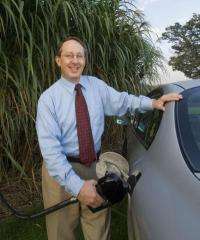
Bruce Dale is a cellulosic ethanol researcher at Michigan State University. Credit: Michigan State University

Publications ranging from the journal Science to Time magazine have blasted biofuels for significantly contributing to greenhouse gas emissions, calling into question the environmental benefits of making fuel from plant material. But a new analysis by Michigan State University scientists says these dire predictions are based on a set of assumptions that may not be correct.

"Greenhouse gas release from changes in land use - growing crops that could be used for biofuels on previously unfarmed land - has been identified as a negative contributor to the environmental profile of biofuels," said Bruce Dale, MSU University Distinguished Professor of chemical engineering and materials science. "Other analyses have estimated that it would take from 100 to 1,000 years before biofuels could overcome this 'carbon debt' and start providing greenhouse gas benefits."

But as Dale and his co-authors point out in their research, published in the January online edition of the journal Environmental Science & Technology, earlier analyses didn't consider a number of variables that might influence the greenhouse gas emissions associated with biofuels.

"Our analysis shows that crop management is a key factor in estimating greenhouse gas emissions associated with land use change associated with biofuels," Dale said. "Sustainable management practices, such as no-till farming and planting cover crops, can reduce the time it takes for biofuels to overcome the carbon debt to three years for grassland conversion and 14 years for temperate zone forest conversion."

The discrepancies between the time it will take biofuels to offer environmental benefits is due to the models used for each analysis, Dale explained.

"There are no real data on what actually happens as demand increases for land for biofuel production in one part of the world potentially leads to land clearing, because it is impossible to track these relationships in the real world," Dale said. "All the estimates are based on economic relationships and theoretical models with various data and assumptions. It's really one set of assumptions versus another set. The other scientists believe their assumptions are more reasonable, and we believe ours are more reasonable.

"How land is managed after it's converted to cropland is very important," Dale continued. "The authors of the Science paper assumed the worst-case scenario - plow tillage - which we don't think is accurate. The actual use of sustainable management practices - no till, reduced till and other approaches - is more than 50 percent and increasing."

Source: Michigan State University


print this article email this article download pdf blog this article bookmark this article     Stumble it Digg this share on Facebook retweet share on Reddit add to delicious
Rate this story - 2 /5 (9 votes)

Rank Filter

Move the slider to adjust rank threshold, so that you can hide some of the comments.


Display comments: newest first

  • Sean_W - Jan 15, 2009
    • Rank: 3.7 / 5 (3)
    And of course, it is impossible to grow biomass or biofuel feedstocks like algae on unproductive land like deserts because that would require a little engineering, some research and some investment. Totally impossible.

    But when one is willing to accept the belief that CO2 is some evil magical force created by one's political enemies in order to destroy the mother earth Goddess, I suppose thinking things through is a bit much to ask.

January 15, 2009 all stories

Comments: 1

2 /5 (9 votes)
  • Stumble this up

  • Digg this

  • share this

  • hide
  • Related Stories

  • Switching Gears to Greener Transportation
    created 9 hours ago | popularity not rated yet | comments 0
  • New study predicts future consequences of a global biofuels program
    created Oct 22, 2009 | popularity not rated yet | comments 0
  • Satellite data instrumental in combating desertification
    created Oct 07, 2009 | popularity not rated yet | comments 0
  • International scientists set boundaries for survival
    created Sep 23, 2009 | popularity not rated yet | comments 0
  • Beetles, wildfire: Double threat in warming world
    created Aug 23, 2009 | popularity not rated yet | comments 0


  • hide
  • Relevant PhysicsForums posts

  • cycles
    created Nov 08, 2009
  • The Origin of the term 'fossil' fuels
    created Nov 05, 2009
  • co2
    created Nov 03, 2009
  • Early Earths Sulfidic Ocean Conditions
    created Oct 30, 2009
  • More from Physics Forums - Earth

Other News

New NASA 3-D Video Shows Thunderstorms in Tropical Storm Ida

New NASA 3-D Video Shows Thunderstorms in Tropical Storm Ida (w/ Video)

Space & Earth / Earth Sciences

created 17 minutes ago | popularity not rated yet | comments 0

(PhysOrg.com) -- NASA's Tropical Rainfall Measuring Mission, or TRMM satellite has the ability to provide data that can be made into three-dimensional images. Visualizers at NASA's Goddard Space Flight Center ...


The 2009 Leonid Meteor Shower

The 2009 Leonid Meteor Shower

Space & Earth / Space Exploration

created 5 minutes ago | popularity not rated yet | comments 0

This year's Leonid meteor shower peaks on Tuesday, Nov. 17th. If forecasters are correct, the shower should produce a mild but pretty sprinkling of meteors over North America followed by a more intense outburst ...


NASA's Great Observatories Celebrate International Year of Astronomy

NASA's Great Observatories Celebrate International Year of Astronomy

Space & Earth / Astronomy

created 2 minutes ago | popularity not rated yet | comments 0

(PhysOrg.com) -- A never-before-seen view of the turbulent heart of our Milky Way galaxy is being unveiled by NASA on Nov. 10. This event will commemorate the 400 years since Galileo first turned his telescope ...


The Stars My Destination

The Stars My Destination

Space & Earth / Space Exploration

created 12 minutes ago | popularity not rated yet | comments 0

The Voyager spacecraft are now in the outermost layer of the heliosphere, traveling toward interstellar space - the first man-made spacecraft to travel such a vast distance from Earth.


Cave study links climate change to California droughts

Space & Earth / Earth Sciences

created 1hour ago | popularity not rated yet | comments 0

California experienced centuries-long droughts in the past 20,000 years that coincided with the thawing of ice caps in the Arctic, according to a new study by UC Davis doctoral student Jessica Oster and geology professor ...