Modeling Genomic Erosion
January 15, 2009 Modeling Genomic Erosion

Enlarge

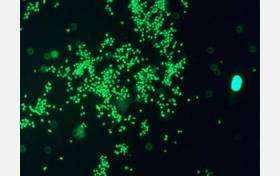
This image shows DNA stain of a disrupted bacteriocyte, a specialized cell in the aphid that contains bacteria. The green dots are Buchnera cells (bacteria), while the larger body is an aphid nucleus. Credit: Nancy Moran, Arizona State University

(PhysOrg.com) -- Even though scientists have successfully sequenced the human genome, they still lack a clear picture of exactly how coding and non-coding DNA sequences function together, or how genomes evolve over time. This has been particularly problematic for scientists who use genetic similarities to characterize evolutionary divergence. Historically, the processes of genetic evolution and genome degradation have been difficult to study due to technological limitations and lack of accurate historical records for species.

Researchers are now beginning to understand this process using symbiotic bacteria as model systems. When these bacteria went from free-living to obligate symbionts (unable to survive apart from the host), there were a number of genes that the bacteria no longer needed because they could obtain the necessary cofactors from the host species and because fewer genes are maintained in small populations such as those of symbionts. These genes were more susceptible to mutation and genetic erosion that ultimately resulted in genome reduction because they were no longer necessary for the bacteria to survive.

A team lead by Nancy Moran of the University of Arizona recently published data that characterize the dynamics and timescale of genomic erosion of the symbiotic bacteria of pea aphids. Pea aphids, native to Eurasia, were introduced to North America in the 1870s.

"We have good historical records for this species," said Moran. "Because this particular aphid species was not native to North America we know that the upper time limit for genetic divergence of the symbiotic bacteria descending from a single aphid introduction is 135 years or less."

The researchers sequenced the entire genome of seven different strains of symbiotic bacteria found within pea aphid strains in North America, including two strains that diverged in the laboratory. Extensive statistical analysis revealed mutation rates 10 times higher than the highest estimate for any species of bacteria. The authors used these results to construct a model of the stepwise process that eventually leads to genome reduction. This work is significant as the basis for how the process of genomic erosion occurs and provides insights about how this mechanism may act on a larger scale.

A full account of this project is published in the January 16 issue of Science magazine.

"Previous National Science Foundation-funded studies examined mutation rates and processes over very long periods of evolutionary time," stated Moran. "This work contributes to our understanding of whole-genome mutation rates and patterns over a well-defined, short period of time, allowing more exact reconstruction of changes. Our model is also consistent with other evidence characterizing mutational patterns."

Provided by National Science Foundation


print this article email this article download pdf blog this article bookmark this article     Stumble it Digg this share on Facebook retweet share on Reddit add to delicious
Rate this story - not rated yet


January 15, 2009 all stories

Comments: 0

not rated yet
  • Stumble this up

  • Digg this

  • share this

  • hide
  • Related Stories

  • Sequencing effort to chart ants and their ecosystem
    created Jun 26, 2009 | popularity not rated yet | comments 0
  • Analysis knocks down theory on origin of cell structure
    created Apr 22, 2009 | popularity not rated yet | comments 0
  • Partnerships of Deep-Sea Methane Scavengers Revealed
    created May 12, 2008 | popularity not rated yet | comments 0
  • A new plant-bacterial symbiotic mechanism promising
    created Jul 16, 2007 | popularity not rated yet | comments 0
  • A new plant-bacterial symbiotic mechanism promising for crop applications
    created Jun 05, 2007 | popularity not rated yet | comments 0


Other News

The six elephants in Sierra Leone were shot and "crudely butchered"

S.Leone elephants 'wiped out' by poachers: official

Biology / Ecology

created 12 hours ago | popularity 5 / 5 (4) | comments 5

Poachers "wiped out" the entire elephant herd in Sierra Leone's only wildlife park, wildlife managers said Thursday after police said they had arrested a gang of 10 poachers.


First-ever blueprint of a minimal cell is more complex than expected

First-ever blueprint of a minimal cell is more complex than expected

Biology / Cell & Microbiology

created 10 hours ago | popularity 5 / 5 (12) | comments 0

What are the bare essentials of life, the indispensable ingredients required to produce a cell that can survive on its own? Can we describe the molecular anatomy of a cell, and understand how an entire organism ...


Ecological speciation by sexual selection on good genes: Is speciation adaptive?

Biology / Ecology

created 10 hours ago | popularity 5 / 5 (1) | comments 0

Darwin suggested that the action of natural selection can produce new species, but 150 years after the publication of his famous book, 'On the Origin of Species', debate still continues on the mechanisms of speciation. New ...


Knockouts in human cells point to pathogenic targets

Knockouts in human cells point to pathogenic targets

Biology / Cell & Microbiology

created 13 hours ago | popularity not rated yet | comments 0

(PhysOrg.com) -- Whitehead researchers have developed a new approach for genetics in human cells and used this technique to identify specific genes and proteins required for pathogens.


Whiteflies sabotage alarm system of plant in distress

Whiteflies sabotage alarm system of plant in distress

Biology / Plants & Animals

created 14 hours ago | popularity 5 / 5 (1) | comments 0

(PhysOrg.com) -- When spider mites attack a bean plant, the plant responds by producing odours which attract predatory mites. These predatory mites then exterminate the spider mite population, thus acting ...