Humans are reason for why domestic animals have strange and varied coat colors
January 16, 2009 Humans are reason for why domestic animals have strange and varied coat colors

Enlarge

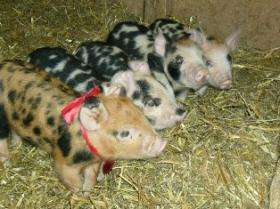
Photo of 'smiling' black and white pigs in a row: Black domestic pigs with white banding caused by mutations in their MC1R gene. This fancy color pattern would never survive in the wild, but is highly prized by people. Photo Jeff Veitch

(Physorg.com) -- Humans have actively changed the coats of domestic animals by cherry-picking rare genetic mutations, causing variations such as different colours, bands and spots, according to a new study.

The study on wild and domestic pigs by Uppsala and Durham Universities, published today in the open access journal PLoS Genetics, reveals that the genetic changes happened over thousands of years.

Although the study was carried out on pigs, the results can explain the evolution in the coat colours of all domesticated animals as they all express the same melanocortin-1 receptor (MC1R) gene, one of the genes that controls coat colour in animals.

The study also explains for the first time why there is a stark contrast between the coat colours of wild and domestic animals and gives further insight into the process of evolution, particularly since animals were first domesticated about 10,000 years ago.

Study co-author Dr Greger Larson, of Durham University's Department of Archaeology, said: "The Mesopotamians had different coloured farm animals 5,000 years ago, and in that regard they were no different to Paris Hilton, who has a pink Chihuahua, or anyone else with animals with unusual coat colours. This study demonstrates that the human penchant for novelty stretches back thousands of years."

For the study, the researchers studied one of the key genes controlling coat colour in animals, the melanocortin-1 receptor (MC1R) gene, in samples of modern wild and domestic pigs from Europe and Asia.

They looked at the DNA sequences of both types of pigs and the effects of the mutations on the protein. While DNA mutations are a natural part of the evolutionary process, some have no effect on the protein, while others can results in different coat colours and strange patterns.

DNA mutations were observed in both wild and domestic pigs. However, in the wild pigs, which have a uniformly black-brown coloured, highly camouflaged coat, none of the mutations altered the protein or the coat colour. Researchers say it is likely that any mutations that resulted in coat colour changes were rapidly selected out of the population by predators, ensuring that the mutation disappeared.

In the domestic pigs, nearly all of the observed mutations changed the protein. In some cases there were three consecutive, or layered mutations - evidence that the initial mutations have been around for a long time. Researchers say this shows that the mutations and resulting coat colour changes were actively encouraged and perpetuated by farmers over thousands of years.

Dr Greger Larson added: "Early farmers may have decided to change the coat of their livestock for a number of reasons. One is that it facilitated animal husbandry since it is easier to keep track of livestock that are not camouflaged. Another could be that it has acted as a metaphor for the improved characteristics of the early forms of livestock compared with their wild ancestors. A third possibility is that the early farmers were as amused and as taken with biological novelty and diversity as we are today."

Professor Leif Andersson of Uppsala University, Sweden, who led the study, said: "Our study settles the debate by showing that the prime reason for the disparity in coat colour is intentional selection by humans. It also shows how quickly a protein can change under strong selection and how humans have created black-spotted pigs, for example, by selecting several consecutive mutations that have occurred by a random process."

Provided by Durham University


print this article email this article download pdf blog this article bookmark this article     Stumble it Digg this share on Facebook retweet share on Reddit add to delicious
Rate this story - 3.9 /5 (9 votes)

Rank Filter

Move the slider to adjust rank threshold, so that you can hide some of the comments.


Display comments: newest first

  • Modernmystic - Jan 16, 2009
    • Rank: 2.8 / 5 (5)
    EVIL HUMANS!!! Giving animals varied and diverse coat colors. Oh the humanity! Just another example of our utter disregard for nature and our pillage of the natural world.
  • Crucialitis - Jan 16, 2009
    • Rank: 5 / 5 (1)
    I thought we figured this out when we domesticated those Russian wolves. Seems humans select for bushy and curly tails, floppy ears, juvenile body frames, and of course social skills with humans.
    As for Modernmystic, those animals naturally changed colors by living an advantageous lifestyle with humans. We don't eat the pretty ones, I'd say that's an advantage in the current state of things.
    I'd be more concerned with the fact that we engage in neoteny on ourselves every generation. Soon we'll be piebald too! :j
  • Modernmystic - Jan 16, 2009
    • Rank: 5 / 5 (1)
    I was being just a tad sarcastic bro :)

    But I understand it's hard to know in this day and age...there are some people out there who could make a comment like my initial post and be ACTUALLY serious....
  • Velanarris - Jan 16, 2009
    • Rank: 3.7 / 5 (3)
    Pigs aren't really the best animal for this study.

    If you turn a standard domesticated pig loose, even if it has reached full maturity, the body will undergo changes making it indistiguishable from a feral hog. Most notable are the growth of the incisors, darkening of the coat, and the substantial skull geometry change. I am aware that this doesn't necessarily change the genetics of the animal, but to see a completely different phenotype arise, even after full maturity has been reached, should cast some doubt on the ability of the pig to be a suitable subject for this testing.
  • KBK - Jan 17, 2009
    • Rank: not rated yet
    So they are gawddamn Werepigs.

    And we eat them.

    Interesting.

    As for Co-inkydinks....they are also ..uh...IIRC..the best candidates for organ transplant into the human body - out of all of the animal world.

    Whooda Thunk it.
  • KBK - Jan 17, 2009
    • Rank: 1 / 5 (1)
    "I am he as you are he as you are me and we are all together.
    See how they run like pigs from a gun, see how they fly.
    I'm crying."

    "Expert texpert choking smokers,
    Don't you think the joker laughs at you? (ho ho ho, he he he, ha ha ha)
    See how they smile like pigs in a sty, see how they snide.
    I'm crying."

    "I am the eggman (woo), they are the eggmen (woo), I am the walrus,...."
  • morpheus2012 - Jan 17, 2009
    • Rank: 1 / 5 (1)
    haha cute

    little piglets

    more cute the stinky dogs or cats

January 16, 2009 all stories

Comments: 7

3.9 /5 (9 votes)
  • Stumble this up

  • Digg this

  • share this

  • hide
  • Related Stories

  • Scientists identify genetic basis for the black sheep of the family
    created Jul 11, 2008 | popularity not rated yet | comments 0
  • Commercial pigs in Ind. test positive for H1N1
    created Nov 04, 2009 | popularity not rated yet | comments 0
  • Ancient bison genetic treasure trove for farmers
    created Oct 20, 2009 | popularity not rated yet | comments 0
  • USDA confirms H1N1 in Minnesota pigs
    created Oct 19, 2009 | popularity not rated yet | comments 0
  • Minn. pigs may have tested positive for swine flu
    created Oct 17, 2009 | popularity not rated yet | comments 0


Other News

Hammerhead shark

Wide heads give hammerheads exceptional stereo view

Biology / Plants & Animals

created 18 hours ago | popularity 4.4 / 5 (5) | comments 4

Hammerhead sharks are some of the Ocean's most distinctive residents. 'Everyone wants to understand why they have this strange head shape,' says Michelle McComb from Florida Atlantic University. One possible ...


Golden Oldie: Key Role for Ancient Protein in Algae Photosynthesis

Golden Oldie: Key Role for Ancient Protein in Algae Photosynthesis

Biology / Biotechnology

created 9 hours ago | popularity not rated yet | comments 1

The discovery that an ancient light harvesting protein plays a pivotal role in the photosynthesis of green algae should help the effort to develop algae as a biofuels feedstock. Researchers with the Lawrence ...


Tough yet stiff deer antler is materials scientist's dream

Biology / Plants & Animals

created 18 hours ago | popularity 3 / 5 (1) | comments 2

Prized for their impressive antlers, red deer have been caught in the hunters' sights for generations. But a deer's antlers are much more than decorative. They are lethal weapons that stags crash together when duelling. John ...


Indonesia rejects Bali plan for turtle sacrifices (AP)

Indonesia rejects Bali plan for turtle sacrifices

Biology / Ecology

created 15 hours ago | popularity not rated yet | comments 0

(AP) -- Indonesia has rejected a push by the resort island of Bali for rare turtles to be legally slain in Hindu ceremonies, siding with conservationists of the protected reptiles against religious advocates, ...


Ecologists sound out new solution for monitoring cryptic species

Biology / Ecology

created 18 hours ago | popularity not rated yet | comments 0

Ecologists have at last worked out a way of using recordings of birdsong to accurately measure the size of bird populations. This is the first time sound recordings from a microphone array have been translated into accurate ...