SQUID: The long (and sticky) arms of the law
January 16, 2009 SQUID: The long (and sticky) arms of the law

Enlarge

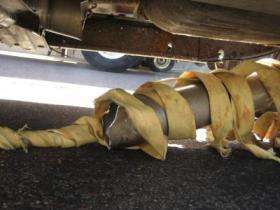
Here, the Department of Homeland Security S&T's Safe Quick Undercarriage Immobilization Device (SQUID) is entangled in the undercarriage of a vehicle. Credit: DHS S&T

What's possible when a group of scientists are inspired by a famous superhero and a giant creature from the sea? How about a new technology for stopping drivers in their tracks?

Fleeing drivers are a common problem for law enforcement. They just won't stop unless persuaded—persuaded by bullets, barriers, spikes, or snares. Each option is risky business.

Shooting up a fugitive's car is one possibility. But what if children or hostages are in it? Lay down barriers, and the driver might swerve into a school bus. Spike his tires, and he might fishtail into a van—if the spikes stop him at all. Existing traps, made from elastic, may halt a Hyundai, but they're no match for a Hummer. In addition, officers put themselves at risk of being run down while setting up the traps.

FLV player

This is the Department of Homeland Security S&T's SQUID in action. Credit: DHS S&T


But what if an officer could lay down a road trap in seconds, then activate it from a nearby hiding place? What if—like sea monsters of ancient lore—the trap could reach up from below to ensnare anything from a MINI Cooper to a Ford Expedition? What if this trap were as small as a spare tire, as light as a tire jack, and cost under a grand?

Thanks to imaginative design and engineering funded by the Small Business Innovation Research (SBIR) Office of the U. S. Department of Homeland Security's Science and Technology Directorate (S&T), such a trap may be possible by 2010. It's called the Safe Quick Undercarriage Immobilization Device, or SQUID. When closed, the current prototype resembles a cheese wheel full of holes. When open (deployed), it becomes a mass of tentacles entangling the axles. By stopping the axles instead of the wheels, SQUID may change how fleeing drivers are, quite literally, caught.

The 1.5-foot-wide disc was conceived and developed by Engineering Science Analysis Corporation (ESA) of Tempe, Arizona. S&T's Borders and Maritime Security Division manages the project.

"SQUID was inspired by a sea creature and a superhero," says ESA president Martín Martínez. Like its oceanic namesake, SQUID ensnares its prey with sticky tendrils. Like Spiderman's webbing, these tendrils stretch to absorb the kinetic energy of their fleeing target.

Huge amounts of such counterforce are necessary to stop a heavy, swift vehicle: Think Spiderman II, where Spidey stretched his webbing for blocks to halt a runaway passenger train. The force nearly killed him. Martínez took a different approach that would have made Spidey proud: Don't fight the Force; just stop the axles from turning. Do that and you can stop (almost) anything with wheels.

Can it really work? Martínez and DHS think so. In testing, a SQUID prototype safely stopped a 35 mph pickup truck (see video). That's a good start, but before SQUID can be marketed, law enforcement officers need proof that it has the fiber to stop a 5,000-pound vehicle—about the heft of a Ford F-150 pickup—speeding at 120 miles per hour.

Beyond performance, SQUID will need to satisfy other demands of law enforcement.

"We must make it lighter," says Mark Kaczmarek, the S&T SQUID program manager. "Also, more affordable, so it becomes the stopper of choice, regardless of budget." Finally, SQUID must be rugged, reliable, and capable of being reloaded. These goals will be pursued in 2009, as ESA teams with Pacific Scientific Energetic Materials Corporation (PSEMC) of Chandler, Arizona.

Meanwhile, the spidery disc has lured the interest of state and local police as well as federal agencies such as Customs and Border Protection (CBP) and Immigration and Customs Enforcement (ICE). In response to concerns about whether criminals will see the disc, SQUID may be reborn as a centipede—that happens to look like a speed bump.

Martínez and Kaczmarek hope their spidery cephalopod will spawn a generation of offspring—in this case, a family of nonlethal stopping devices for land, sea, and air…all based on the same sticky principle, less is more.

"If bad guys need 'inspiration' to comply," says a smiling Martínez, "we'll be glad to inspire them."

Source: US Department of Homeland Security


print this article email this article download pdf blog this article bookmark this article     Stumble it Digg this share on Facebook retweet share on Reddit add to delicious
Rate this story - 4 /5 (6 votes)

Rank Filter

Move the slider to adjust rank threshold, so that you can hide some of the comments.


Display comments: newest first

  • superhuman - Jan 16, 2009
    • Rank: not rated yet
    While it's a good idea for car's with rear and all wheel drive as the driveshaft is easily accessible from below the axles in front wheel drive cars are usually not accessible so I don't see it working in that case.
  • KBK - Jan 16, 2009
    • Rank: not rated yet
    It grips the tires..circles around..and in that moment of being whipped round the tires..falls into the axle area (with the rest of the squid trailing along)..then it wraps around the axles and suspension components and tightens. I'd hazard it guess that it is made of vectran, spectra, or Kevlar...and with a 100,000lb or so breaking strength. Vectran is the real suspect material..and damn... that shit is strong. Unbelievably so. 50,000x times stronger than the equivalent weight of/in steel.

    It will stop a car or truck. No problem.

    You put fingers of out out to have the sticky bits grab the tires..and it unravels from the pack in the center..and thus it nearly immediately ends up moving inward to wrap around the axles. Get it?

    Watch the video again. Watch for it, look at the 'pack' of the material, how it is set up.
  • KBK - Jan 16, 2009
    • Rank: not rated yet
    At full speed?

    At the lock up point...it'll blow the suspension right off the car. Right freaking off. Which is why the test was at 35mph. Note how hard the truck's lock-up was.

    Zip...BANG! And the undercarriage explodes right off the car.

    Note the sheared metal in the supplied DHS photo.
  • superhuman - Jan 17, 2009
    • Rank: not rated yet
    Yes, you are right that it grabs tires first, so it can work on FWD also.

    And yes at full speed there is a very serious risk of shrapnels flying around.
  • Trucker18 - Jan 18, 2009
    • Rank: not rated yet
    What if a vehicle doesn't have a central motor, drive shaft, or rear end differential/axle?

    I see a future were propulsion systems for autos and trucks will consists of hydrogen fuel cells, ultracapactors (energy storage from fuel cell and regenerative braking from wheel motors) and 4-wheel drive wheel hub motors.

    http://www.youtub...Q2-yKT4Y
    http://www.lightn...y.co.uk/
  • Velanarris - Jan 18, 2009
    • Rank: not rated yet
    The CV axle would break shutting the transmission down on a fwd or awd, much weaker than a driveshaft and U joint.

    As for future propulsion, right now the systems are about the same, it's the powerplant that's changing.
  • URBusted - Jan 22, 2009
    • Rank: not rated yet
    The Squid device that you are apparently working on for stopping vehicles is an absolute joke. It will be the laughing stock of criminals as they blow around it sitting there in the road. Not to mention that on front wheel driven vehicles (which are the bulk of modern vehicles) it can actually cause loss of control and lead to serious or even deadly accidents.

    When the straps are deployed to become entangled in the mechanical drive parts of the Drive Train they wrap around the Drive Shaft or other moving (rotating) parts. Unless they wrap equally around each front drive axle and at the very same rate they will create unequal resistance on the front Drive Shafts. The consequence of this unequal resistance is that one wheel will be forced to turn slower than the other (this will occur abruptly and without any warning to the suspect). If this happens it will cause the vehicle to veer in the direction of the wheel with the most resistance. In other words, the vehicle will make an abrupt uncontrolled turn in that direction. It is very similar to accidents that are caused when someones front tire blows out without any way of knowing it is going to happen. Many deadly accidents have occurred just because of this very scenario. This can propel the vehicle into oncoming vehicles or even strike pedestrians along side the roadway or on sidewalks. Or it can even cause a roll-over of the fleeing vehicle which can cause serious injury or even death to the suspect.

    For a REAL solution to this problem go to: www.policepursuit...ator.com
  • Velanarris - Jan 22, 2009
    • Rank: not rated yet
    The Squid device that you are apparently working on for stopping vehicles is an absolute joke. It will be the laughing stock of criminals as they blow around it sitting there in the road.
    They said the same thing about the stinger. FYI: it's still in common usage around the world due to it's effectiveness.

    Not to mention that on front wheel driven vehicles (which are the bulk of modern vehicles) it can actually cause loss of control and lead to serious or even deadly accidents.
    As I said before a CV axle will break at the bearings before this would happen. When a CV breaks the transmission can not engage the drive gear any longer resulting in a gradual deceleration, effectively the same as turning the car off.

    When the straps are deployed to become entangled in the mechanical drive parts of the Drive Train they wrap around the Drive Shaft or other moving (rotating) parts. Unless they wrap equally around each front drive axle and at the very same rate they will create unequal resistance on the front Drive Shafts. The consequence of this unequal resistance is that one wheel will be forced to turn slower than the other (this will occur abruptly and without any warning to the suspect).
    Actually everytime you go around a corner one wheel is forced to turn slower than the other. I think you're ignorant of the fact that 2wd whther they are fwd or rwd only provide power to 1 wheel. 4wd only provides power to 2, awd provides variable power to all 4. This is a tech that's been in use for a while now. It was introduced to combat the shudder you'd get from 2wd vehicles when accelerating around corners as one wheel has a shorter path to travel than the other when the vehicle navigates the turn. Couple that with constant velocity systems and varible speed gearing of transaxles and rear end gear boxes and this catastropic risk you're referring to is greatly reduced.

    The only thing I'd put any merit behind would be pole vaulting, when a driveshaft breaks and gets caught agaist the ground and the vehicle, but this would only happen on vehicles with modified solid drive shafts, which you won't find on any non-aftermarket street legal vehicles in the US.

  • URBusted - Jan 22, 2009
    • Rank: not rated yet
    Velanarris

    With all due respect I know far more about the mechanical functioning of all aspects of motor vehicles than you are obviously aware of.

    Yes, when someone makes a turn it is one of the laws of Physics that one wheel will rotate at a higher rate than another. The wheels nearest to the center of the arc turns more slowly than the wheels at the outer arc of that same center. The larger the speed between the wheel near the center of the arc and the wheel furthest from that same point will turn proportionally faster. The larger the distance between the two wheels, the larger the difference in relevant speeds.

    Your referencing someone steering a vehicle causes this very result only serves to prove my point. The primary difference is that with your example the Driver is taking a deliberate and planned action, whereas I was speaking of an unplanned and abrupt interference with the controlled operation of the vehicle.

    The next time your out driving your car ask someone to ride with you. Instruct them to at some point without any warning reach over and give a good firm, quick turn of the wheel. What do you think would happen? You may be able to recover, but depending on your speed and surroundings it will be very difficult and in most instances you will fail to recover. Of coarse I don't actually want you to do this, but just try to imagine this real situation and I think you will get the point.

    Additionally due to the fact that front wheel drive vehicles use as a part of the drive components what is generally referred to as a CVJ (Constant Velocity Joint). This joint is the "weakest link" in the drive portion of this type of system. If the drive axle is stressed from an extemporaneous source (such as the SQUID) the CVJ is the most likely part to fail as many of the shafts on these vehicles are solid alloy steel and almost impossible to break. The CVJ will fail long before most of the shafts will. When this happens it will be a matter of the joint actually rupturing in a very explosive way. Due to the fact that the vast majority of front wheel drive cars axle is an integral part of this joint, it can cause a catastrophic failure and the loss of the axle as well. Since the axle is the weight bearing structure for that part of the vehicle as wheel as half of the steering system, it is only another opportunity for loss of control.

    Beside, what criminal worth his title would deliberately drive over something like this while being pursued? What if they swerve to miss the SQUID and crash as a result? What if they are able to avoid the device but the pursuing vehicle or unsuspecting motorist runs over it shortly after it has been activated?

    NO, this device is fraught with many issues. I say put it in the scrapheap before it causes any trouble to innocent people.
  • Velanarris - Jan 23, 2009
    • Rank: not rated yet
    I'm sorry but a CV is not a main weight bearing part of your front end. In most vehicles this is the strut assembly on top and a lower control arm(s) assembly on the bottom. Your CV also has very little to do with steering.

    Conversely you're correct, if you did wrap this item up in your steering assembly I do see chance for calamity there but only at terribly high speeds(excess of 40 mph), which unfortunately, is exactly what they're attempting to design this for. It will be interesting to see how they address the issue.

January 16, 2009 all stories

Comments: 10

4 /5 (6 votes)
  • Stumble this up

  • Digg this

  • share this

  • hide
  • Related Stories


  • hide
  • Relevant PhysicsForums posts

Other News

A system of space solar power system (SSPS)

Japan eyes solar station in space as new energy source

Technology / Energy

created 20 hours ago | popularity 4.7 / 5 (13) | comments 19

It may sound like a sci-fi vision, but Japan's space agency is dead serious: by 2030 it wants to collect solar power in space and zap it down to Earth, using laser beams or microwaves.


Software cos. eye key patent case in Supreme Court (AP)

Software cos. eye key patent case in Supreme Court

Technology / Business

created 21 hours ago | popularity 5 / 5 (4) | comments 2

(AP) -- With the technology industry looking on, the Supreme Court on Monday will explore what types of inventions should be eligible for a patent in a pivotal case that could undermine such legal protections ...


Framed for child porn -- by a PC virus

Framed for child porn -- by a PC virus

Technology / Internet

created 12 hours ago | popularity 5 / 5 (5) | comments 2

(AP) -- Of all the sinister things that Internet viruses do, this might be the worst: They can make you an unsuspecting collector of child pornography.


Campaigners are stepping up efforts to curb online tracking

Advertisers face resistance to on-line tracking

Technology / Internet

created 20 hours ago | popularity 5 / 5 (3) | comments 0

Campaigners are stepping up efforts to curb online tracking of Internet use by firms that deliver adverts tailored to the specific interests of consumers, as polls reveal widespread unease with the practice.


Sony offers 'Cloudy' early to people with its TVs

Technology / Business

created 13 hours ago | popularity not rated yet | comments 0

(AP) -- In a bid to sell living room electronics and spur buzz for "Cloudy with A Chance of Meatballs," Sony Corp. is offering the movie for free to U.S. buyers of its Internet-connected TVs and Blu-ray players starting ...