January 16, 2009 feature
Physicists Propose Method for Entangling Moving Material Particles
(PhysOrg.com) -- When physicists experiment with quantum entanglement, they usually work with photons, the intangible particles of light. In the past few years, however, scientists have begun to broaden their experiments by entangling material particles. By seeing how far this quantum property extends into the classical realm, researchers can investigate the implications of entanglement in the macroscopic world, such as our intuitive assumptions of “realism” - that objects exist whether or not anyone observes them - and “locality” - that objects cannot communicate with each other faster than the speed of light.
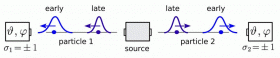
In a recent study, physicists Clemens Gneiting and Klaus Hornberger from the Ludwig-Maximilians-University of Munich in Germany have proposed a scheme to take entanglement one step further: they explain how to entangle the motion of two macrosopically separated particles. Rather than resorting to entangling the internal states of the particles, the physicists suggest using a pulsed magnetic field to spatially separate the particles’ wave functions. Then, an interferometer can detect the correlation between each particle’s two separated wave packets, demonstrating what the scientists call “dissociation time entanglement” (DTE).
As the physicists explain, entangling the motion of massive particles could have certain advantages compared with entangling their internal states. “In contrast to spin, motion - or rather position - has a direct classical analogue,” Gneiting told PhysOrg.com. “Describing the motion of a material particle is a key concept in classical physics. Demonstrating non-classical features in the motion of a material particle thus reveals best the incompatibility of our experienced world with a classical description.”
Gneiting and Hornberger predict that, although their scheme faces technological challenges, experimentally realizing their method seems to be within reach of present-day technology. They have published their proposed method in a recent issue of Physical Review Letters.
To realize the entanglement of moving material particles, the physicists proposed using a Bose-Einstein condensate (BEC), which is an ultra-cold state of matter that displays collective quantum properties even for a large number of particles. When made of lithium molecules, a BEC has the advantage of possessing a relatively long lifetime of 10 seconds, which would enable researchers to apply a macroscopic time separation of one second between pulses which split the molecules.
By applying two field pulses at the BEC molecule, it’s possible to separate, or dissociate, the molecule into two atoms traveling in opposite directions from the source. Each counterpropagating atom has two wave packets corresponding to the two possible dissociation times: an early and a late wave packet. Then, simple position measurements behind interferometers reveal the correlations between the early and late wave packets of the two atoms. Their entanglement is verified if these correlations violate a Bell inequality.
As Gneiting and Hornberger explain, the Bell measurement is analogous to detecting the spin rotation of a particle. In this view, the early wave packet could correspond to spin up, and the late wave packet to spin down.
“The interferometers reveal the entanglement between the two atoms by reuniting the early and the late wave packets on each side,” Hornberger explained. “The resulting interference influences at what direction the atoms exit the interferometers, which can be detected by simple position measurements. The latter can be easily understood from a classical point of view, which permits to compare the experiment with the classical expectation.”
One challenge in performing an experiment of this motion entanglement will be to control unavoidable wave packet dispersion. If the early and late wave packets broaden too much, their distortion prevents accurate measurements. But if researchers can successfully perform the experiment, the results may provide insight into how accurately the macroscopic world can be described by local realism.
“In general, violation of a Bell inequality demonstrates the incompatibility of a realistic and a local description of our physical world,” Gneiting said. “Establishing such a violation even in the motion of material particles and on everyday life scales makes it ever harder to come up with a plausible alternative theory based on hidden variables, even when dispensing with the combination of reality and locality.”
More information: Gneiting, Clemens and Hornberger, Klaus. “Bell Test for the Free Motion of Material Particles.” Physical Review Letters 101 260503 (2008).
Copyright 2008 PhysOrg.com.
All rights reserved. This material may not be published, broadcast, rewritten or redistributed in whole or part without the express written permission of PhysOrg.com.


