Researchers identify potential cancer target
January 16, 2009 Researchers identify potential cancer target

Enlarge

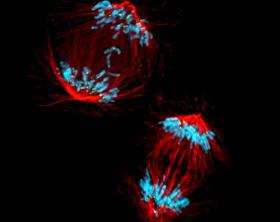
Two anaphase spindles from the control (lower) and Kif2b-depleted (upper) cells. See how the upper spindle contains two lagging chromosomes. Microtubules are shown in red, chromosomes in blue, and the kinetochore marker is in green. (image by Samuel Bakhoum)

(PhysOrg.com) -- Dartmouth Medical School researchers have found two proteins that work in concert to ensure proper chromosome segregation during cell division. Their study is in the January 2009 issue of the journal Nature Cell Biology.

This finding is relevant for treating solid cancerous tumors that lose the ability to accurately segregate their chromosomes. Tumors that shuffle chromosomes, a process called chromosomal instability, are known to have a poor prognosis.

"We show that the function of two proteins, called Kif2b and MCAK, is to correct improper attachments during cell division to prevent the mis-segregation of chromosomes" said Duane Compton, the senior author on the paper and a professor of biochemistry at Dartmouth Medical School. "The two proteins share the workload as Kif2b acts early in cell division and MCAK acts later. This cooperation underlines the importance of proper chromosome segregation for the healthy life of all cells." Compton is also director of the Cancer Mechanisms Research Program at Norris Cotton Cancer Center at Dartmouth-Hitchcock Medical Center.

Compton explained this finding follows a study his team published in the February 2008 issue of The Journal of Cell Biology that showed that the main cause of chromosomal instability is that chromosomes make improper attachments to the spindle apparatus during cell division. "These improper attachments occur normally during cell division in all cells, but in the tumor cells, the improper attachments fail to get corrected and cells attempt to divide with persistent improper attachments," said Compton.

The current study shows the two proteins complete their job by regulating the attachment between the chromosomes and the spindle apparatus. Based on these results, the team also determined that increasing quantities of either Kif2b or MCAK in tumor cells restored nearly normal accuracy of chromosome segregation.

"We discovered how to make the tumor cells faithfully segregate their chromosomes every time the cell divides," said Compton. "Chromosomal instability has been studied for over a decade in tumor cells; this is the first time anyone has suppressed it in tumor cells indicating a strong causal relationship between correction of improper attachments of chromosomes to the spindle apparatus and chromosomal instability. These results give us insight into the overall mechanisms of cell division in tumor cells compared to normal cells, and we may be able to exploit that, leading to new therapeutic strategies or treatments that might prevent tumor progression."

Compton and his team will now work to directly test the contribution of CIN to tumor development.

Source: Dartmouth College


print this article email this article download pdf blog this article bookmark this article     Stumble it Digg this share on Facebook retweet share on Reddit add to delicious
Rate this story - 5 /5 (1 vote)

Rank Filter

Move the slider to adjust rank threshold, so that you can hide some of the comments.


Display comments: newest first

  • E_L_Earnhardt - Jan 16, 2009
    • Rank: not rated yet
    You are dealing with seperate cells. ONE CELL can malfunction all by itself! Electron speed and spin can break hydrogen bonds creating accelerated mitosis
    in a single cell! Tap off the excess energy,(cool it)
    and the instability will stabilize before mitosis!

January 16, 2009 all stories

Comments: 1

5 /5 (1 vote)
  • Stumble this up

  • Digg this

  • share this

  • hide
  • Related Stories


  • hide
  • Relevant PhysicsForums posts

  • Obsessive Compulsive Disorder
    created Nov 20, 2009
  • West's zone 2 starling resistor respiratory physiology
    created Nov 18, 2009
  • 50-0-50 rule
    created Nov 18, 2009
  • What is the evidence in support of the anti-vaccine movement?
    created Nov 17, 2009
  • More from Physics Forums - Medical Sciences

Other News

Swine flu vaccine effective despite mutations: experts

Medicine & Health / Diseases

created 15 hours ago | popularity 1 / 5 (1) | comments 1

Swine flu vaccines are still effective despite reported cases of mutations in the A(H1N1) virus, health experts in Europe and North America said Saturday.


Study raises concerns about outdoor second-hand smoke

Medicine & Health / Health

created Nov 18, 2009 | popularity 2 / 5 (4) | comments 21

Indoor smoking bans have forced smokers at bars and restaurants onto outdoor patios, but a new University of Georgia study in collaboration with the Centers for Disease Control and Prevention suggests that these outdoor smoking ...


smoking, cigarette

Vaccine being developed to help smokers quit

Medicine & Health / Medications

created Nov 20, 2009 | popularity 4.5 / 5 (11) | comments 10

(PhysOrg.com) -- Glaxo-SmithKline has joined forces with Nabi Pharmaceuticals to produce a vaccine to help smokers give up their addiction permanently.


Pilot study relates phthalate exposure to less-masculine play by boys

Medicine & Health / Research

created Nov 16, 2009 | popularity 4.8 / 5 (9) | comments 9

A study of 145 preschool children reports, for the first time, that when the concentrations of two common phthalates in mothers' prenatal urine are elevated their sons are less likely to play with male-typical toys and games, ...


wine

Alcohol helps lower heart disease risk for men: study

Medicine & Health / Health

created Nov 19, 2009 | popularity 4.2 / 5 (6) | comments 7

Men who drink alcohol every day see a nearly one-third average reduction in the risk of coronary heart disease, according to a long-term study among Spanish men published on Thursday.