Neurons show sex-dependent changes during starvation
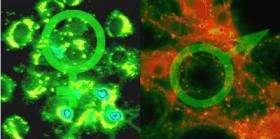
January 16, 2009 Male vs. Female Starved Neurons

Enlarge

After 24 hours of starvation, neurons from females (left panel) mobilize free fatty acids and form lipid droplets (bright green), keeping them alive. In contrast, neurons from males (right panel) begin eating themselves from the inside to break down proteins, presumably to use as fuel. Credit: Robert S.B. Clark

When it comes to keeping brains alive, it seems nature has deemed that females are more valuable then males. As reported in this weeks' JBC, researchers found that nutrient deprivation of neurons produced sex-dependent effects. Male neurons more readily withered up and died, while female neurons did their best to conserve energy and stay alive.

The idea that the sexes respond differently to nutrient depravation is not new, and revolves around the male preferences to conserve protein and female preferences to conserve fat. However, these metabolic differences have really only been examined in nutrient-rich tissues like muscles, fat deposits, and the liver.

Robert Clark and colleagues at the Children's Hospital of Pittsburgh of University of Pittsburgh Medical Center examined whether this sex-dependent response in starvation could manifest in brain cells. They grew neurons taken separately from male and female rats or mice in lab dishes and subjected them to starvation over 72 hours.

After 24 hours, the male neurons experienced significantly more cell dysfunction (measured by analyzing cell respiration, which decreased by over 70% in male cells compared to 50% in female cells) and death. Visually, male neurons also displayed more abundant signs of autophagy, whereby a cell breaks down its components as a fuel source, while female neurons created more lipid droplets to store fat reserves.

As with other cell culture studies, the researchers note these results may not be truly indicative of what happens in living animals during starvation, but it allows them to look at the neurons independent of external factors like circulating hormones.

Article: "Starving Neurons Show Sex Difference in Autophagy" by Lina Du, Robert W. Hickey, Hülya Bayır, Simon C. Watkins, Vladimir Tyurin, Fengli Guo, Patrick M. Kochanek, Larry W. Jenkins, Jin Ren, Greg Gibson, Charleen T. Chu, Valerian E. Kagan, and Robert S. B. Clark
http://www.jbc.org/cgi/content/full/284/4/2383

Source: American Society for Biochemistry and Molecular Biology


print this article email this article download pdf blog this article bookmark this article     Stumble it Digg this share on Facebook retweet share on Reddit add to delicious
Rate this story - 3 /5 (2 votes)

Rank Filter

Move the slider to adjust rank threshold, so that you can hide some of the comments.


Display comments: newest first

  • Crucialitis - Jan 16, 2009
    • Rank: not rated yet
    I'm never going 24hrs without food again..
  • el_gramador - Jan 16, 2009
    • Rank: not rated yet
    You do realize that you effectively can survive for 7 days without food or water right? You'll probably die of dehydration first, but effectively you can last for 3-4 days without food. Not to say that isn't problematic in and of itself. Though by sleeping you could also reduce the need for food altogether.

January 16, 2009 all stories

Comments: 2

3 /5 (2 votes)
  • Stumble this up

  • Digg this

  • share this

  • hide
  • Related Stories


  • hide
  • Relevant PhysicsForums posts

  • Swine flu vaccination
    created Nov 10, 2009
  • Improving the brain through chemistry
    created Nov 07, 2009
  • Sleep / REM Sleep and homeostasis
    created Nov 07, 2009
  • The Biceps Reflex
    created Nov 05, 2009
  • More from Physics Forums - Medical Sciences

Other News

New brain findings on dyslexic children

Medicine & Health / Neuroscience

created 14 minutes ago | popularity not rated yet | comments 0

The vast majority of school-aged children can focus on the voice of a teacher amid the cacophony of the typical classroom thanks to a brain that automatically focuses on relevant, predictable and repeating auditory information, ...


Novel mouse gene reduces major pathologies associated with Alzheimer's disease

Medicine & Health / Neuroscience

created 54 minutes ago | popularity not rated yet | comments 0

A new study reveals that a previously undiscovered mouse gene reduces the two major pathological perturbations commonly associated with Alzheimer's disease (AD). The research, published by Cell Press in the November 12 issue ...


Drug industry presses FDA to allow more online ads (AP)

Drug industry presses FDA to allow more online ads

Medicine & Health / Medications

created 34 minutes ago | popularity not rated yet | comments 0

(AP) -- As federal regulators take their first tentative steps toward policing the wild west of medical information online, pharmaceutical companies are pressing their case to market drugs via Google, Twitter ...


UN: 200 million kids have stunted growth

Medicine & Health / Health

created 41 minutes ago | popularity not rated yet | comments 0

(AP) -- Nearly 200 million children in poor countries have stunted growth because they don't get enough to eat, according to a new report published Wednesday by UNICEF.


Athletes on performance enhancers more likely to abuse alcohol, other drugs

Medicine & Health / Health

created 14 minutes ago | popularity not rated yet | comments 0

College athletes who use performance-enhancing substances may be at heightened risk of misusing alcohol and using recreational drugs as well, according to new research in the Journal of Studies on Alcohol and Drugs.