Researchers work out structure of TIGAR, a possible cancer flag
January 17, 2009 TIGAR

Enlarge

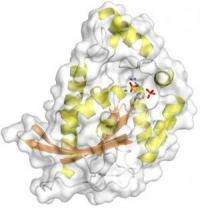
Researchers at Brown have worked out the three-dimensional structure of an enzyme known as TIGAR. Because it is a marker for cell damage and repair, TIGAR could signal physicians that cancer may be developing. Credit: Jogl Laboratory/Brown University

Two Brown University researchers have determined the three-dimensional structure of an enzyme whose presence in the body could help doctors detect cancer earlier or develop more targeted treatments.

Hua Li and Gerwald Jogl detail their progress with the enzyme known as TIGAR in a paper to be published Jan. 16, 2009, in The Journal of Biological Chemistry.

"It will help us to understand where else we should be looking for good [anti-cancer] targets," said Jogl, assistant professor of biology in the Department of Molecular Biology, Cell Biology and Biochemistry at Brown. Jogl is the study's principal investigator and corresponding author. Li is a fifth-year Ph.D. student based in Jogl's lab and is the lead author.

Jogl and Li wanted to determine the structure of TIGAR. After more than a year of research, they discovered that it is has a more substantive active site than they had expected. To map the structure, the pair used a method called X-ray crystallography.

The process involved using intensive X-ray light produced at the National Synchroton Light Source in Brookhaven, N.Y., to analyze crystals grown from samples of the TIGAR enzyme.

A separate study by researchers from St. Jude's Children's Research Hospital first identified the existence of TIGAR. Those results were published in CELL in 2006.

TIGAR, which helps regulate energy production in the cell, is activated after cell damage. Because of this, the presence of the enzyme can indicate potential problems that may lead to cancer. But TIGAR itself is positive. Once activated, TIGAR slows all processes in the cell, allowing time to repair cell damage. This process is also intended to prevent further damage that could lead to cancer.

Jogl and Li believe their finding may suggest that TIGAR has additional functions in the cell.

Understanding TIGAR is important, Jogl said, because the enzyme is "one of the good guys" in the battle against cancer. Because its presence can come in tandem with cellular damage, TIGAR is an important clue for scientists that could indicate cancer may follow. Knowing more about TIGAR could lead to earlier cancer detection or even preventative treatments.

"We are looking at the good guys," Jogl said. "Studying the good guys will lead us to the bad guys and where the places are to interfere."

Source: Brown University


Rate this story - not rated yet


January 17, 2009 all stories

Comments: 0

not rated yet

  • hide
  • Related Stories


  • hide
  • Relevant PhysicsForums posts

  • does anyone know
    created Dec 27, 2009
  • Parkinsons like symptoms
    created Dec 26, 2009
  • Kidneys processing urine
    created Dec 25, 2009
  • Protein synthesis with learning
    created Dec 25, 2009
  • More from Physics Forums - Medical Sciences

Other News

Antibody finds, wipes out prostate cancer: study

Medicine & Health / Cancer

created 7 hours ago | popularity 5 / 5 (14) | comments 1

US researchers have found an antibody that hunts down prostate cancer cells in mice and can destroy the killer disease even in an advanced stage, a study showed Monday.


A facial expression is worth a thousand words

A facial expression is worth a thousand words

Medicine & Health / Psychology & Psychiatry

created 9 hours ago | popularity 3.8 / 5 (4) | comments 0

(PhysOrg.com) -- Moving pictures are more suitable to interpret the mood of a person than a static photograph.


Johns Hopkins scientists discover a controller of brain circuitry

Scientists discover a controller of brain circuitry

Medicine & Health / Neuroscience

created 8 hours ago | popularity 5 / 5 (8) | comments 1

By combining a research technique that dates back 136 years with modern molecular genetics, a Johns Hopkins neuroscientist has been able to see how a mammal's brain shrewdly revisits and reuses the same molecular ...


Newly Discovered Gene Mutation Linked to Nerve Diseases

Medicine & Health / Genetics

created 8 hours ago | popularity 5 / 5 (1) | comments 0

(PhysOrg.com) -- Researchers from the Northwestern University Feinberg School of Medicine have identified mutations in the gene for TRPV4 that cause two related degenerative motor nerve disorders, scapuloperoneal spinal muscular ...


Schizophrenia mouse model should improve understanding and treatment of the disorder

Schizophrenia mouse model should improve understanding and treatment of the disorder

Medicine & Health / Research

created 9 hours ago | popularity 5 / 5 (1) | comments 1

Scientists have created what appears to be a schizophrenic mouse by reducing the inhibition of brain cells involved in complex reasoning and decisions about appropriate social behavior.